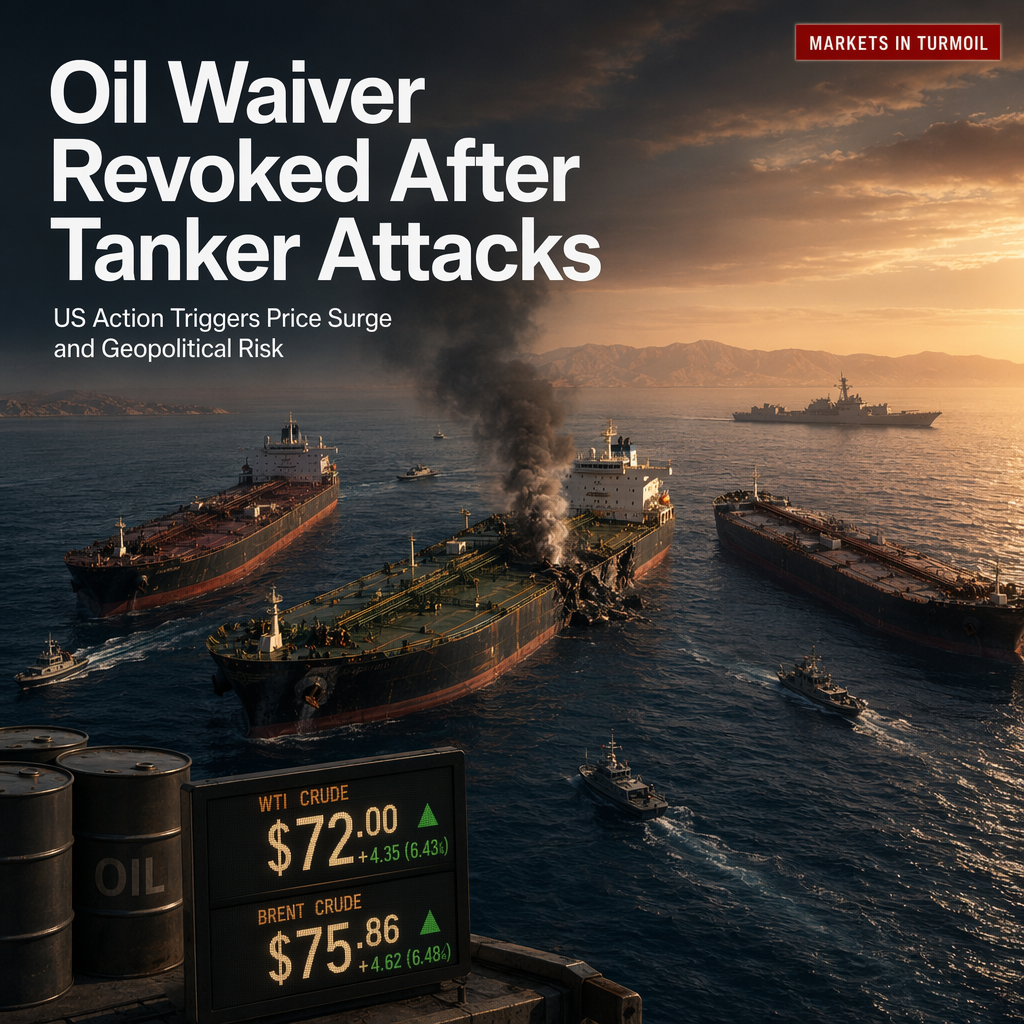
The United States Treasury Department revoked the general license authorizing Iranian crude oil sales on Tuesday, just nineteen days after granting it, following attacks on three tankers in the Strait of Hormuz [2]. The waiver, which was issued in June under a fourteen-point memorandum of understanding and was originally set to permit Iranian sales through August 21, will now be unwound by July 17 [2]. American officials described the decision as performance-based, citing Iran's conduct in the strait as intolerable, and warned of consequences, while negotiations for a final deal are shelved until at least July 18 [2]. President Donald Trump stated that the United States will 'finish the job' if no agreement materializes [2].
The tanker attacks occurred within a single Tuesday window, affecting a Qatari liquefied natural gas carrier and a Saudi-flagged supertanker, both of which sustained damage from projectiles and missiles, respectively. Iranian authorities denied involvement, though state television noted that at least one ship ignored warnings from Iranian forces [2]. Enforcement details regarding the restored sanctions remain unclear, with no confirmation of a naval blockade, but Iran managed to ship roughly 50 million barrels through its shadow fleet in June [2].
The oil market reacted swiftly, with West Texas Intermediate (WTI) crude surging about 4.7% to roughly $72 per barrel, its highest of the week, and Brent crude jumping 5.22% to close at $75.86, marking the largest single-day advance since early May [1][2]. The bulk of the move occurred shortly after 18:30 GMT, and both benchmarks remain below the war's triple-digit levels, suggesting further volatility if enforcement escalates [2]. Technical resistance for WTI is now at $72.33, while Brent faces resistance at $76.22 [2].
The broader market saw the US Dollar firm toward the 101.05 shelf, holding support rather than breaking lower, while gold slipped despite the geopolitical tensions [1][3]. The Dollar Index (DXY) traded near 101.00, with the Greenback showing strength against major currencies, particularly the Swiss Franc (+0.38%) [3]. New York Fed President John Williams commented that inflation remains too high but monetary policy is well-positioned, with future decisions dependent on incoming data [3]. Semiconductors dropped 4.6%, pulling the Nasdaq down, while sector rotation kept the S&P 500 near 7,500 [1].
Looking ahead, traders are advised to monitor headlines from the Strait of Hormuz, the upcoming Fed minutes, and the RBNZ statement, as these events are expected to drive short-term volatility and directional moves [1]. Negotiations regarding Iran's oil exports are paused until at least July 18, and the possibility of further escalation remains a market concern [2].
CONCLUSION
The revocation of Iran's oil waiver following tanker attacks in the Strait of Hormuz has triggered a sharp rally in oil prices and heightened geopolitical risk. The US Dollar remains firm, while tech stocks face pressure and broader indices show resilience. Market participants should stay alert for further developments in the Middle East and upcoming central bank decisions, as these will likely influence volatility and risk sentiment in the near term.