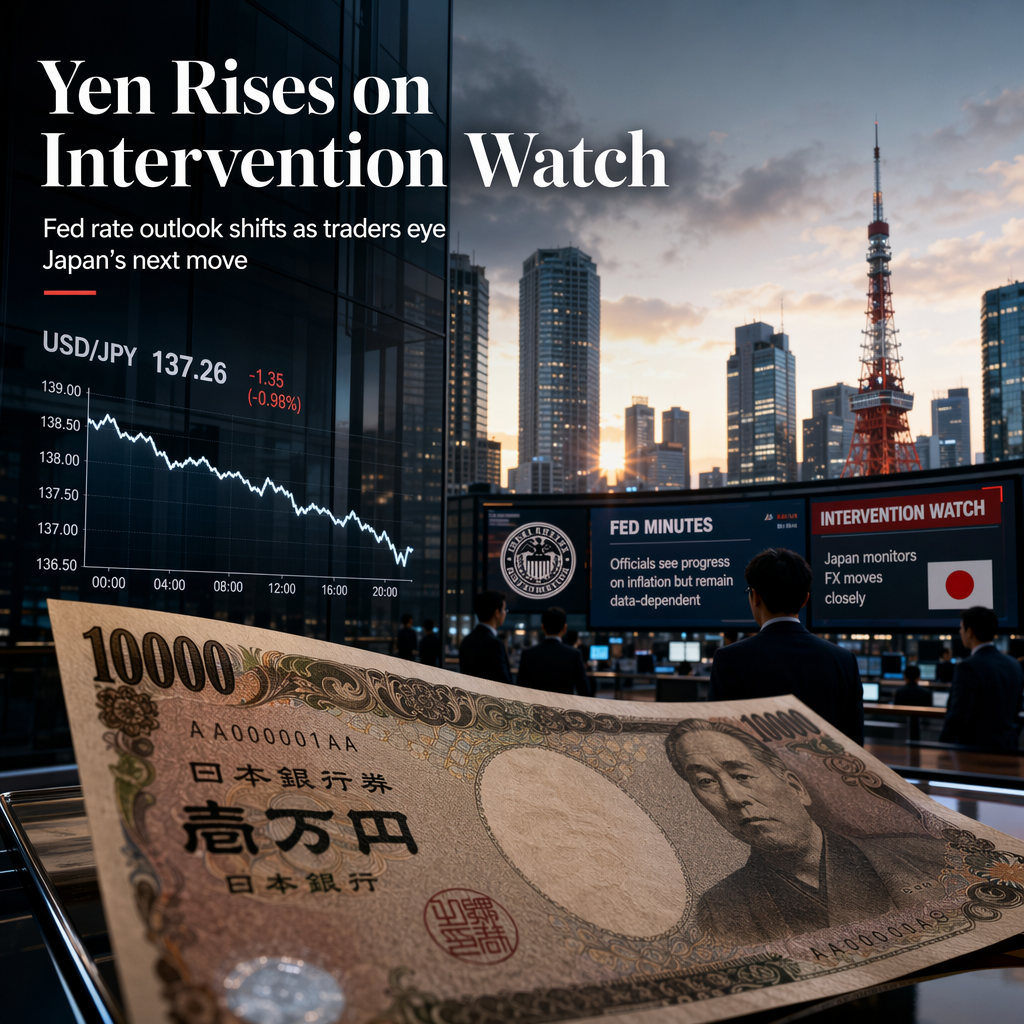
The Japanese Yen (JPY) edged higher against the US Dollar (USD), with the USD/JPY pair trading near 162.35 during the early Asian session on Wednesday, as market participants grew increasingly wary of potential intervention by Japanese authorities to support the currency [1]. Finance Minister Satsuki Katayama reiterated that authorities are prepared to intervene at any time and emphasized ongoing close communication between Japan and the US regarding foreign exchange policy [1].
The market's focus also turned to the upcoming release of the Federal Reserve’s June meeting minutes, the first under new Chairman Kevin Warsh, as traders sought further clarity on the US interest rate outlook [1]. Expectations for additional US rate hikes have diminished following weaker-than-expected Nonfarm Payrolls (NFP) data, which has put downward pressure on the Greenback [1]. According to LSEG data, markets are now pricing in about 26 basis points (bps) of Fed rate hikes by December, a decrease from approximately 38 bps a week ago [1].
Comments from Federal Reserve officials further influenced sentiment. New York Fed President John Williams noted a reduced concern about inflation due to a recent decline in energy prices, which he anticipates will persist [1]. Meanwhile, Fed Governor Christopher Waller highlighted the dual nature of forward guidance, stating it can be valuable but also problematic if misused [1].
Traders remain on high alert for possible intervention by Japanese authorities, which could limit further upside in the USD/JPY pair [1]. The ongoing policy divergence between the Bank of Japan and other major central banks, particularly the US Federal Reserve, continues to be a key factor influencing the Yen’s performance [1].
CONCLUSION
The Japanese Yen's recent gains reflect heightened market vigilance over potential intervention by Japanese authorities and a shift in US rate hike expectations. With both central bank policy and official statements in focus, traders are closely monitoring upcoming Fed communications and any signs of action from Japan. The market remains sensitive to further developments in monetary policy and foreign exchange interventions.