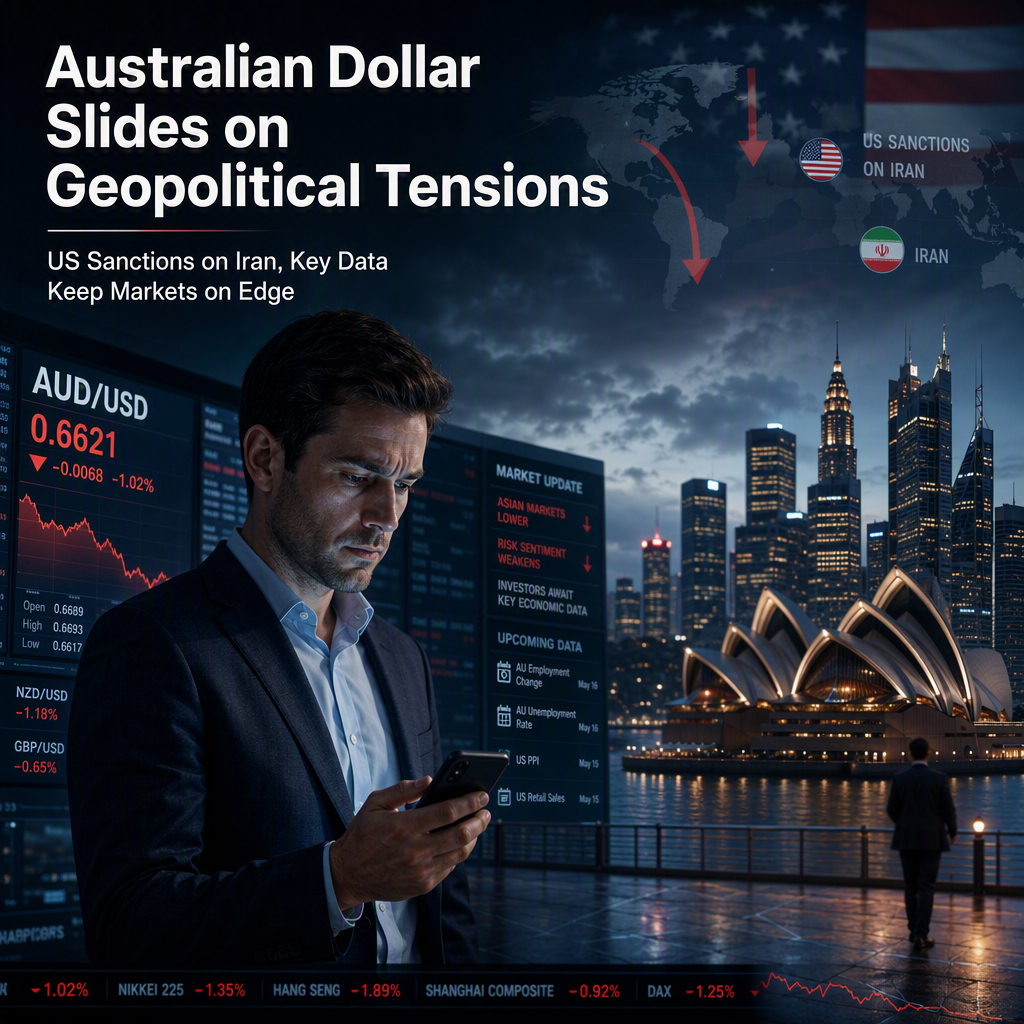
The Australian Dollar (AUD) began the week on a weaker note, falling 0.28% against the US Dollar (USD) to trade at 0.7159, as risk appetite diminished following the US Department of the Treasury's imposition of sanctions on Iran-linked entities [1]. The sanctions, announced by US Treasury Secretary Scott Bessent, target five sectors: digital assets, technology, gold, aviation, and shipping. Bessent stated that world leaders have been given a timeline to cut ties with Iran, and President Trump is expected to engage with other countries on the matter [1].
The negative sentiment extended to Wall Street, which ended Monday's session in the red. In the US, the Chicago Fed’s National Activity Index declined to -0.08 from 0.06 in July, remaining near trend levels throughout the year [1]. Looking ahead, the US economic calendar is set to intensify with upcoming releases on growth, inflation, and jobs data, including the Federal Reserve’s preferred inflation gauge, the Core Personal Consumption Expenditures (PCE) Price Index. Additionally, market participants are awaiting Fed Chair Kevin Warsh's speech at Jackson Hole on August 28 [1].
In Australia, attention is focused on the upcoming release of the Reserve Bank of Australia’s (RBA) meeting minutes and a speech by RBA’s head of domestic markets, David Jacobs. Following the last RBA meeting, money markets priced in a 14% probability of a rate hike at the September 29 meeting, with an 86% chance of rates remaining unchanged, according to Prime Terminal [1]. The Australian economic calendar will also feature inflation data on Wednesday, with economists estimating a 0.8% rise in prices for July. Year-on-year, inflation is expected to have eased from 3.8% to 3.2%, while the trimmed-mean Consumer Price Index (CPI) is forecast to decline by a tenth to 3.5% [1].
From a technical perspective, AUD/USD maintains a bullish near-term bias, trading above the 50-, 100-, and 200-day simple moving averages clustered around 0.7001. The relative strength index (RSI) at 65 indicates firm, but not extreme, upside momentum. Key resistance is seen near 0.7320, with further barriers at 0.8472 and 0.9208, while immediate support lies around 0.7150 and the SMA cluster near 0.7001 [1].
CONCLUSION
The Australian Dollar's decline reflects heightened risk aversion following new US sanctions on Iran and ahead of significant economic data releases. Market participants are closely watching upcoming RBA minutes, inflation data, and US economic indicators for further direction. The overall market sentiment remains cautious, with technicals suggesting near-term support for AUD/USD.