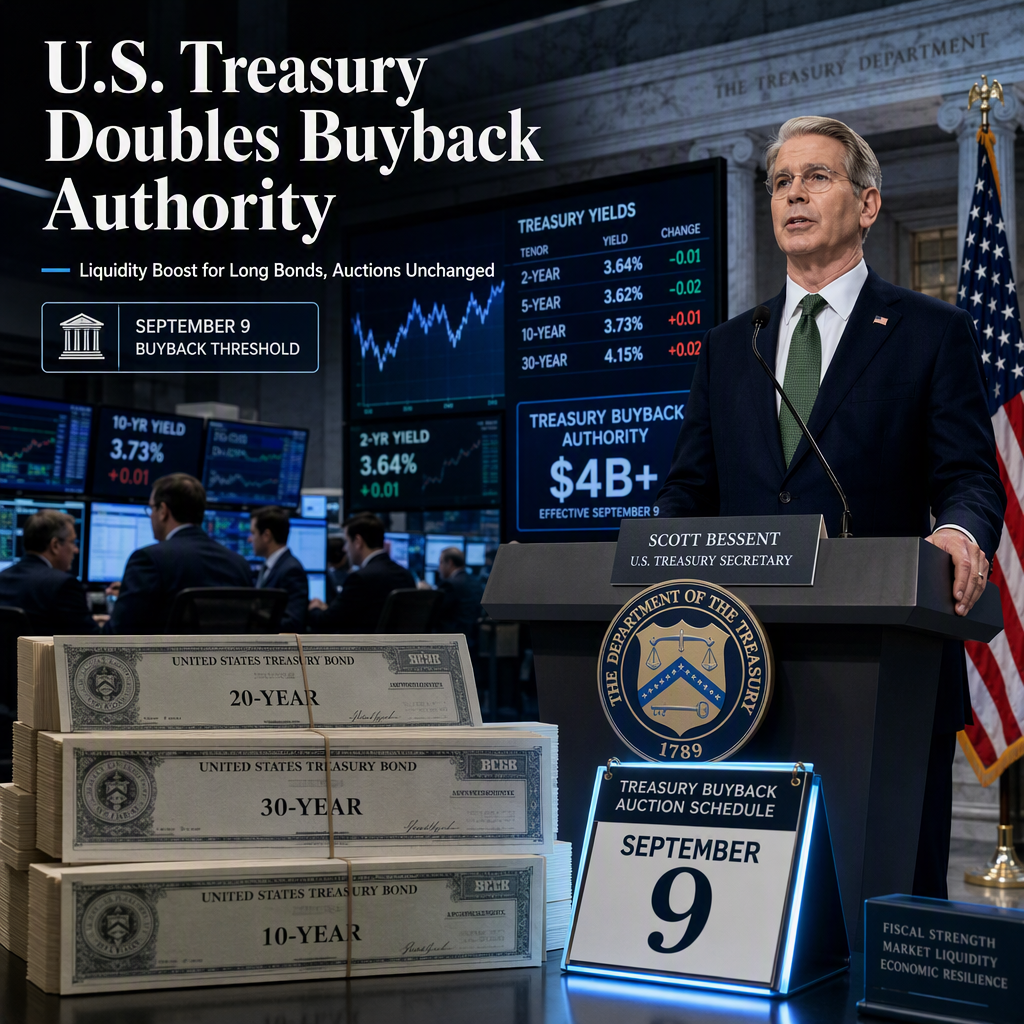
The U.S. Treasury Department, under Secretary Scott Bessent, announced an expansion of its buyback program for longer-dated securities, increasing the maximum buyback authority from $2 billion to at least $4 billion per operation. This new threshold will act as a floor, allowing the size of buybacks to adjust according to market conditions. The change, announced on August 19, will take effect on September 9 and is expected to remain in place through November 4, after which the Treasury will provide further guidance on future buyback sizes [1].
Despite the expanded buyback program, Bessent emphasized that regularly scheduled Treasury auctions of U.S. debt will continue as usual. He stated, 'We are going to continue with our regular program of auctions. So you will be hearing from us again at the beginning of next quarter,' and clarified that no bonds have been purchased yet under the new program [1]. The next auctions for longer-dated Treasurys, including the 10-year note and the 20- and 30-year bonds, are not scheduled until mid-September, which is the earliest the new buyback structure could be implemented [1].
The Treasury's decision to increase buybacks is aimed at providing greater liquidity support in longer-dated nominal sectors, where there is consistent strong sponsorship from market participants. The department cited the significant volume of high-quality offers it routinely receives in these buyback operations as a reason for the change [1]. Bessent also noted that the higher buybacks are intended to support liquidity in the more thinly traded 30-year sector, which is currently competing with heavy issuance of corporate bonds at higher yields, particularly amid the ongoing artificial intelligence buildout [1].
Following the announcement, yields on the 10-year Treasury note and on 20- and 30-year bonds briefly declined but largely retraced those declines by the end of the week. Yields were reported to be down modestly on Monday [1]. Bessent highlighted that higher yields on Treasurys can increase fiscal pressure on the federal government due to higher interest payments on the national debt [1].
CONCLUSION
The U.S. Treasury's expansion of its buyback program is designed to enhance liquidity in longer-dated securities while maintaining the regular auction schedule. Market reaction was modest, with yields initially declining before stabilizing. The Treasury will reassess the program after November 4, providing further updates as needed.