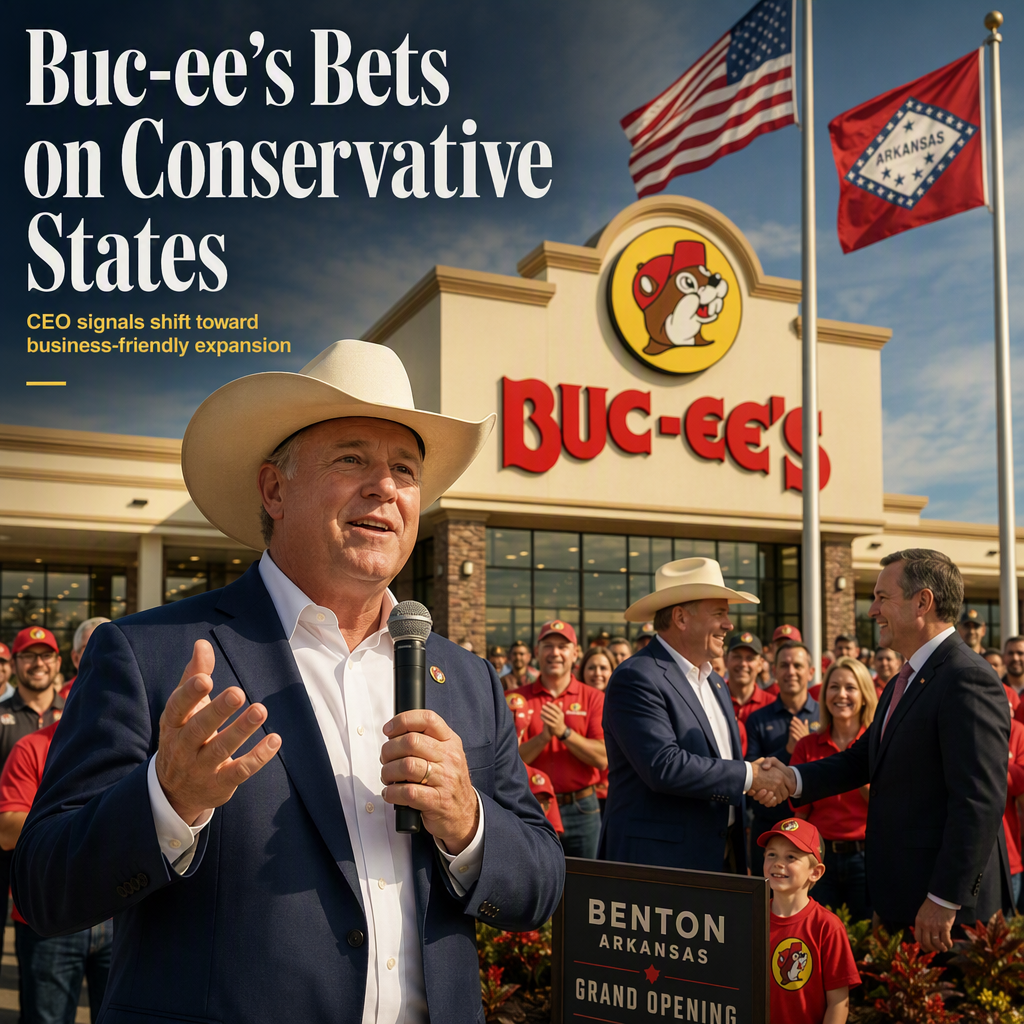
Buc-ee’s CEO and co-founder Arch "Beaver" Aplin III announced a strategic shift in the company’s expansion plans, indicating a move away from 'blue' states and districts that he claims 'don’t appreciate' the chain, in favor of conservative, business-friendly states. Aplin made these remarks during the grand opening of Buc-ee’s newest location in Benton, Arkansas on August 17, emphasizing that conservative states offer values and policies more aligned with the company’s business model and family-oriented approach [1].
Aplin highlighted that Buc-ee’s is experiencing growth and has many opportunities for expansion, but he prefers to focus on communities that welcome the company’s presence. He stated, 'I'm starting to realize life's too short to try to build in places that people don't appreciate what you're bringing, versus a place like this where people do appreciate what you are building' [1]. He further credited Benton’s business-friendly environment as a key factor in the decision to open the new location there [1].
Buc-ee’s, founded in 1982, operates large travel centers typically featuring 74,000 square feet of space and 120 fueling positions, with each location often creating more than 200 jobs. The company currently has 58 locations, including 37 in Texas, and has expanded into 13 other states such as Alabama, Georgia, Florida, Kentucky, Tennessee, Arkansas, Arizona, Colorado, Mississippi, Missouri, Ohio, South Carolina, and Virginia [1]. While most Buc-ee’s locations are in conservative-leaning areas, there are exceptions in more politically mixed cities like Auburn, Alabama, and Brunswick, Georgia [1].
Aplin’s comments suggest that future Buc-ee’s expansion will prioritize states and communities with leadership and policies that align with the company’s values, potentially limiting growth in more liberal or less business-friendly regions [1].
CONCLUSION
Buc-ee’s is shifting its expansion strategy to focus on conservative, business-friendly states, citing greater appreciation and alignment with company values in these areas. This move may influence the company’s future growth trajectory and job creation, with less emphasis on entering politically liberal or mixed regions.