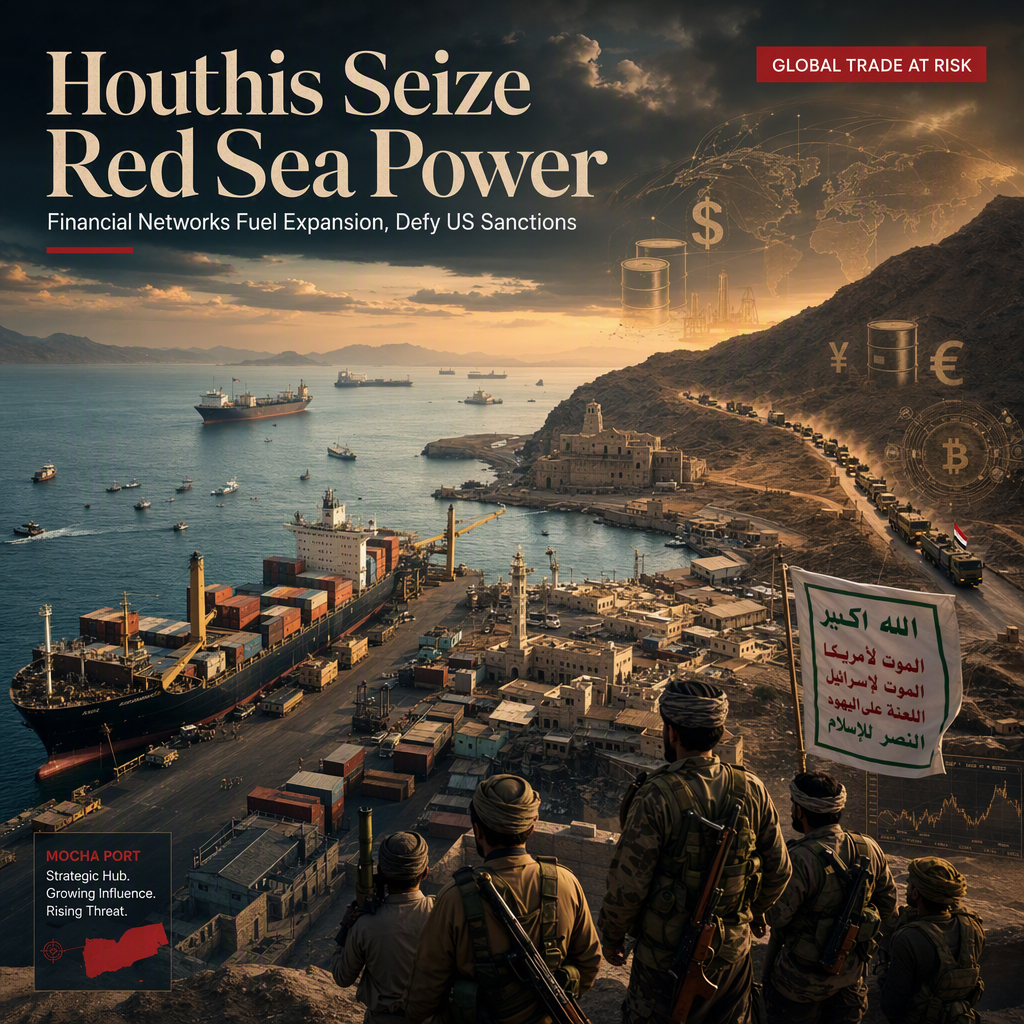
Iran-backed Houthis have established a vast financial network that spans oil, ports, cryptocurrency, Russia, and China, complicating U.S. efforts to disrupt the group's funding streams, according to Adam Rousselle, founder of Between the Lines (BTL) Research [1]. The Houthis' recent territorial advances along Yemen’s Red Sea coast, including the strategic port city of Mocha and expansion toward the Bab el-Mandeb Strait, have drawn renewed attention to their financial operations and the threat they pose to global trade routes [1]. The Bab el-Mandeb Strait is a critical maritime chokepoint connecting the Red Sea to the Gulf of Aden, through which a significant share of global maritime trade and energy shipments passes [1].
The Houthis' financial system, as detailed in a 2025 investigation for the Global Network on Extremism and Technology, includes revenues from Houthi-controlled ports, tariffs, Iranian oil, informal hawala networks, cryptocurrency exchanges, and foreign facilitators in Russia, Türkiye, and Southeast Asia [1]. Control of ports is particularly lucrative, as Yemen relies heavily on imports, and the Houthis have imposed steep fees and tariffs on goods entering their territory from rival Yemeni ports [1].
Nadwa Al-Dawsari, a Yemen expert and associate fellow at the Middle East Institute, emphasized in testimony before the House Foreign Affairs Committee that territorial control is central to the Houthis’ resilience and ability to withstand external pressure [1]. Al-Dawsari stated, "The Houthis have been able to consolidate their power and build increasingly sophisticated military capabilities because they control significant territory, a large population, ports, infrastructure, and resources" [1]. This territorial base enables the group to recruit, generate revenue, manufacture and store weapons, and control smuggling routes [1].
The U.S. is intensifying efforts to cut off funding to Iran and its proxies, but the Houthis’ sophisticated sanctions-evasion network and control over critical infrastructure present significant challenges. The dilemma for U.S. policymakers is how to disrupt the Houthis’ financial flows without harming the civilian population that depends on the same economic lifelines for food, fuel, and other essentials [1].
CONCLUSION
The Houthis’ expanding territorial and financial control is strengthening their economic base and complicating U.S. efforts to curb their influence. Their ability to generate revenue from ports and international networks poses a significant challenge to global trade and regional stability. Market participants should closely monitor developments in the Red Sea region, as further Houthi advances could have substantial implications for global shipping and energy markets.