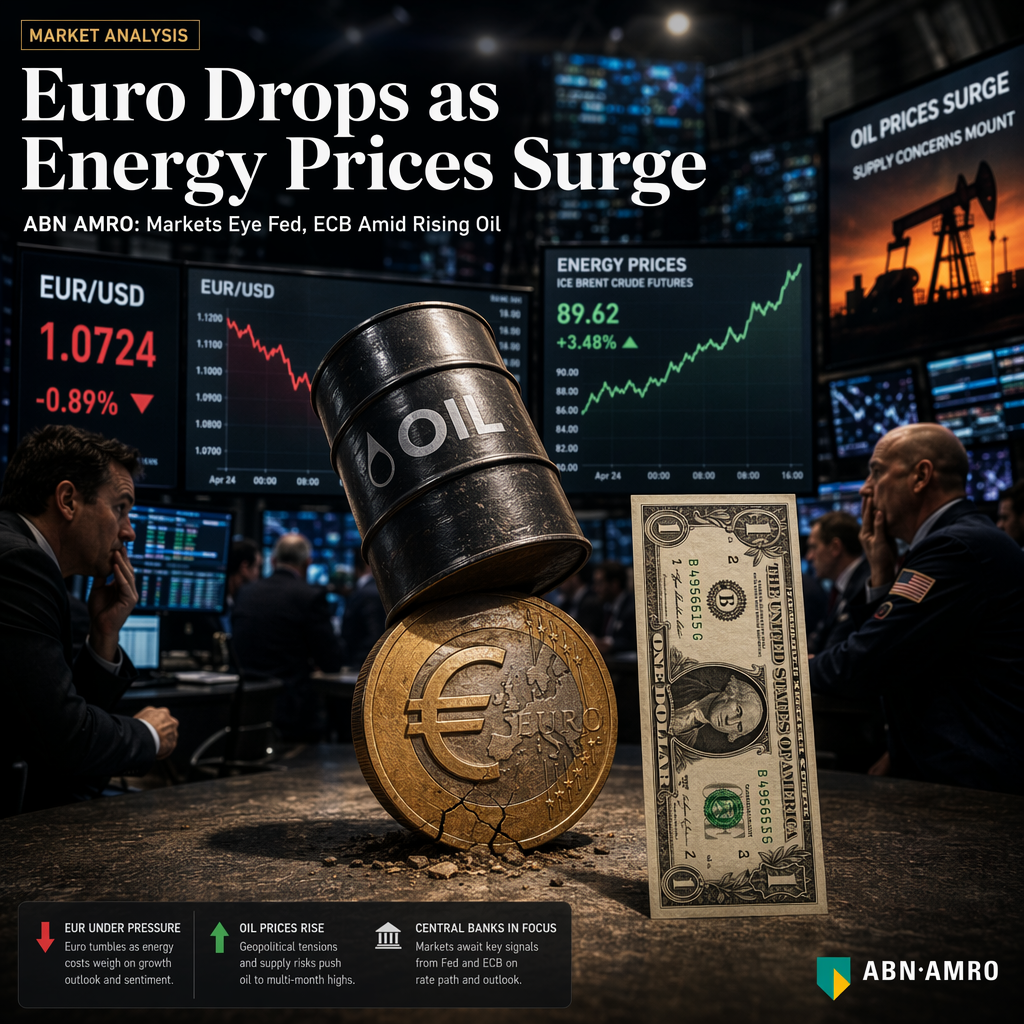
According to ABN AMRO’s Georgette Boele, the Euro’s relationship with energy prices has shifted over recent periods. Initially, during the US-Iran conflict, higher energy prices negatively impacted the Euro (EUR) against the US Dollar (USD). However, as the conflict progressed, the EUR/USD pair became more influenced by expectations for the Federal Reserve (Fed) and European Central Bank (ECB) rather than energy prices alone [1].
Boele notes that when a Memorandum of Understanding was announced, energy prices dropped sharply, but the Euro saw little gain against the US Dollar, as market participants were more focused on the prospect of Fed rate hikes [1]. Subsequently, oil and gas prices rose significantly, which benefited the currencies of energy exporters such as the Norwegian krone, Canadian dollar, and US dollar, while the currencies of energy importers, including the Euro, weakened [1].
Recently, the Euro has again declined against the US Dollar as energy prices have increased. Looking ahead, Boele emphasizes that the direction of EUR/USD will be determined by expectations for the Fed and ECB, inflation expectations, changes in nominal and real yield spreads between the US and Europe, and concerns about potential energy shortages in the eurozone [1].
CONCLUSION
The Euro has shown renewed sensitivity to rising energy prices, leading to a decline against the US Dollar. Future movements in EUR/USD are expected to hinge on central bank expectations, yield spreads, and eurozone energy risks.