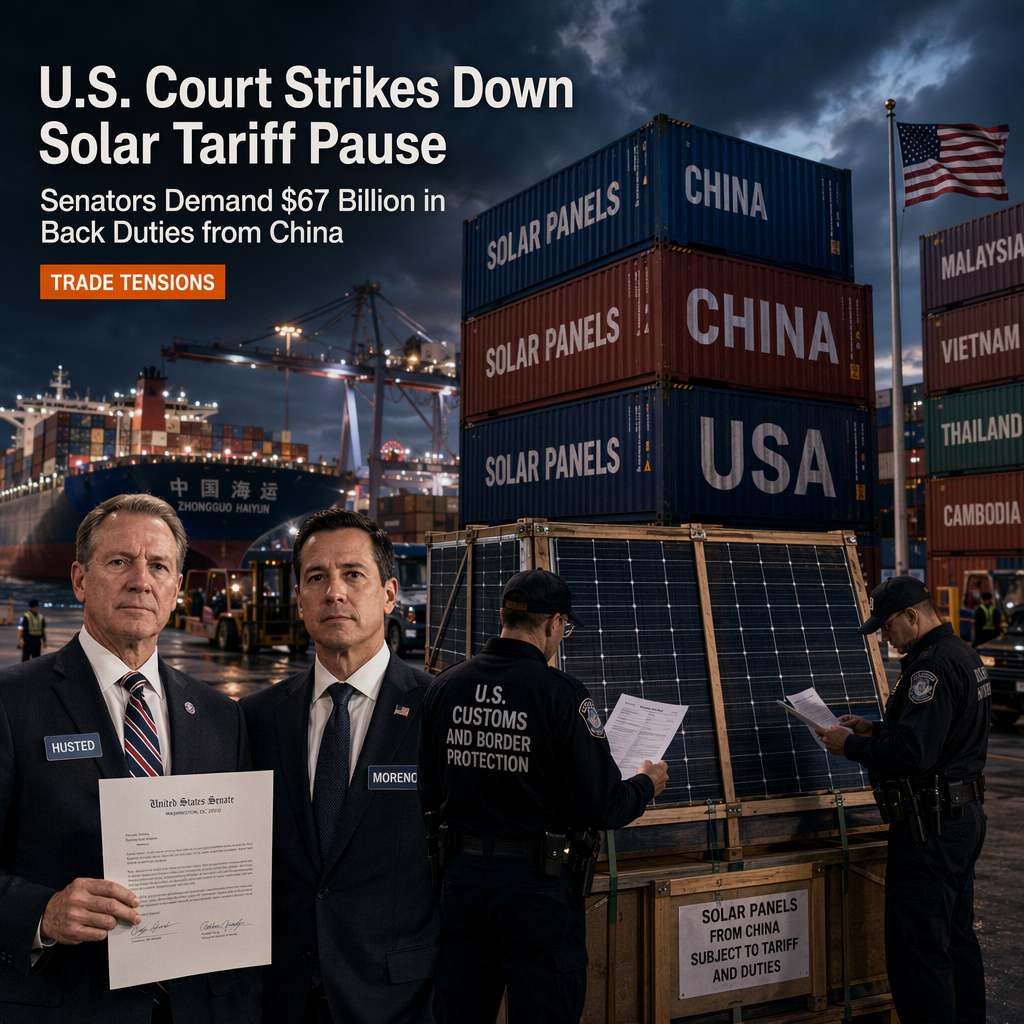
The Biden administration's 2022 decision to temporarily pause tariffs on solar panels originating from Southeast Asia, many of which contained components manufactured by Chinese corporations, has been declared unlawful by the United States Court of International Trade as of August 2025. The court found that the law used to initiate the tariff pause could not be applied to solar panels, rendering the moratorium invalid [1].
Ohio Republican Senators Jon Husted and Bernie Moreno have responded by urging the Department of Homeland Security to demand that Chinese solar companies pay back the import duties they avoided during the tariff pause. In a letter sent in May, the senators argued that the moratorium acted as a 'unilateral tariff giveaway' that allowed Chinese manufacturers to circumvent anti-dumping duty orders and cost the American economy billions of dollars. According to Husted, Chinese companies owe the United States $67 billion in tariff payments as a result of the now-voided moratorium [1].
The four Southeast Asian countries covered by the tariff pause—Malaysia, Cambodia, Thailand, and Vietnam—were identified as locations where Chinese solar manufacturers have been accused of attempting to bypass U.S. trade laws. These countries accounted for 84% of U.S. solar panel imports in late 2023 [1]. The senators also raised concerns about the quality and security risks of these imported solar products, stating that they are 'second rate' and pose risks to national security and domestic manufacturing capabilities [1].
The controversy highlights ongoing tensions over Chinese dominance in solar manufacturing and the potential risks of U.S. reliance on Chinese supply chains for critical energy infrastructure. The senators' push for retroactive tariff collection signals possible significant financial and market implications for the solar industry and U.S.-China trade relations [1].
CONCLUSION
The court's ruling against the Biden administration's tariff pause and the senators' demand for $67 billion in back duties from Chinese companies mark a significant escalation in U.S.-China trade tensions. The outcome could have major financial repercussions for the solar industry and reshape the landscape of solar imports and domestic manufacturing.