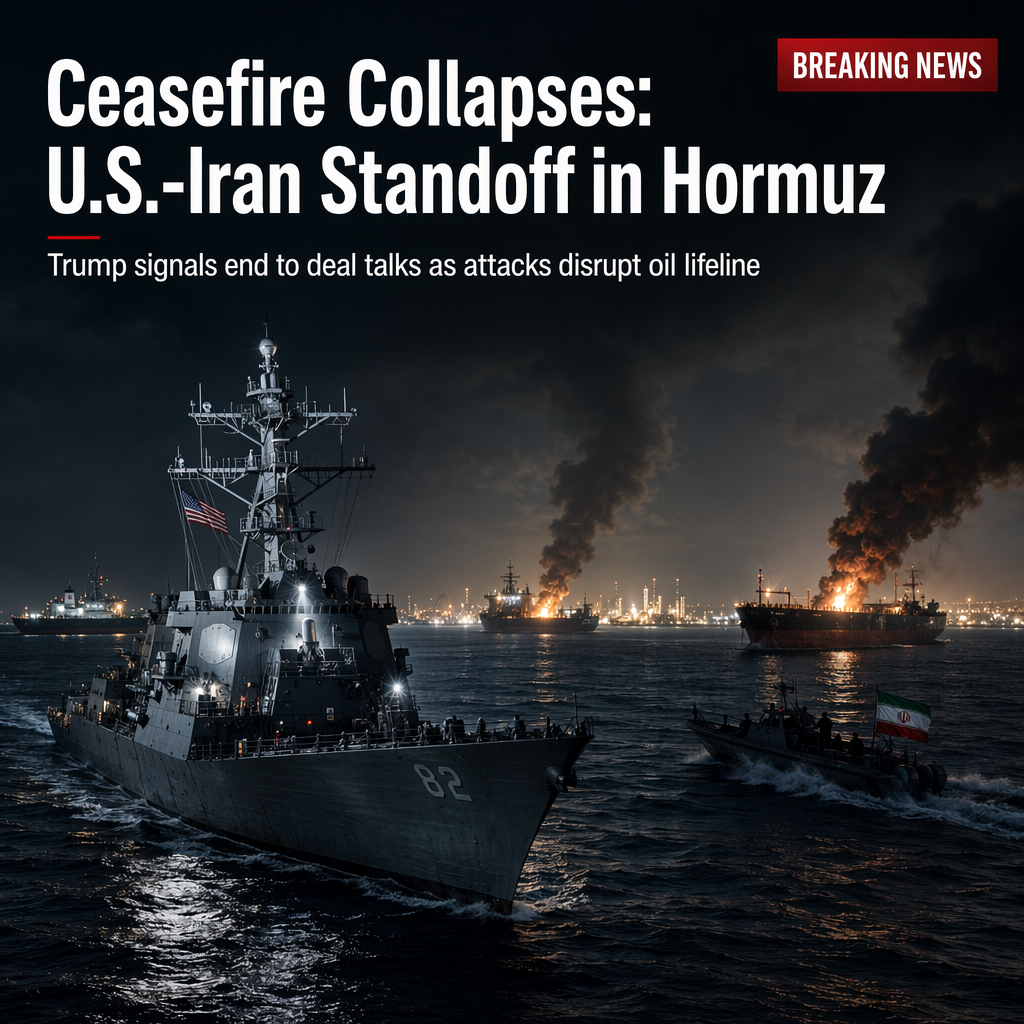
President Donald Trump announced that he may no longer be interested in pursuing a deal with Iran, following the collapse of a recent ceasefire agreement amid renewed hostilities in the Strait of Hormuz [1]. During a press conference in Ankara, Turkey, Trump stated, "I'm not sure I want to make a deal with them," and emphasized his hardened stance by saying, "Let's just finish the job" [1]. This marks a sharp reversal from his position just a month earlier, when he had described Iran's leaders as "smart," "very rational," and "nice to deal with" [1].
The escalation comes after Tehran attacked three commercial vessels in or near the Strait of Hormuz, according to U.S. Central Command and the Joint Maritime Information Center, a U.S.-led naval group [1]. In response, the U.S. revoked its waiver of sanctions on Iranian oil sales, which had been part of the temporary ceasefire deal struck last month [1]. The U.S. then launched dozens of retaliatory strikes on Iranian military infrastructure and small boats [1]. The Strait of Hormuz, a critical chokepoint for global oil trade, has been the main flashpoint during the ongoing war that began on February 28 [1].
Iran's leverage in the region has increased due to its ability to threaten the waterway and its intent to start charging tolls on ships passing through the strait [1]. In retaliation, Trump ordered a naval blockade of Iranian ports in the area [1]. Under the now-defunct deal, the U.S. had agreed to lift its blockade in exchange for Iran's commitment to ensure the safe passage of commercial vessels in the Gulf region [1].
Iranian Foreign Affairs Ministry spokesman Esmaeil Baqaei accused the U.S. of violating the deal's terms, asserting that Iran is responsible for determining arrangements for ships transiting the strait [1]. Baqaei stated that the U.S. "has challenged this clause and, in practice, violated the agreement's structure through its unilateral actions and also aggressive attacks against Iran," and emphasized that Iran will "steadfastly pursue the protection of its national interests" [1].
CONCLUSION
The breakdown of the U.S.-Iran ceasefire and renewed military actions in the Strait of Hormuz have sharply escalated tensions, with President Trump signaling an end to diplomatic efforts. The revocation of sanctions waivers and threats to oil transit routes suggest significant potential disruption to global energy markets. Market participants are likely to react to the heightened risk and uncertainty in this critical region.