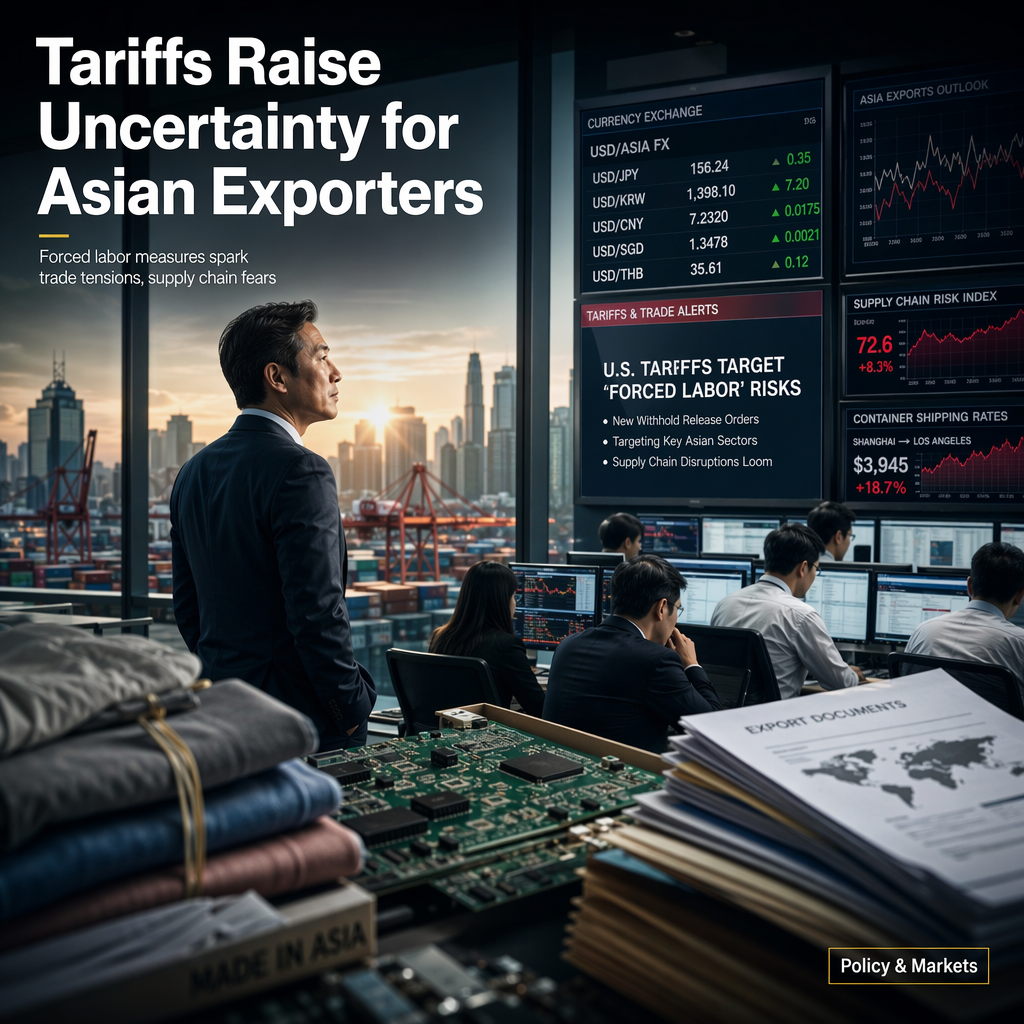
The White House announced new tariffs ranging from 10% to 12.5% on goods from 60 economies, citing 'forced labor' concerns as the justification for these measures [1]. These tariffs are based on U.S. definitions and processes rather than internationally recognized legal standards, leading to disappointment and skepticism among Asian governments and analysts [1]. A senior trade official in Singapore criticized the move, stating that it creates ambiguity for exporters and undermines the credibility of the global trading system [1].
Financial markets responded with caution following the announcement. Asian currencies, including the Thai baht and Korean won, depreciated by 0.3% and 0.4% respectively against the U.S. dollar, as traders evaluated the potential for broader disruption in regional supply chains [1]. Exporters in affected economies expressed concern about the lack of clear criteria for enforcement and the risk of unpredictable penalties, which complicates business planning and risk management [1].
The tariffs are set at 10% for most goods, with certain categories such as electronics and textiles facing a higher rate of 12.5% [1]. Analysts highlighted that these sectors are particularly vulnerable due to their reliance on complex cross-border supply chains. Kentaro Takeda, a Nikkei contributor, noted that the electronics sector is already dealing with chip shortages and supply chain disruptions, and the new tariffs could further increase costs and squeeze margins, especially for small and medium-sized manufacturers [1].
No specific technical chart data or price levels were provided, but market sentiment remains cautious. Trading desks are advised to maintain hedges against currency volatility and review exposure to affected sectors [1]. The Indian government, aiming for a $1 trillion export target, stated its intention to protect its interests, particularly in sectors vulnerable to forced labor allegations, and emphasized its commitment to international labor standards while criticizing the unilateral U.S. measures [1]. Regional policy experts warned that the U.S. move could escalate trade tensions and set a precedent for subjective trade barriers that other economies might emulate [1].
CONCLUSION
The U.S. tariffs on 60 economies, justified by 'forced labor' concerns, have been met with skepticism and concern across Asia, with markets reacting cautiously and key sectors facing increased uncertainty. The lack of alignment with international standards and potential for arbitrary enforcement heighten risks for exporters and could further strain global trade relations.