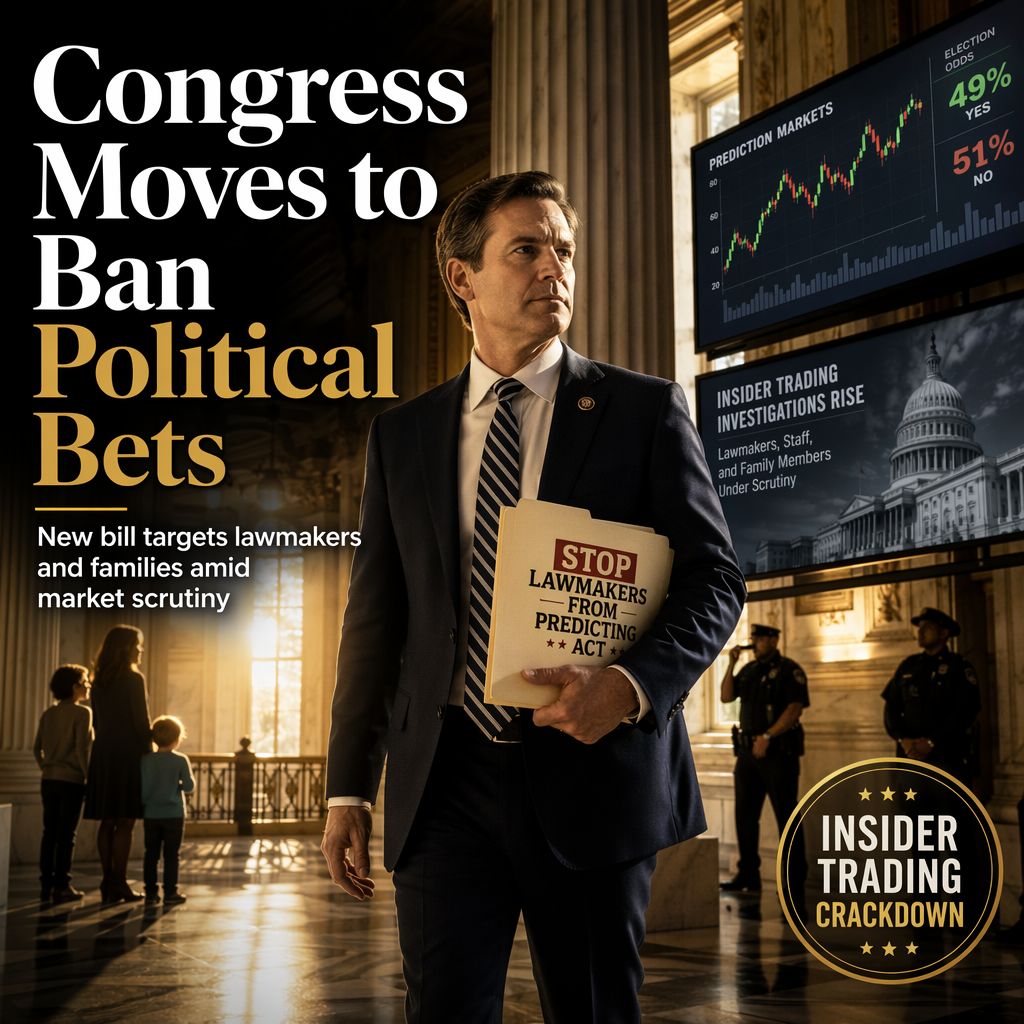
A new legislative proposal, the Stop Lawmakers From Predicting Act, has been introduced by House Administration Committee Chairman Bryan Steil, R-Wis., aiming to prohibit members of Congress, their spouses, and dependent children from placing bets on prediction markets related to public policy issues, elections, and other events where lawmakers may possess insider information [1][2]. The bill would impose penalties on violators, requiring them to pay a fee of $2,000 or 10% of the value of the prohibited transaction, whichever is greater, as well as any net gains from the transaction [1][2]. Lawmakers would also be barred from using official funds or political contributions to pay these fines, and those who leave office without settling penalties could face civil enforcement by the Justice Department [1].
The provision, which Steil's office shared with CNBC, is being added to a broader bill that would also ban members of Congress from purchasing new shares of individual stocks, except for shares bought with dividends from existing holdings [2]. The bill is backed by House Speaker Mike Johnson, R-La., and President Donald Trump, with GOP lawmakers promising a House floor vote [2]. However, passage in the Senate is uncertain, especially if the measure remains attached to the larger stock trading ban, which lacks Democratic support due to its limited scope [2].
The proposed ban follows increased scrutiny of prediction markets such as Kalshi and Polymarket, particularly after an incident in March where blockchain analysts identified suspected insiders who made significant profits from suspiciously timed bets on prediction markets related to the Iran conflict and the death of Ayatollah Ali Khamenei [1]. Both Kalshi and Polymarket have expressed support for efforts to regulate prediction market activity among lawmakers [1].
The Senate previously adopted a rule change in April, introduced by Sen. Bernie Moreno, R-Ohio, that prohibits senators and their staff from betting on prediction markets [1][2]. Additionally, a bipartisan bill in the Senate, the Prediction Market Act, has been introduced by Sens. Dave McCormick, R-Pa., and Kirsten Gillibrand, D-N.Y., to further regulate prediction markets and address insider trading concerns [1]. Steil clarified that his measure would still allow lawmakers and their families to place bets on non-political events, such as sports, stating, "Some avenues of prediction markets I don't think create the ethical complications that other areas do" [2].
CONCLUSION
The introduction of the Stop Lawmakers From Predicting Act marks a significant step toward curbing potential conflicts of interest and insider trading among members of Congress in prediction markets. While the bill has garnered support from key Republican leaders and aligns with recent Senate actions, its ultimate passage remains uncertain due to partisan divisions. The legislative push reflects growing concern over ethical standards and transparency in lawmakers' financial activities.