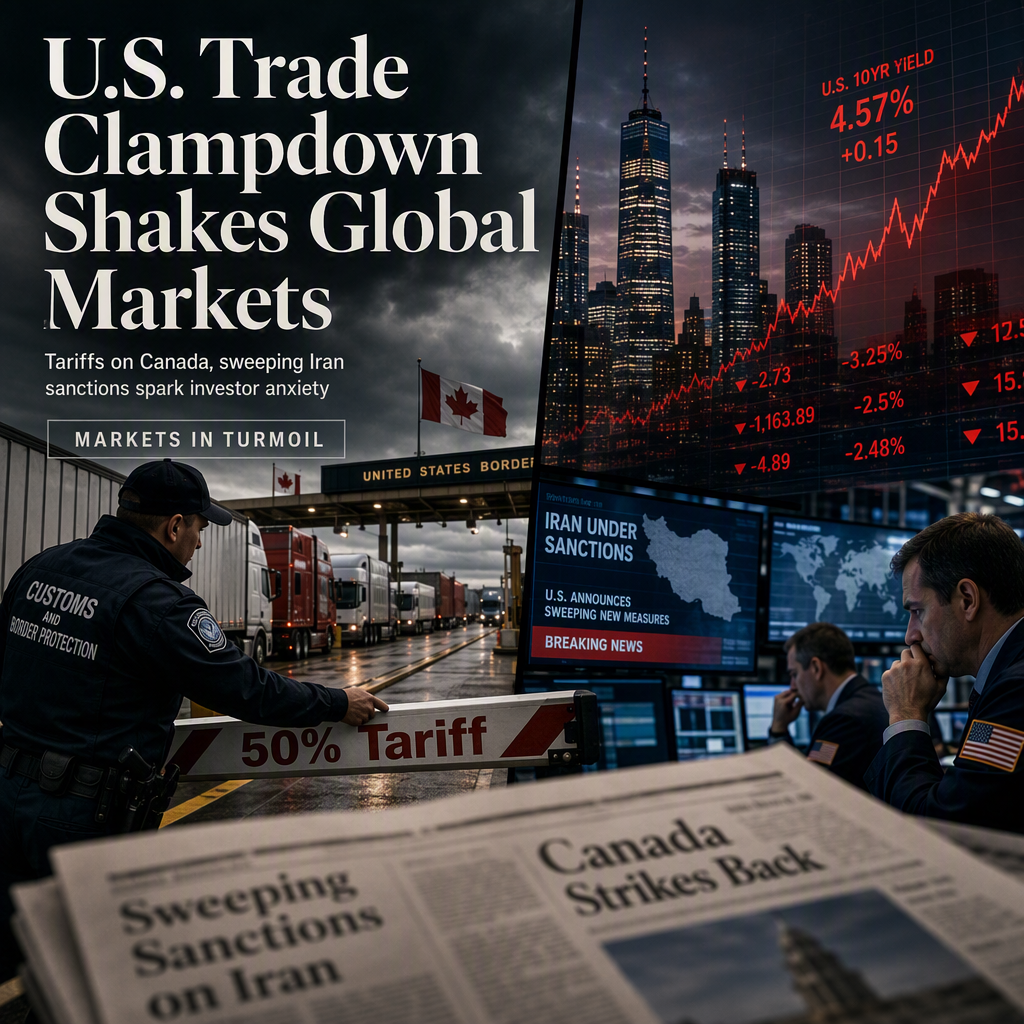
The United States has escalated trade tensions by imposing 50% tariffs on certain Canadian imports after trade negotiations between the two countries collapsed over the weekend, with both sides blaming each other for the failure to reach a deal [1]. In response, Canadian Prime Minister Mark Carney announced that Ottawa would implement retaliatory tariffs on U.S. goods starting September 8, matching the U.S. measures dollar for dollar [1]. President Donald Trump criticized Canada, stating, 'Canada wants the benefits of being a State, without being one' [1].
Simultaneously, the U.S. is preparing to intensify its economic pressure on Iran. Treasury Secretary Scott Bessent is expected to announce what he describes as 'the single greatest financial offensive ever marshalled against an adversary,' with a sweeping package of sanctions set to be unveiled Monday [1]. Bessent indicated that the Trump administration's strategy aims to severely damage Iran's economy, potentially removing the need for major U.S. military operations [1]. The administration has also demanded that U.S. allies and other countries cease business with Iran, with Bessent stating, 'we are going to them and saying you are either with us or against us' [1]. Iran's foreign ministry spokesperson, Esmaeil Baqaei, condemned the U.S. actions as an assertion of 'extraterritorial sovereignty' over other United Nations members [1].
The market reaction to these developments has been negative. U.S. stock futures slipped as longer-dated Treasury yields resumed their upward trajectory, erasing much of the previous rally that followed the Treasury Department's decision to expand government debt repurchases [1]. The 30-year Treasury yield rose to 5.273%, and the benchmark 10-year yield climbed to approximately 4.734% [1]. While U.S. futures declined, Asian markets were mixed, with Japan's Nikkei 225 rising in early trading and South Korea's Kospi falling [1].
No forward-looking analyst opinions were provided in the article, but the combination of escalating trade tensions with Canada, the threat of sweeping sanctions against Iran, and rising Treasury yields has contributed to increased market uncertainty [1].
CONCLUSION
The U.S.'s imposition of steep tariffs on Canadian imports and its impending sanctions against Iran have heightened global economic tensions and contributed to a negative market reaction, as evidenced by slipping U.S. stock futures and rising Treasury yields. With Canada set to retaliate and Iran condemning the measures, the situation signals ongoing volatility and uncertainty for markets.