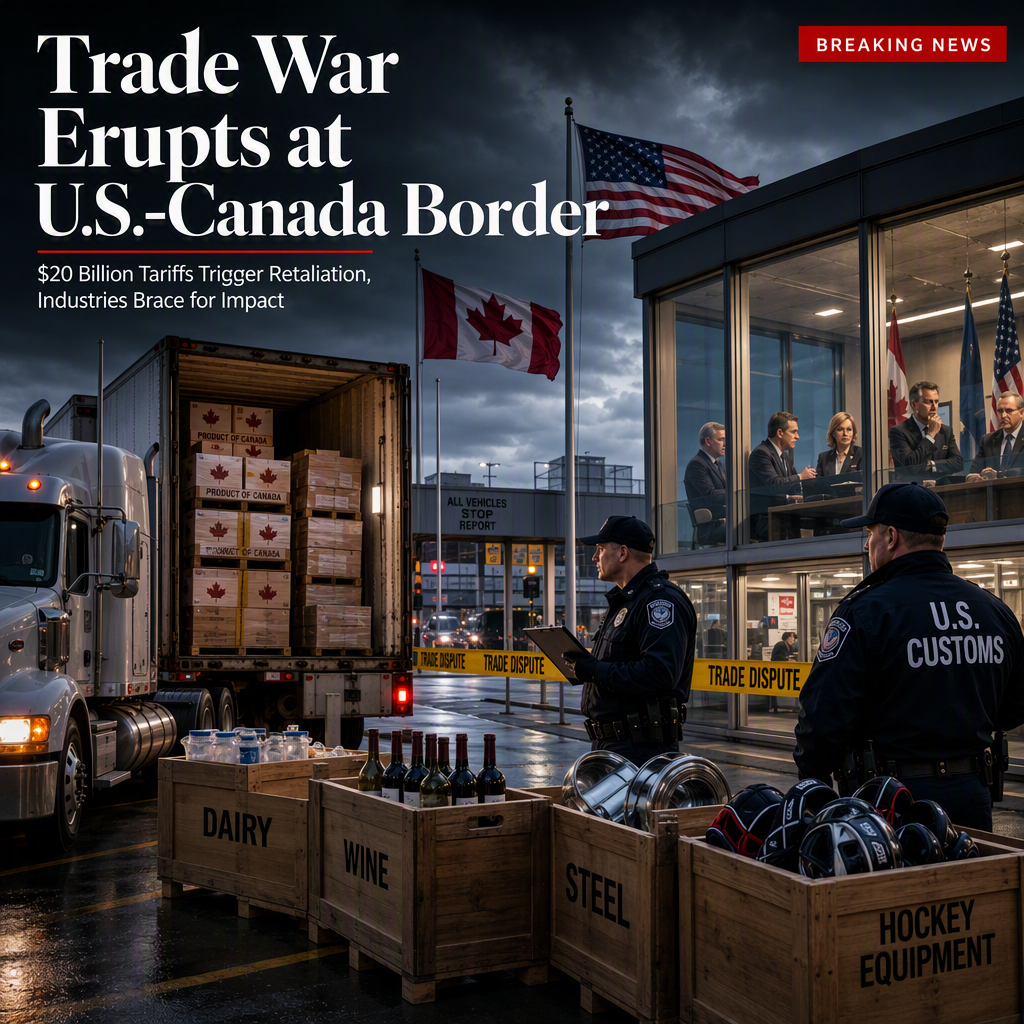
Trade negotiations between the United States and Canada collapsed on Friday, resulting in the Trump administration imposing 50% tariffs on approximately $20 billion worth of Canadian imports, including wine, furniture, dairy products, cement, clothing, fishing rods, and hockey equipment [1]. Canadian Prime Minister Mark Carney announced that Canada would retaliate 'dollar for dollar' with its own tariffs starting September 8, targeting sectors such as steel, dairy, agricultural equipment, and pulp and paper [1].
Negotiators from both countries had been working throughout the week, with signals that a deal was close. President Donald Trump postponed the original Wednesday deadline, suggesting an agreement was imminent, but talks ultimately failed. U.S. Trade Representative Jamieson Greer stated that 'Canada declined to finalize the trade deal under the terms agreed earlier this week' [1]. Conversely, Carney argued that last-minute changes in U.S. terms were 'unfair, uneconomic, and called into question the reliability of any deal,' emphasizing that the U.S. demands were excessive and Canada was willing to drop its remaining retaliatory tariffs if the U.S. lowered its own [1].
The tariffs are expected to have significant implications for both countries, affecting a wide range of industries and potentially disrupting cross-border trade. Carney underscored the importance of the energy relationship, stating, 'Canada fuels American growth … I don't think they want us to stop sending any of that energy' [1]. President Trump criticized Canada's trade policies, asserting that Canada has charged U.S. farmers 'massive amounts of Tariffs' for years and that this would no longer be tolerated [1].
Senate Minority Leader Chuck Schumer, D-N.Y., also weighed in, criticizing the retaliatory U.S. tariffs in a post on X [1]. Additional details on Canada's retaliatory measures are expected to be released in the coming days, with Carney reiterating that the response will be 'dollar for dollar' [1].
CONCLUSION
The breakdown of U.S.-Canada trade talks has led to the imposition of substantial tariffs on both sides, affecting $20 billion in Canadian exports and prompting Canada to announce retaliatory measures. The escalation signals heightened trade tensions and is likely to impact multiple industries, with further details on Canada's response forthcoming. Market participants should anticipate continued volatility and disruption in affected sectors.