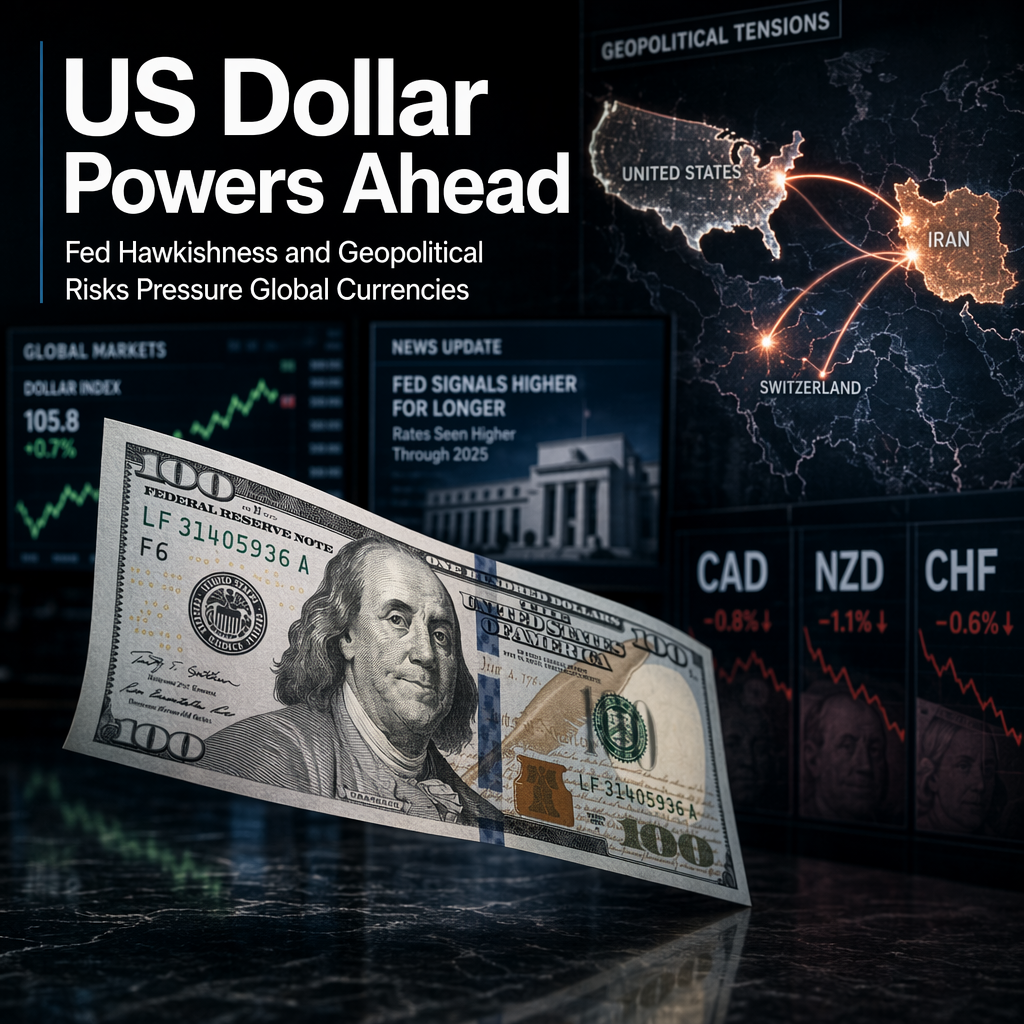
The US Dollar (USD) has strengthened against several major currencies, including the Canadian Dollar (CAD), New Zealand Dollar (NZD), and Swiss Franc (CHF), driven by a combination of hawkish Federal Reserve (Fed) policy expectations and heightened geopolitical tensions, particularly surrounding US-Iran relations [1][2][3]. The USD/CAD pair is trading around 1.4220-1.4225, near its highest levels since April 2025, as investors anticipate speeches from Bank of Canada (BoC) Governor Tiff Macklem and Fed Chair Kevin Warsh for further direction [1]. Divergent policy expectations are evident: the BoC is expected to keep rates steady through late 2026, while the Fed's latest projection signals a potential rate hike to 3.8% by year-end [1]. Falling crude oil prices, which have reached new lows since the onset of the US-Iran war in February, are further undermining the CAD, a commodity-linked currency [1].
Similarly, the NZD/USD pair is trading weaker around 0.5670, with the New Zealand Dollar holding losses after a modest gain the previous day [2]. The USD's safe-haven appeal has been bolstered by uncertainty over US-Iran peace talks in Doha, as Tehran has denied plans to meet directly with US envoys Jared Kushner and Steve Witkoff, dampening hopes for a swift resolution [1][2]. The Fed's hawkish stance was reinforced at its June meeting, where it held rates at 3.50%-3.75% but removed language hinting at future cuts. The CME FedWatch tool now shows a nearly 63% probability of a rate hike by September [2]. Market participants are closely watching upcoming US economic data, including the ADP private employment report, ISM Manufacturing PMI, and the Nonfarm Payrolls (NFP) report [1][2].
The Swiss Franc has also depreciated for a second consecutive day, with USD/CHF appreciating by 0.14% and nearing the 0.8100 level, despite a strong 3.5% year-on-year increase in Swiss Real Retail Sales for May, which beat expectations of 0.8% [3]. The positive retail sales data had little impact on the CHF, as the USD remains supported by robust US macroeconomic indicators and expectations of further Fed tightening [3]. US JOLTS Job Openings rose to 7.594 million in May, surpassing both the previous month's 7.585 million and the market consensus of 7.3 million, signaling a pickup in US employment creation in 2026 [3].
Across all three markets, the dominant narrative is the USD's broad-based strength, underpinned by a hawkish Fed outlook and persistent geopolitical risks. While local economic data, such as Swiss retail sales and Chinese PMI figures, have provided some support to their respective currencies, these have been outweighed by global risk sentiment and US policy developments [1][2][3].
CONCLUSION
The US Dollar's rally is being driven by expectations of further Fed rate hikes and ongoing geopolitical uncertainty, particularly regarding US-Iran relations. This has led to notable weakness in the Canadian Dollar, New Zealand Dollar, and Swiss Franc, despite some positive domestic data in Switzerland. Market participants remain focused on upcoming US economic releases and central bank commentary for further direction.