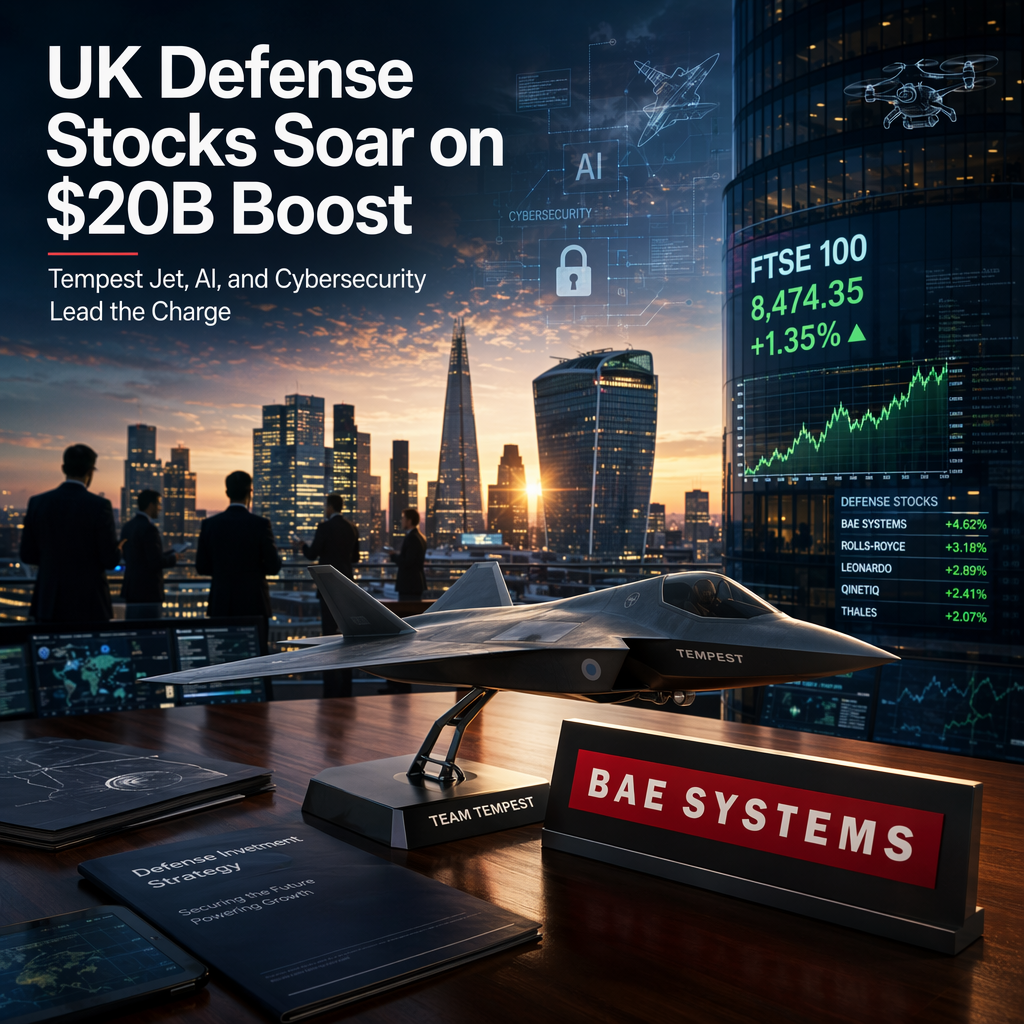
The United Kingdom announced an additional £15 billion ($19.9 billion) in defense spending over the next four years as part of its Defence Investment Plan (DIP), raising annual defense expenditure to £79.1 billion by 2029, or 2.7% of GDP [1]. Outgoing Prime Minister Keir Starmer revealed that the DIP aims to enhance the UK's military capabilities, nuclear deterrent, and industrial capacity, with a focus on technical investments in cybersecurity, drones, and artificial intelligence [1].
Following the announcement, the FTSE 350 Aerospace & Defense index climbed nearly 5% since the Tuesday market open in London, with notable gains for companies such as Babcock, BAE Systems, and Chemring [1]. Over the past five years, the FTSE 350 Aerospace & Defense index has surged approximately 540%, significantly outpacing the Dow Jones U.S. Select Aerospace & Defense Index, which returned 120% in the same period, reflecting robust defense spending among European and NATO allies [1].
BAE Systems CEO Charles Woodburn welcomed the government's commitment, stating it "provides much-needed clarity for industry and a clear strategic direction for our armed forces" [1]. Saxo UK Investor Strategist Neil Wilson identified BAE Systems as a key beneficiary, particularly due to the £8.6 billion allocated over four years for the Tempest sixth-generation fighter jet project, for which BAE is responsible for overall aircraft design and flight systems [1]. Wilson also highlighted Chemring, Cohort (which traded 3% higher on the news), Rolls-Royce (benefiting from nuclear power and Tempest engine considerations), and QinetiQ (active in AI, robotics, and autonomous warfare) as likely winners from the DIP [1].
Despite the positive market reaction, analysts cautioned that high UK borrowing costs could limit the extent of future defense spending increases. Dan Coatsworth, head of markets at AJ Bell, noted that while the sector has already priced in a stronger earnings pipeline, valuations for key stocks like BAE Systems are elevated, and there remains uncertainty regarding which companies will ultimately benefit from the new government spending. He also warned of the sector's history of project delays and cancellations, suggesting that earnings may not materialize as expected [1].
CONCLUSION
The UK government's near-$20 billion defense spending boost has sparked a strong rally in defense stocks, particularly among key contractors like BAE Systems and Chemring. However, analysts urge caution due to high valuations and potential constraints from borrowing costs, leaving some uncertainty about the long-term sustainability of the rally and the ultimate beneficiaries of the new investment.