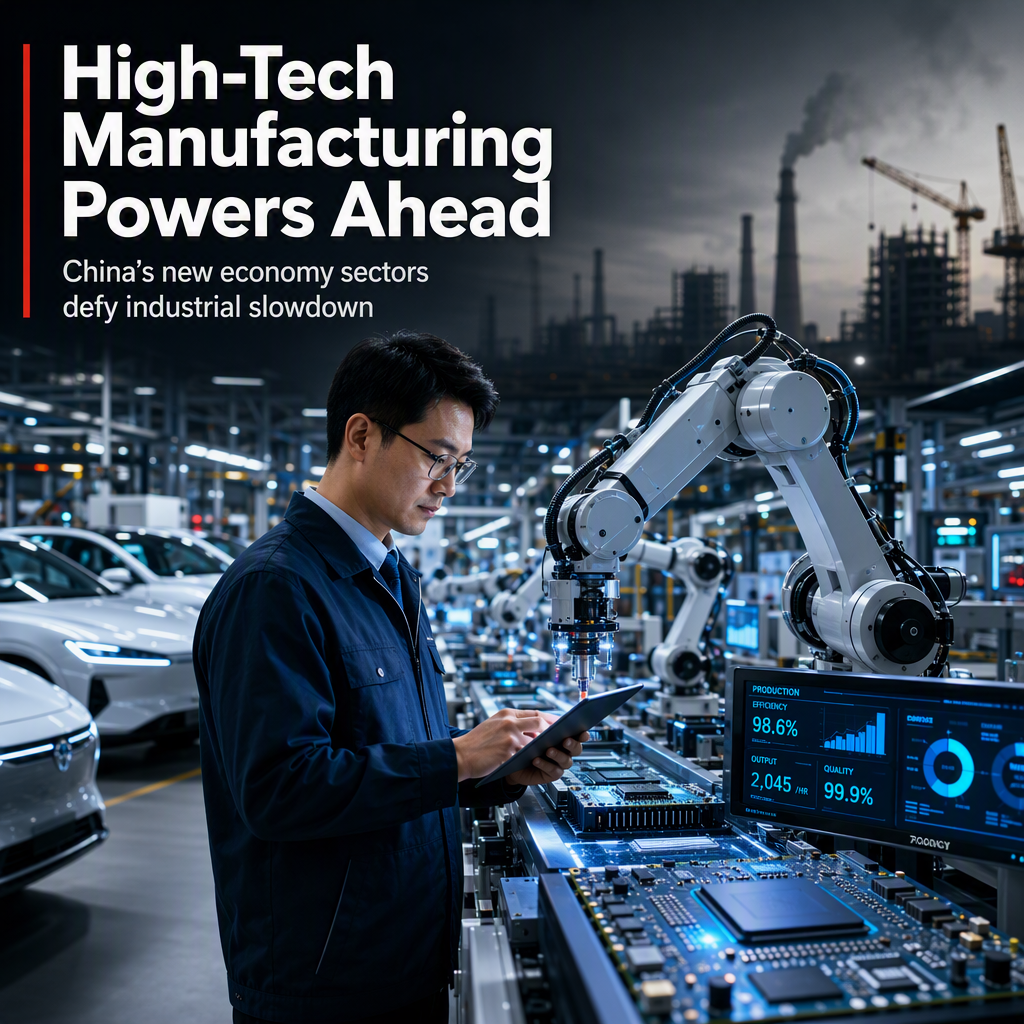
China's industrial production growth slowed more than expected in July, rising 4.5% year-on-year compared to 5.3% in June and missing both market and ING forecasts of 5.0% growth [1]. Despite this moderation, industrial production remained relatively resilient when compared to other domestic indicators [1]. Year-to-date industrial production growth reached 5.3% year-on-year, slightly below the 5.4% recorded in the first half of the year [1].
Manufacturing outperformed the broader industrial sector, growing 5.5% year-on-year in July [1]. High-tech manufacturing was a standout, accelerating to 16.9% year-on-year from 14.1% in June, highlighting the sector's role as a strategic driver of China's industrial growth [1]. Product-level data showed robust gains in new economy sectors: industrial robots production surged 30.2% year-on-year, new energy vehicles (NEVs) rose 29.9% year-on-year, and semiconductor integrated circuits increased 20.7% year-on-year [1]. These figures reinforce the trend of industrial upgrading and the growing importance of high-tech manufacturing in China's economic strategy [1].
In contrast, traditional property and infrastructure-linked sectors continued to struggle, reflecting the ongoing property downturn [1]. Cement output dropped 11.6% year-on-year, steel products fell 4.1% year-on-year, and flat glass declined 3.6% year-on-year [1]. These declines underscore the persistent weakness in construction-related industries and the drag from the old property and construction cycle [1].
According to ING’s Lynn Song, the resilience in high-tech and manufacturing sectors is being supported by industrial upgrading and external demand, while traditional sectors remain under pressure [1].
CONCLUSION
China's July industrial production data highlights a clear divergence between high-tech manufacturing, which is experiencing robust growth, and traditional property-linked sectors, which continue to contract. The market takeaway is that China's industrial growth is increasingly reliant on high-tech and new economy sectors, cushioning the impact of broader economic headwinds.