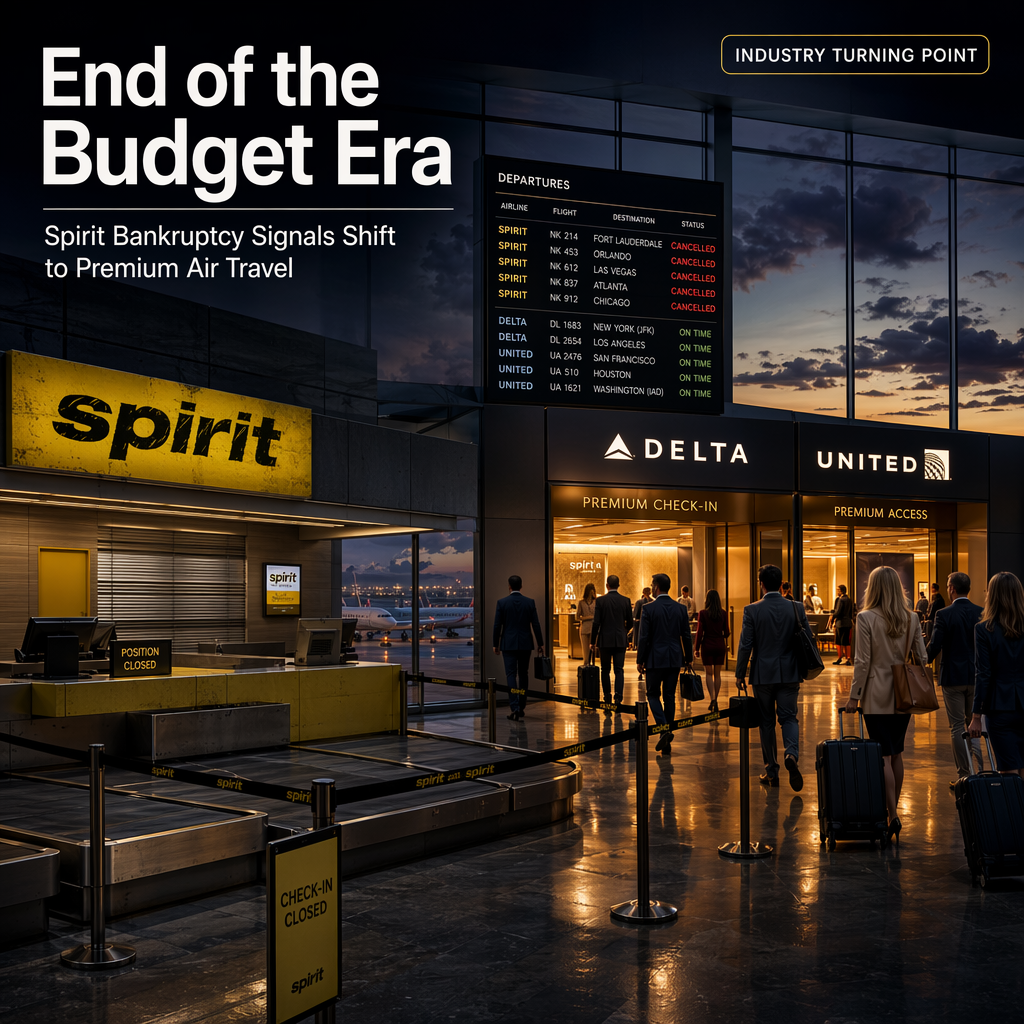
Spirit Airlines' bankruptcy has marked a significant turning point for the U.S. airline industry, with fewer low-cost options available to travelers during the busy summer season [1]. While carriers such as Breeze Airways, Frontier, and Avelo may benefit from Spirit's exit, the overall budget airline model remains under considerable stress, driven by factors beyond just rising jet fuel prices [1]. Major airlines like Delta Air Lines and United Airlines have leveraged their scale, loyalty programs, and premium offerings to out-compete low-cost upstarts, as traveler preferences have shifted toward premium cabins and services [1].
Kyle Potter, editor of Thrifty Traveler, noted that Americans' longstanding preference for cheaper fares fueled the rise of low-cost carriers like Spirit and Frontier. However, Potter believes Spirit's demise signals the start of a new era, potentially a return to the 'Golden Age' of travel, which may not favor everyday flyers seeking affordable options [1].
Recent financial results from leading carriers reinforce this trend. Delta Air Lines reported a record annual revenue of $58.3 billion in 2025, despite selling $1.1 billion less in economy tickets compared to the previous year. The gap was filled by premium ticket sales, with 60% of Delta's total revenue now coming from higher-margin segments such as premium cabins, loyalty programs, and cargo [1]. Delta CEO Ed Bastian described a bifurcation in the market, with premium sector demand growing fastest and lower-end consumers struggling. He emphasized that fares are driven by demand, and customers are increasingly willing to pay for premium seats [1].
United Airlines also saw robust performance, posting $3.5 billion in adjusted net profit for 2025, up 6%, and an 11% increase in premium seat revenue for the year. Although United expected record profits before the outbreak of war in the Middle East, it has since stated that demand remains strong, supported by less price-sensitive customers [1].
CONCLUSION
The bankruptcy of Spirit Airlines underscores a fundamental shift in the U.S. airline industry, with premium travel demand outpacing budget options. Major carriers like Delta and United are benefiting from this trend, as loyalty programs and premium services drive revenue growth. Travelers may face fewer low-cost choices going forward, signaling a lasting change in the market landscape.