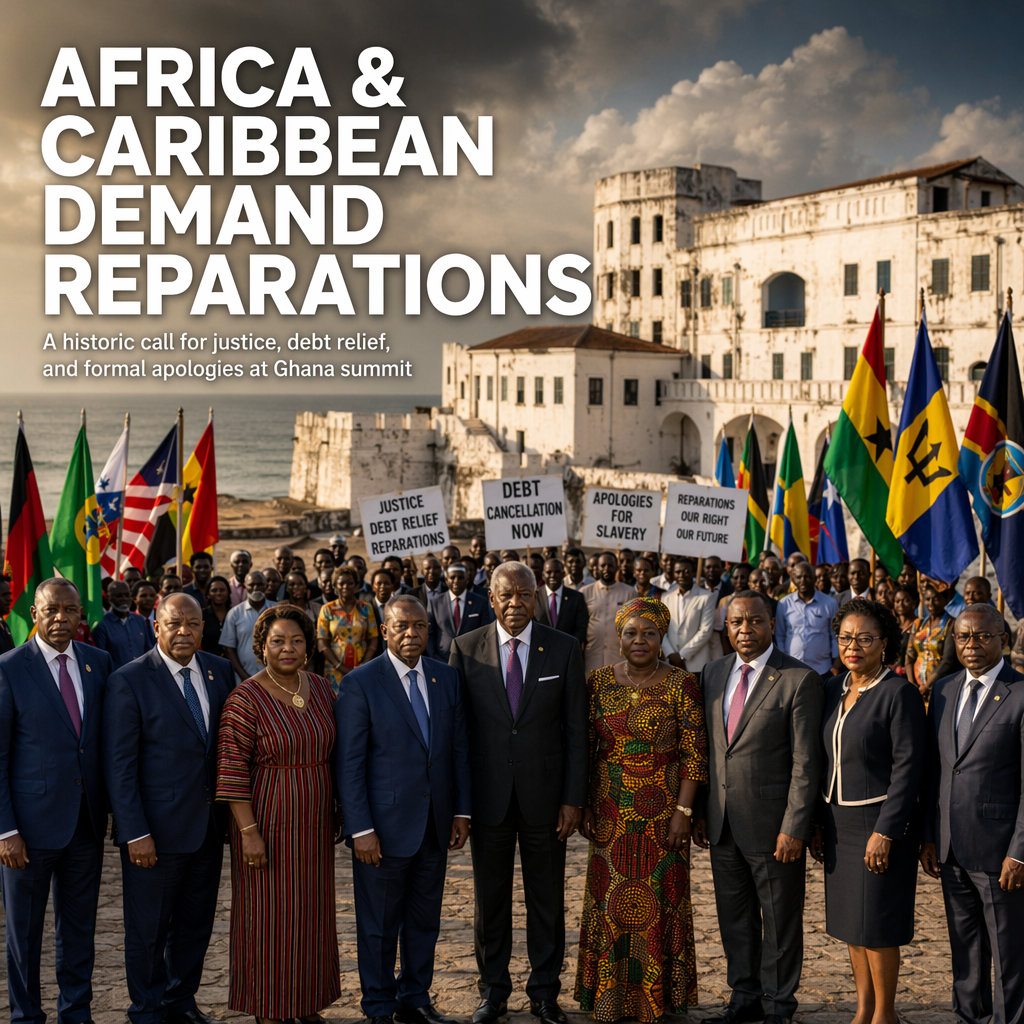
African and Caribbean leaders have adopted a comprehensive reparations plan at a conference in Ghana, calling for financial compensation, debt cancellation, and formal apologies from countries that benefited from the transatlantic slave trade [1]. The 19-point framework, agreed upon by the African Union and the Caribbean Community (CARICOM) Commission on Reparatory Justice, includes demands for a Global Reparations Fund, the return of looted cultural artifacts and ancestral remains, and reforms to international financial institutions that are perceived to disadvantage Third World countries [1]. The plan also advocates for climate justice financing, expanded citizenship pathways for Africans in the diaspora, and a 'right of return' for descendants of enslaved Africans, as well as the preservation of former slave forts and castles as memorial sites [1].
The proposal does not specify which countries should provide compensation or issue formal apologies, but it is expected to be presented at the next UN General Assembly as part of a coordinated push for slavery reparations by African and Caribbean nations [1]. The conference was attended by heads of state from Namibia, Liberia, Senegal, Barbados, and Sao Tome and Principe, with French President Emmanuel Macron addressing the gathering virtually and acknowledging the suffering caused by slavery [1]. Macron emphasized that reparations should not be seen as a simple financial settlement, stating, 'reparations should not be viewed as an end point, or a cheque written to bring the story to a close' [1].
Advocates at the conference cited that at least 12.5 million Africans were kidnapped and transported aboard European ships between the 15th and 19th centuries, and argued that the effects of slavery continue to impact Africa and the Caribbean today [1]. The event follows a UN vote in March recognizing transatlantic slavery as the 'gravest crime against humanity,' which passed with 123 votes in favor, while the U.S., Israel, and 52 other countries either voted against or abstained due to concerns about creating a hierarchy among crimes against humanity [1].
The reparations plan's call for debt cancellation and reforms to international financial institutions could have significant implications for global financial markets and international relations, particularly if the proposal gains traction at the United Nations or among creditor nations [1].
CONCLUSION
African and Caribbean leaders have unified in their call for reparations, debt relief, and formal apologies for the legacy of slavery, advancing a detailed plan that could influence future international financial and diplomatic discussions. The proposal's presentation at the UN General Assembly may prompt further debate and potential policy responses from the global community.