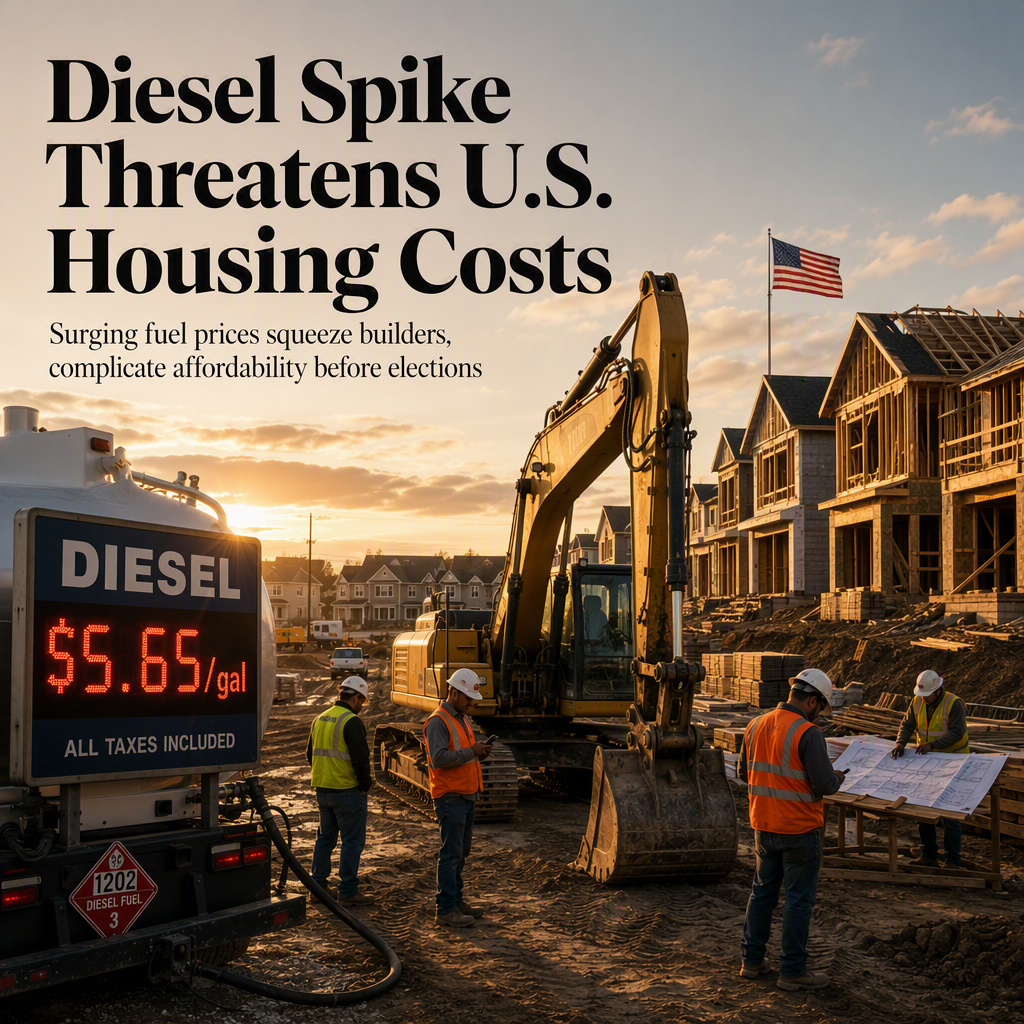
The U.S. home construction industry is facing new cost pressures as the national average price of on-highway diesel fuel surged to $5.65 per gallon this week, marking an increase of nearly $2.00 from a year ago, according to data from the Energy Information Administration [1]. This sharp rise in diesel prices, which has outpaced the increase in gasoline prices (with regular gas averaging about $4.09 per gallon), is impacting every phase of home construction, from hauling materials to operating heavy equipment on building sites [1].
Jim Tobin, president and CEO of the National Association of Home Builders (NAHB), emphasized that diesel is "critical to construction," noting that the recent spike has put additional short-term pressure on home building costs [1]. Builders, who had largely avoided the tariff-driven material price spikes previously feared, are now contending with expensive financing, labor, materials, and regulatory costs, all of which are being exacerbated by higher diesel prices [1].
The increase in diesel costs is also becoming a political issue, as it poses a challenge to President Donald Trump’s efforts to make housing more affordable ahead of the upcoming midterm elections. In March, Trump signed an executive order directing federal agencies to reduce regulatory barriers to construction and homeownership, aiming to speed up permitting and expand housing supply [1]. However, builders warn that savings from reduced regulatory costs can be quickly offset by rising expenses in other areas, such as fuel [1].
Industry leaders point out that states prioritizing homebuilding have been better able to accommodate population growth and economic expansion, but the broad economic impact of diesel price increases is likely to filter through supply chains and ultimately affect consumers [1].
CONCLUSION
The recent surge in diesel prices is adding significant cost pressures to the U.S. home construction industry, complicating efforts to improve housing affordability. As the midterm elections approach, these rising costs present a political and economic challenge for President Trump and congressional Republicans, potentially impacting their housing agenda and the broader market.