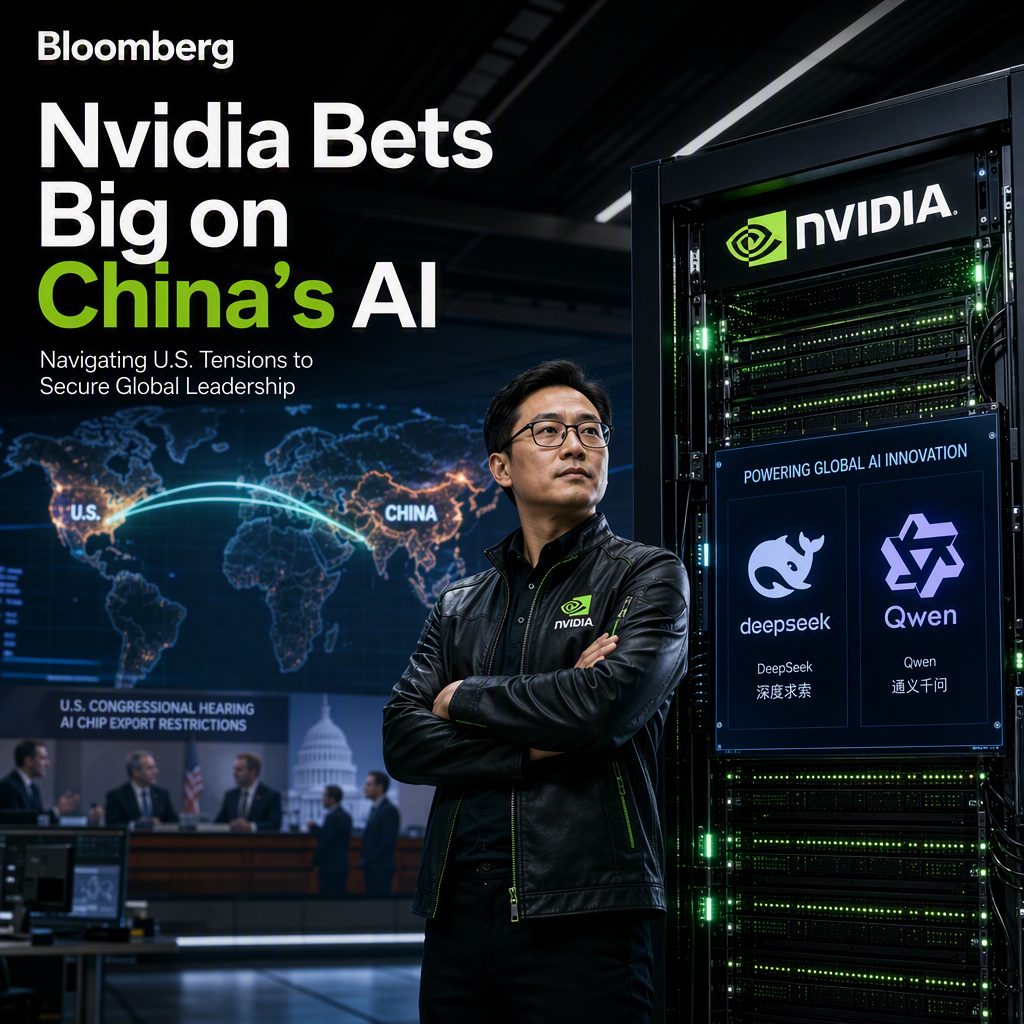
Nvidia has announced enhanced support for Chinese open artificial intelligence models, including DeepSeek's V4 Flash and Alibaba's Qwen 3.8, as part of a local AI initiative aimed at optimizing its hardware for these systems [1]. This strategic move is intended to position Nvidia ahead of domestic Chinese chipmakers in the rapidly evolving AI landscape [1]. The announcement comes at a time when U.S. lawmakers are expressing increasing concern over the adoption of Chinese AI models by American companies, highlighting the growing tension in the technological competition between the U.S. and China [1].
In its second-quarter earnings SEC filing, Nvidia warned of significant business risks stemming from potential White House restrictions on AI developed in China [1]. The company specifically noted that any regulatory control or restriction limiting its ability to support third-party applications and models built on open-source foundation models originating in China—such as DeepSeek, Qwen, or Kimi—could materially impact its business [1]. The U.S. government is reportedly considering new tariffs on U.S. semiconductors, though a White House official stated that any such reporting should be regarded as baseless speculation unless officially announced by the administration [1].
Nvidia's stock rose on Thursday following the release of better-than-expected second-quarter results and revenue guidance that exceeded estimates, with shares up more than 10% so far in 2026 [1]. The company, which maintains a near monopoly over advanced AI chips, is not alone in opposing potential U.S. government intervention in open AI models. Microsoft, Meta, Palantir, and over 20 other companies joined Nvidia in a July statement urging policymakers to avoid 'premature restrictions' on open-weight models [1].
An unnamed Nvidia employee emphasized that supporting models worldwide enables developers to build on the American tech stack, reinforcing the company's position that open access is crucial for innovation [1].
CONCLUSION
Nvidia's proactive support for Chinese open AI models underscores the company's efforts to maintain its leadership in the global AI hardware market, despite rising regulatory risks. The company's strong financial performance and industry-wide pushback against potential U.S. restrictions highlight the high stakes and market sensitivity surrounding open AI model access. Any future regulatory actions could have significant implications for Nvidia and the broader tech ecosystem.