
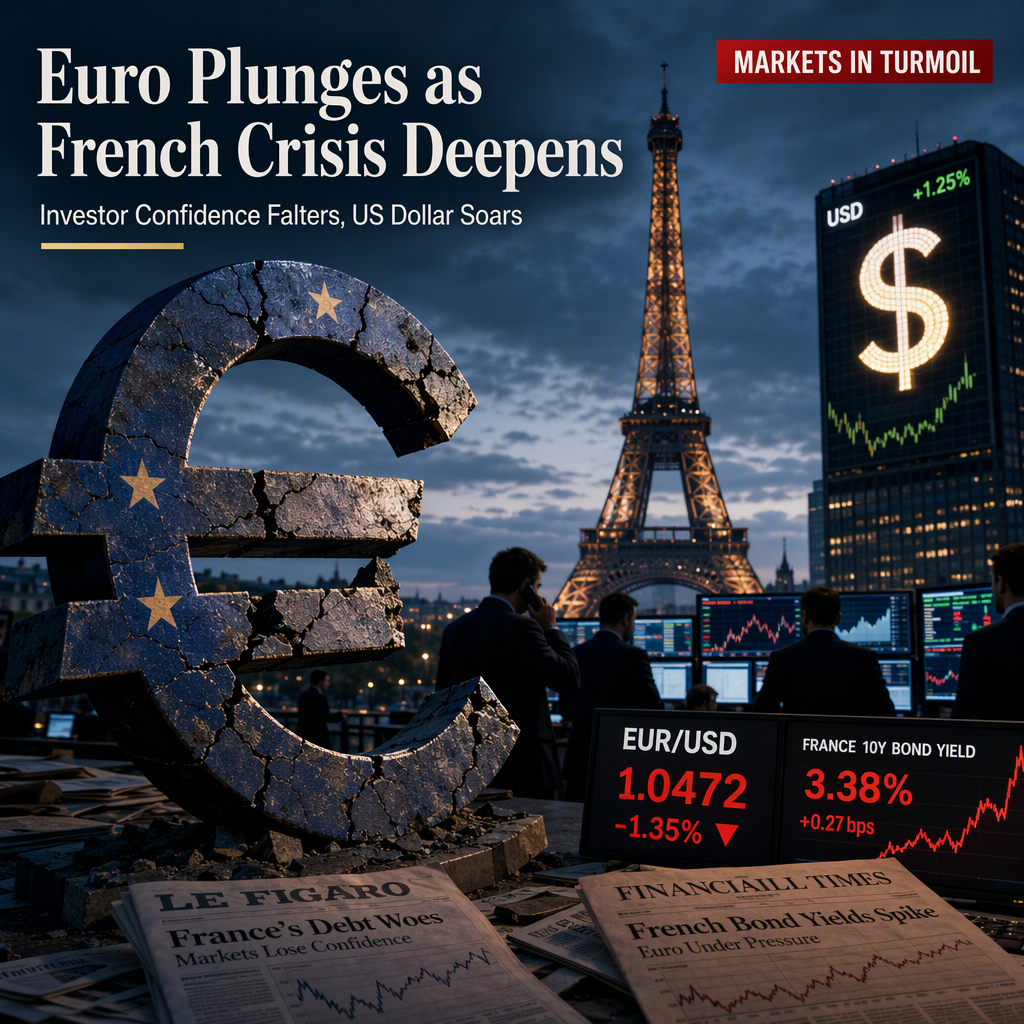
The Euro (EUR) continued its decline against the US Dollar (USD) and other major currencies on Monday, driven by a combination of mixed services activity data, deteriorating investor confidence, and mounting concerns over France's fiscal health [2][5][6][9]. The EUR/USD pair attempted to recover above 1.1200 after hitting fresh 17-month lows near 1.1160, following a 3% drop over the previous four weeks [2]. The Eurozone's Sentix Investor Confidence index fell sharply to 2.7 in October from 5.1 in September, reflecting waning optimism among investors [2][5]. Despite this, the immediate market reaction was muted, with the Euro's movement primarily influenced by French fiscal risks [5].
French 10-year government bond yields surged to 4.99% on Friday, surpassing the 2008 peak, fueling fears of a credit crisis that could spread to other Eurozone nations [2][6]. The EUR/GBP cross dropped for the seventh consecutive day, nearing year-to-date lows around 0.8460-0.8455, as traders positioned for further downside amid the French debt crisis [6]. Technical indicators such as MACD and RSI signaled stretched selling, suggesting potential dip-buying if the sell-off continues [6].
Final HCOB Services PMI data showed Eurozone activity grew at 53 in September, up from 51.7 in August, with Germany's PMI confirmed at 52.9 (previously 49.7). However, Italian and French PMIs slowed more than expected, while Spain outperformed forecasts [2][9]. ECB Chief Economist Philip Lane warned that higher long-term interest rates are constraining growth and that medium-term inflation expectations remain de-anchored, adding to uncertainty about price stability [9].
Meanwhile, the US Dollar Index (DXY) pushed to new yearly highs, with 102.85 as the next upside target, supported by euro weakness and firm Fed policy expectations [3]. ING's Chris Turner noted that the market is comfortable with unchanged Fed policy in October and a hike in December, with the ISM Services PMI and FOMC minutes expected to further support the dollar [3][1]. Analysts at DBS Group Research cautioned that higher yields driven by market anxiety may not offer durable support for the USD [2].
Across other markets, the Euro lost ground against the Canadian Dollar (CAD) as oil prices fell and ECB growth concerns weighed on sentiment [9]. The EUR was also the weakest against the Japanese Yen (JPY) and other majors, as shown in daily currency heat maps [6][9].
CONCLUSION
The Euro's sharp decline reflects deepening concerns over French fiscal stability, weak investor confidence, and mixed economic data, while the US Dollar continues to strengthen on resilient Fed policy expectations. Market sentiment remains negative for the Euro, with technical and fundamental factors pointing to further downside risk. The situation is closely watched as fiscal and monetary developments in Europe and the US drive currency and bond market volatility.