
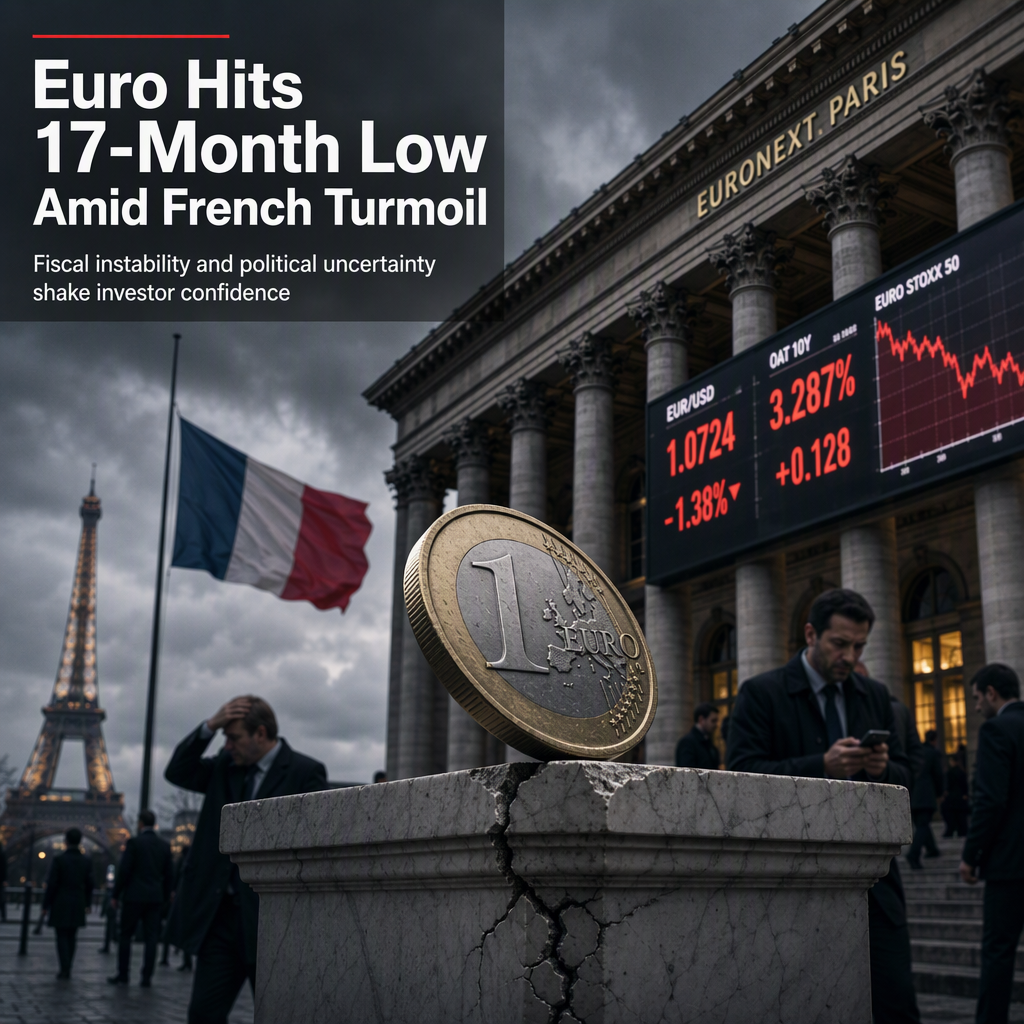
The Euro (EUR) has sharply depreciated against major currencies, hitting its lowest level against the U.S. dollar in 17 months, as mounting fiscal risks and political instability in France weigh heavily on investor sentiment [1][4][5]. On Monday, the Euro was 0.6% lower against the dollar, marking its weakest point since May 19, 2025, according to LSEG data [4][5]. The currency also underperformed against the Swiss Franc, falling below 0.9300, and was the weakest against the Japanese Yen among major peers [1].
French fiscal concerns have intensified following a steep bond market rout, with 10-year French bond yields rising 0.65% to near 4.89% and posting a multi-decade high near 5% on Friday. Over the past two months, French 10-year yields have surged more than 28%, while German Bund yields increased over 10%, widening the gap between the two countries' borrowing costs [1]. France's Finance Minister Roland Lescure has pledged to reduce the budget deficit from a target of 5% of GDP next year to the EU limit of 3% by 2029, but analysts at Brown Brothers Harriman and Barclays doubt the current minority government can deliver, citing political hurdles and 'optimistic' economic assumptions in the draft budget [1][3][4]. ING strategists add that even if the budget is passed, it would not resolve France's structural fiscal problems, with deficits remaining too high to stabilize the debt ratio and rising expenditures likely to persist [4].
Political tensions in France have come to the forefront earlier than expected, with analysts warning that any budget promises lack credibility amid looming elections in April 2027 [3]. The risk of contagion from France's fiscal crisis to the wider Eurozone has raised fears reminiscent of the sovereign debt crisis over a decade ago, potentially prompting the European Central Bank (ECB) to intervene to support French government debt [3][2]. Commerzbank's Thu Lan Nguyen notes that concerns about France's public debt sustainability are now weighing on the Euro, with markets increasingly worried that the ECB may be forced into a more persistently accommodative monetary policy stance to ease pressure on long-term bond yields [2].
Investor discomfort is also being fueled by speculation of a snap election in Spain, adding to the political uncertainty across the eurozone [4][5]. Barclays economists highlight that French fiscal and political developments cloud the euro area outlook, with fiscal fundamentals remaining weak and unlikely to reach an inflection point before next year's presidential election [4]. Market reactions have been pronounced, with global bond markets and currency pairs showing signs of pressure, and the Euro's weakness raising concerns about export competitiveness and imported inflation for the region [1][5].
Forward-looking statements from analysts suggest that none of the main French presidential candidates have presented a sufficiently detailed plan to stabilize the debt ratio, and further difficult fiscal choices will be required by the next government [4]. Experts speaking to CNBC caution that fears of a 'fiscal apocalypse' are exaggerated, but acknowledge the heightened uncertainty and risk sentiment driving current market moves [5].
CONCLUSION
The Euro's sharp decline reflects deepening fiscal and political risks in France, compounded by broader eurozone uncertainties. Analysts doubt the credibility and effectiveness of France's deficit reduction plans, warning of persistent structural challenges and potential ECB intervention. With market volatility elevated and no clear resolution in sight, investors remain cautious as the eurozone faces a critical period ahead.