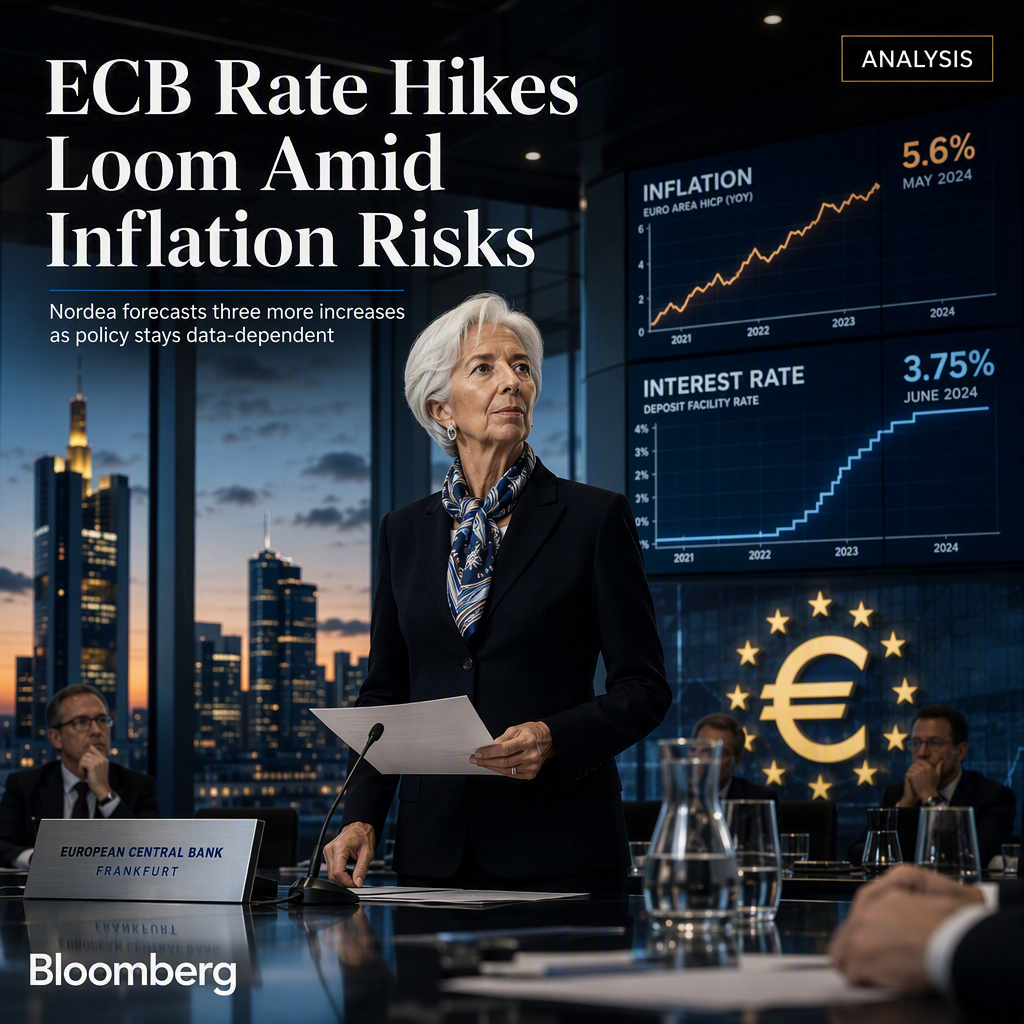
According to Nordea’s Jan von Gerich, the European Central Bank (ECB) remains primarily focused on upside inflation risks and is likely to continue tightening monetary policy in the coming months. The analysis, based on the monetary policy account of the ECB’s July meeting, indicates that unless there is a material improvement in the inflation outlook, further rate hikes are expected [1].
Nordea forecasts three additional rate increases by the ECB, specifically in September, December, and March 2027. These hikes would bring the ECB’s deposit rate to 3% [1]. The report emphasizes that energy prices and broader price pressures are key factors influencing the future path of interest rates [1].
The absence of second-round effects currently allows the ECB to monitor economic developments, which Nordea interprets as consistent with a quarterly pace of 25 basis point rate hikes rather than a more aggressive tightening cycle. However, the report notes that if the inflation situation becomes more acute—such as through unanchored inflation expectations, a clear pick-up in underlying price pressures, or firms accelerating price adjustments—a more pre-emptive and rapid rate increase could be justified [1].
While Nordea’s base case is for several more hikes at a measured pace, the risks are tilted towards fewer hikes if inflation pressures ease. The report underscores the ECB’s data-dependent approach and the potential for policy adjustments should inflation dynamics change [1].
CONCLUSION
Nordea expects the ECB to implement three more rate hikes, bringing the deposit rate to 3%, with the pace and extent of tightening dependent on inflation developments. The outlook remains data-dependent, with risks skewed towards fewer hikes if inflation pressures subside.