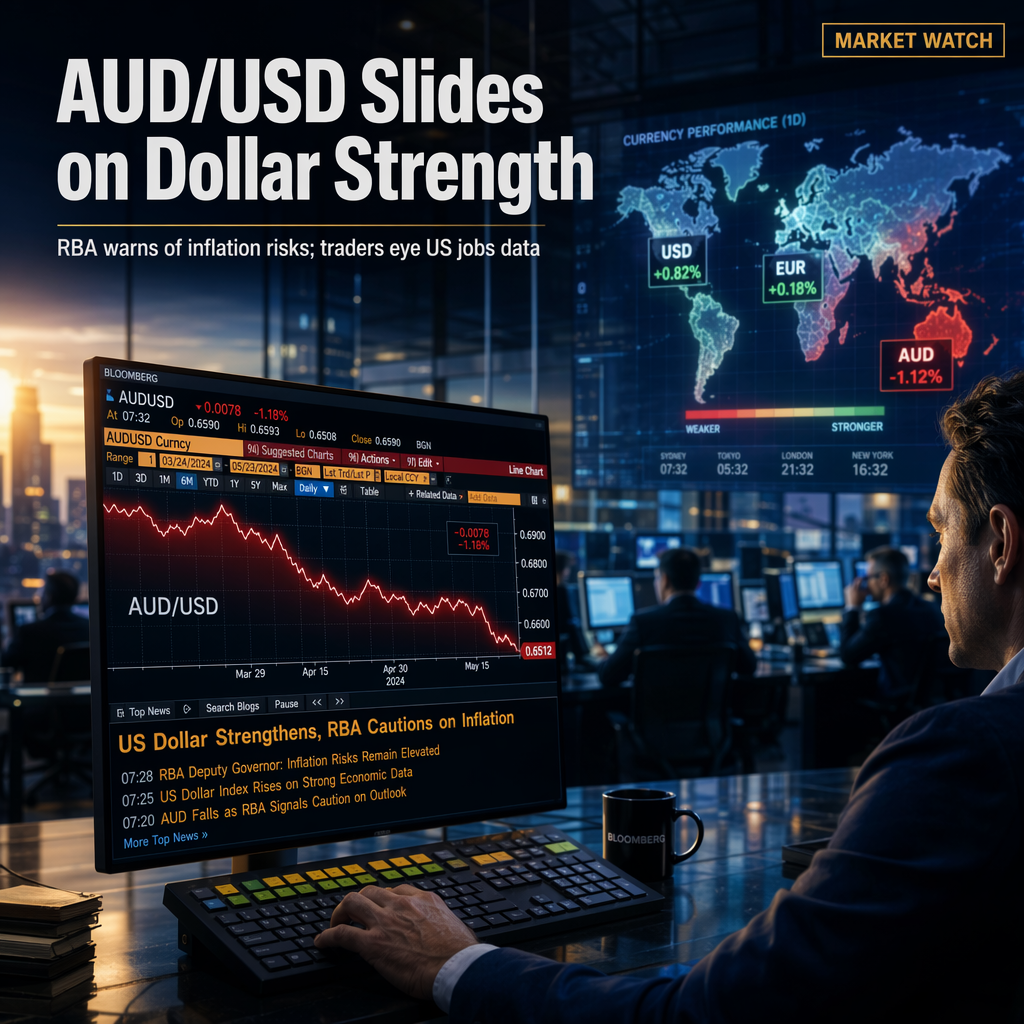
The Australian Dollar (AUD) showed a mixed performance against major currencies during the European trading session on Tuesday, following the release of the Reserve Bank of Australia (RBA) monetary policy meeting minutes [1]. The RBA minutes from the June meeting revealed that policymakers remain concerned about higher inflationary pressures and downside growth risks, particularly in light of ongoing Middle East conflicts. The RBA emphasized that it would not hesitate to raise interest rates further to ensure price stability [1].
Despite these concerns, the recent signing of a memorandum of understanding (MoU) between the United States and Iran has helped ease some Middle East-related risks [1]. However, the AUD/USD pair has been pressured by a strengthening US Dollar, which is up 0.2% on the day, with the US Dollar Index (DXY) trading near 101.36 [1]. This strength in the Greenback is attributed to market caution ahead of the upcoming US Nonfarm Payrolls (NFP) data for June and the anticipated release of the US JOLTS Job Openings data for May at 14:00 GMT [1].
Technically, AUD/USD is trading lower at around 0.6875, maintaining a bearish near-term bias as the price remains below the 20-period exponential moving average (EMA) at 0.6990. The EMA now acts as immediate resistance, suggesting that any rebounds are likely to be capped while this barrier holds. The Relative Strength Index (14) is deep in oversold territory near 26, indicating stretched selling pressure but not yet signaling a confirmed reversal [1].
The heat map of currency performance shows that the Australian Dollar was strongest against the Swiss Franc, but generally weaker against the US Dollar and other majors [1].
CONCLUSION
The AUD/USD pair remains under pressure due to RBA's hawkish stance on inflation and a stronger US Dollar ahead of key US economic data releases. Technical indicators suggest continued downside risk, with limited prospects for a near-term reversal unless market conditions shift.