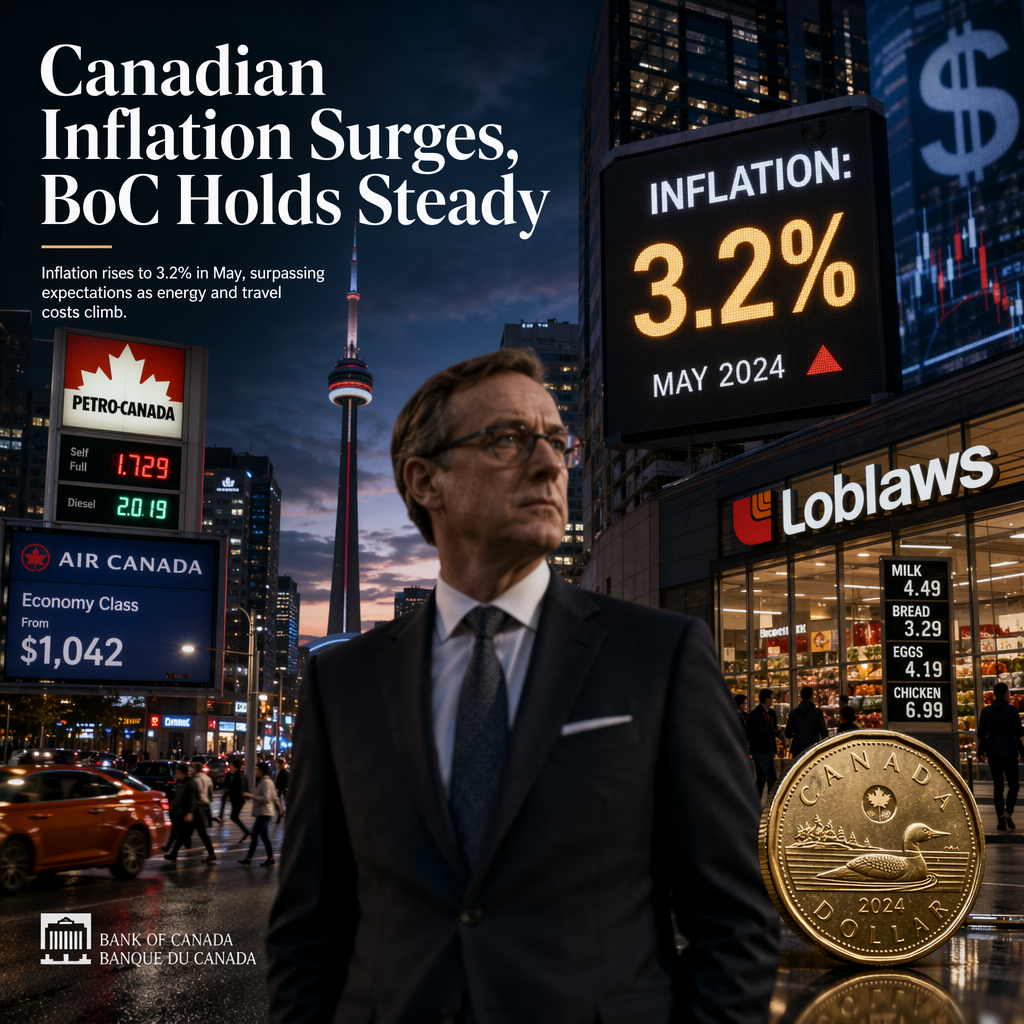
The Canadian headline Consumer Price Index (CPI) for May rose by 3.2% year-over-year, exceeding expectations, with prices increasing by 1.0% month-over-month. This upside surprise was primarily driven by energy products, seasonal factors, and mean reversion in travel-related components [1]. Despite the headline CPI tracking above the Bank of Canada’s (BoC) projections from the April Monetary Policy Report, core inflation measures remained stable, with CPI-trim and CPI-median unchanged at 2.0% and 2.1% year-over-year, respectively, and firming to 2.3% on a three-month annualized basis [1].
TD Securities strategists argue that the BoC is likely to look through the headline CPI strength, as core inflation measures do not indicate broad pressures from higher oil prices, and indicators of CPI breadth actually declined from April [1]. As a result, they expect the BoC to remain patient and keep rates on hold through 2026, even as impacts from the war are reflected in the data [1].
On the currency front, firmer inflation has eased some pressure on the Canadian dollar (CAD), with TD Securities noting that CAD bearishness appears stretched and could reverse if Canadian economic data stabilizes. However, they caution that it remains difficult to counter near-term US dollar strength, and express a preference for short AUDCAD positions on the crosses [1].
CONCLUSION
May’s higher-than-expected Canadian inflation has not shifted TD Securities’ outlook for the Bank of Canada, which is expected to maintain its current policy stance through 2026. While the Canadian dollar may see some relief if domestic data improves, the overall market impact is tempered by persistent US dollar strength.