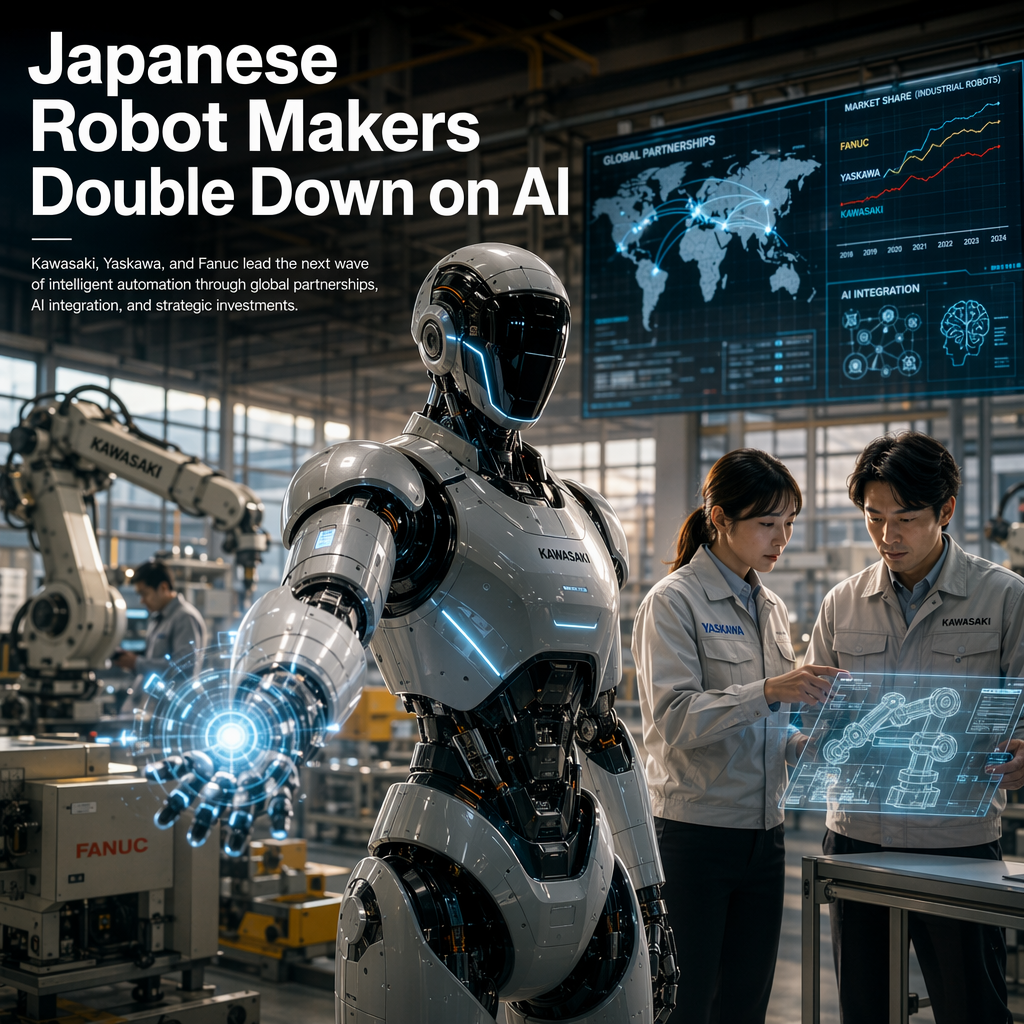
Japanese industrial robot manufacturers are intensifying their focus on artificial intelligence and open collaboration to reclaim their former dominance in the global market, which has seen their share fall to 40% from previous leadership levels [1]. Companies such as Yaskawa Electric are integrating AI-powered machines into their production lines, with approximately one-third of the robots in their new factory utilizing artificial intelligence [1].
Key industry players are making significant investments and forming strategic partnerships to accelerate this AI-driven transformation. Kawasaki Heavy has announced plans to raise over $1 billion through new shares and bonds, specifically to fund AI technology investments in manufacturing [1]. The company is also collaborating with Nvidia on physical AI and is opening a US robot center to expand its international presence [1]. Fanuc and Siemens are leveraging their manufacturing expertise to enhance the intelligence and capabilities of factory robots in the physical AI space [1].
The Japanese government is supporting these efforts with a target of $65 billion in public-private physical AI investment by 2040, emphasizing the sector's importance in the national industrial strategy [1]. Additionally, Japan is backing SoftBank-led AI models with up to $6.2 billion to remain competitive with the US and China in advanced AI technology [1]. Toyota is also harmonizing vehicle specifications with AI to speed up production and improve efficiency [1].
Market analysis indicates that while trading sentiment is bullish, there is caution due to the rising leverage and risk profiles associated with increased AI investments in the industry [1]. Technical experts highlight that AI-powered robots are being designed with advanced sensors and machine learning algorithms for real-time adjustments and predictive maintenance, which is expected to improve productivity [1]. Industry experts also note that while industrial robot prices remain competitive, the integration of AI features is likely to increase average selling prices, and investors are closely monitoring the share performance of major Japanese robotics companies [1].
CONCLUSION
Japanese industrial robot makers are making a concerted push to regain global market share through AI integration, strategic investments, and international partnerships. While the outlook is bullish, the industry faces higher risk profiles as it navigates the complexities of AI adoption. The government's substantial investment targets and support for AI initiatives underscore the sector's critical role in Japan's industrial future.