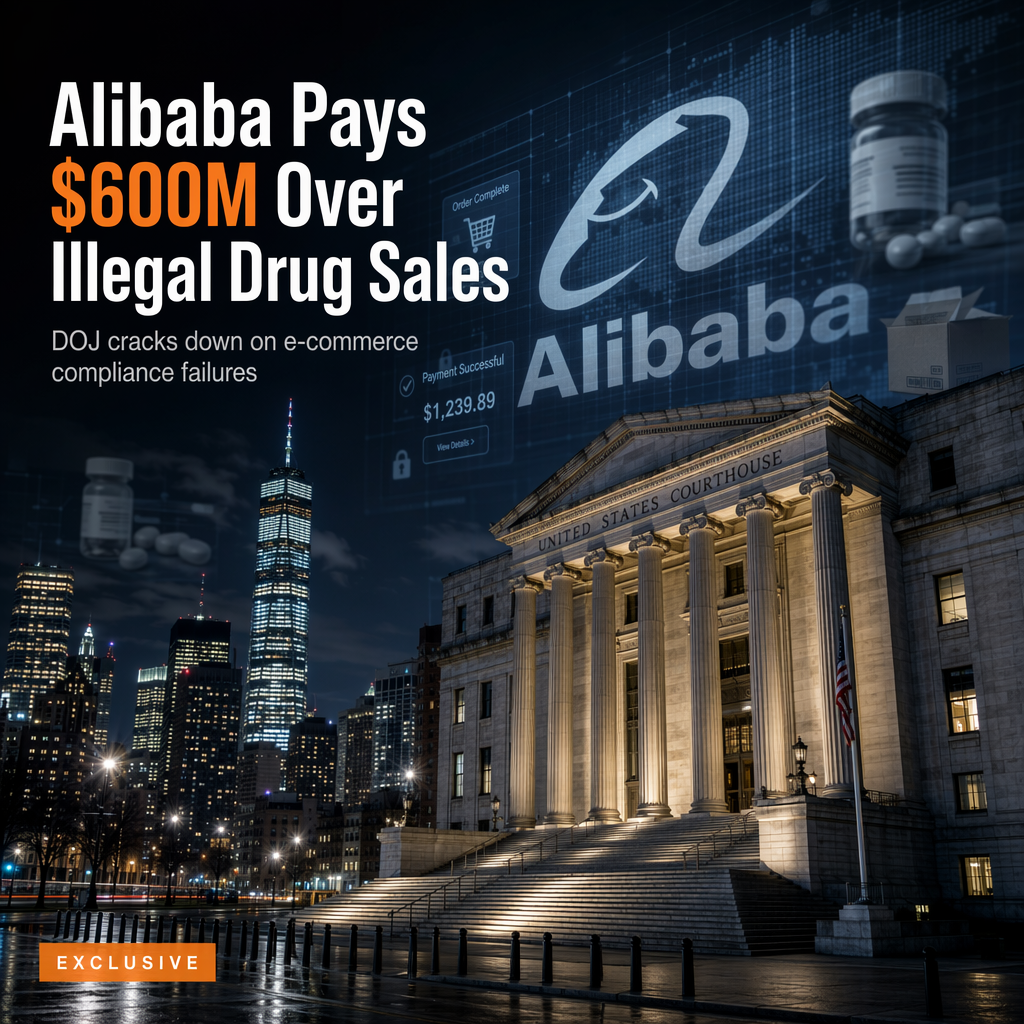
Alibaba Group Holding Ltd. has agreed to pay $600 million and enter into a non-prosecution agreement with the U.S. Department of Justice (DOJ) after admitting it failed to prevent tens of thousands of illegal product sales into the United States through its online marketplaces, Alibaba.com and AliExpress.com [1]. The DOJ stated that, between January 2016 and December 2024, approximately 80,000 unlawful product sales involving imports into the U.S. violated the Federal Food, Drug and Cosmetic Act and other federal laws [1]. These transactions generated more than $200 million in gross merchandise value, according to the company's admission [1].
The settlement also involves Alibaba's U.S.-based payment processor, AUS Merchant Services (formerly Alipay U.S.), which admitted to shortcomings in its anti-money laundering compliance program [1]. Specifically, court documents reveal that the company failed to fully incorporate certain wire transfer data into its transaction monitoring system, resulting in missed high-risk transactions. In at least one case, a merchant continued selling prohibited products to U.S. buyers even after being investigated and reported by AUS [1]. Federal investigators conducted more than 40 undercover purchases of illegal pharmaceuticals and pharmaceutical counterfeiting equipment through Alibaba's platforms [1].
Assistant Attorney General Brett A. Shumate emphasized that companies operating online marketplaces must implement appropriate safeguards to prevent bad actors from exploiting their platforms, warning that the Department will hold them accountable if they fail to do so [1]. Alibaba stated it cooperated fully with the DOJ's investigation and has agreed to strengthen compliance measures governing product sales on its platforms [1].
Following the news, Alibaba's stock (BABA) traded at $96.14, down $1.85 or 1.89% [1].
CONCLUSION
Alibaba's $600 million settlement with the DOJ marks a significant enforcement action over the sale of illegal pharmaceuticals and related goods on its U.S. platforms. The company has committed to enhancing its compliance measures, but the immediate market reaction was negative, with shares falling nearly 2%. This development underscores regulatory risks for global e-commerce firms operating in the U.S.