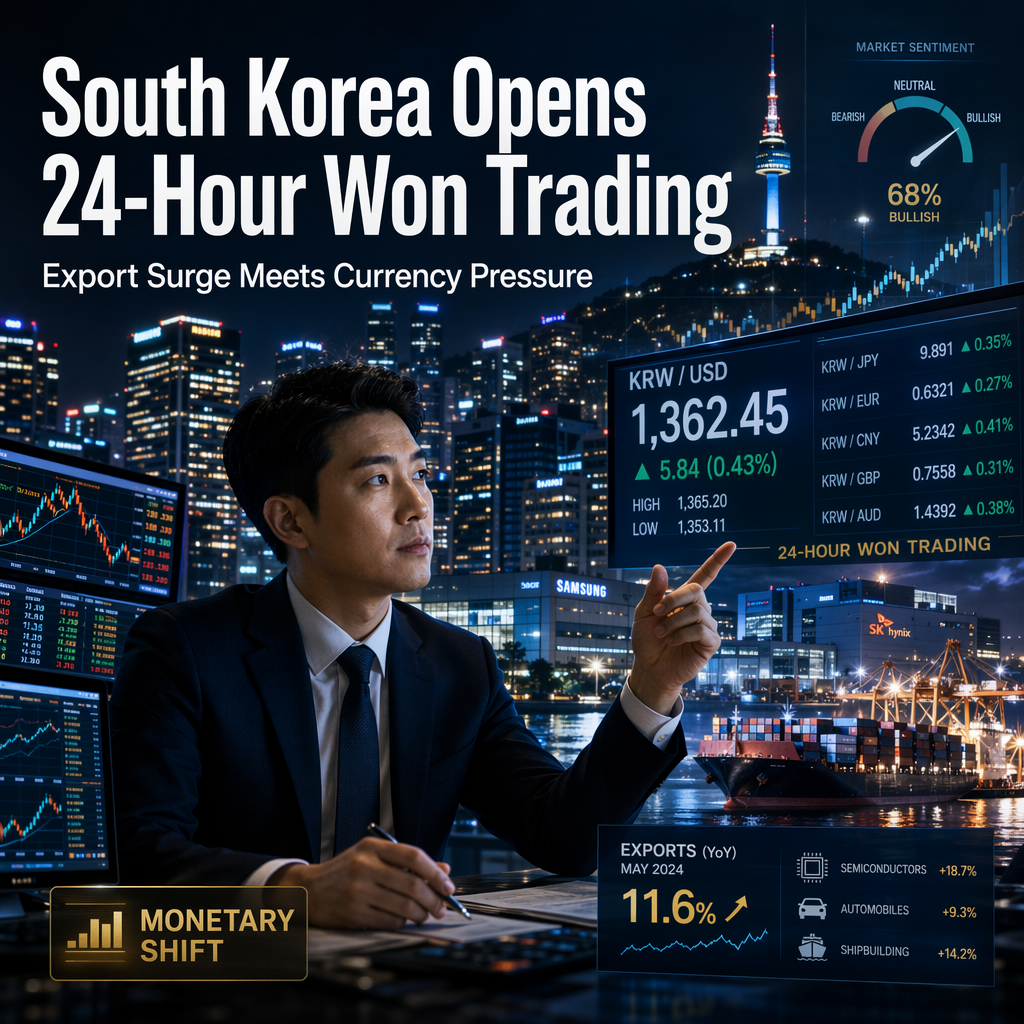
South Korea has initiated round-the-clock trading of its currency, the won, beginning Monday, in a significant policy shift aimed at making the won a more international currency and helping exporters manage exchange rate risk more effectively [1]. This move is particularly welcomed by chipmakers and other major exporters, who anticipate improvements in hedging and pricing strategies, as well as enhanced market liquidity and resilience [1]. The government and market participants are closely monitoring financial data and technical indicators to assess the impact of this change, with exporters focusing on how 24-hour trading will affect support and resistance levels for the won [1].
Despite these structural reforms and robust export performance, the Korean won remains under selling pressure. According to Societe Generale, the USD/KRW exchange rate has surpassed the psychological barrier of 1,550, with interim resistance levels identified at 1,561 and further at 1,573/1,580 [2]. In June, South Korea recorded strong export growth of 70.9% and a widening trade surplus to $36.2 billion from $27.03 billion in May, yet these positive fundamentals have not prevented further depreciation of the won [2].
Societe Generale attributes the export gains to AI-driven demand and notes that inflation accelerated to 3.2% in June [2]. The bank suggests that these factors clear the way for the Bank of Korea (BoK) to resume policy tightening, starting with a 25 basis point rate hike to 2.75% in two weeks [2].
Market sentiment among exporters is generally optimistic regarding the operational benefits of 24-hour trading, but the currency market itself continues to face downward pressure on the won despite strong trade data and anticipated monetary tightening [1][2].
CONCLUSION
South Korea's move to 24-hour won trading is seen as a positive step for exporters and market flexibility, but the currency remains under pressure despite strong export and trade surplus data. With inflation rising, analysts expect the Bank of Korea to resume rate hikes soon. The overall market impact is high, as both structural reforms and monetary policy shifts are closely watched by participants.