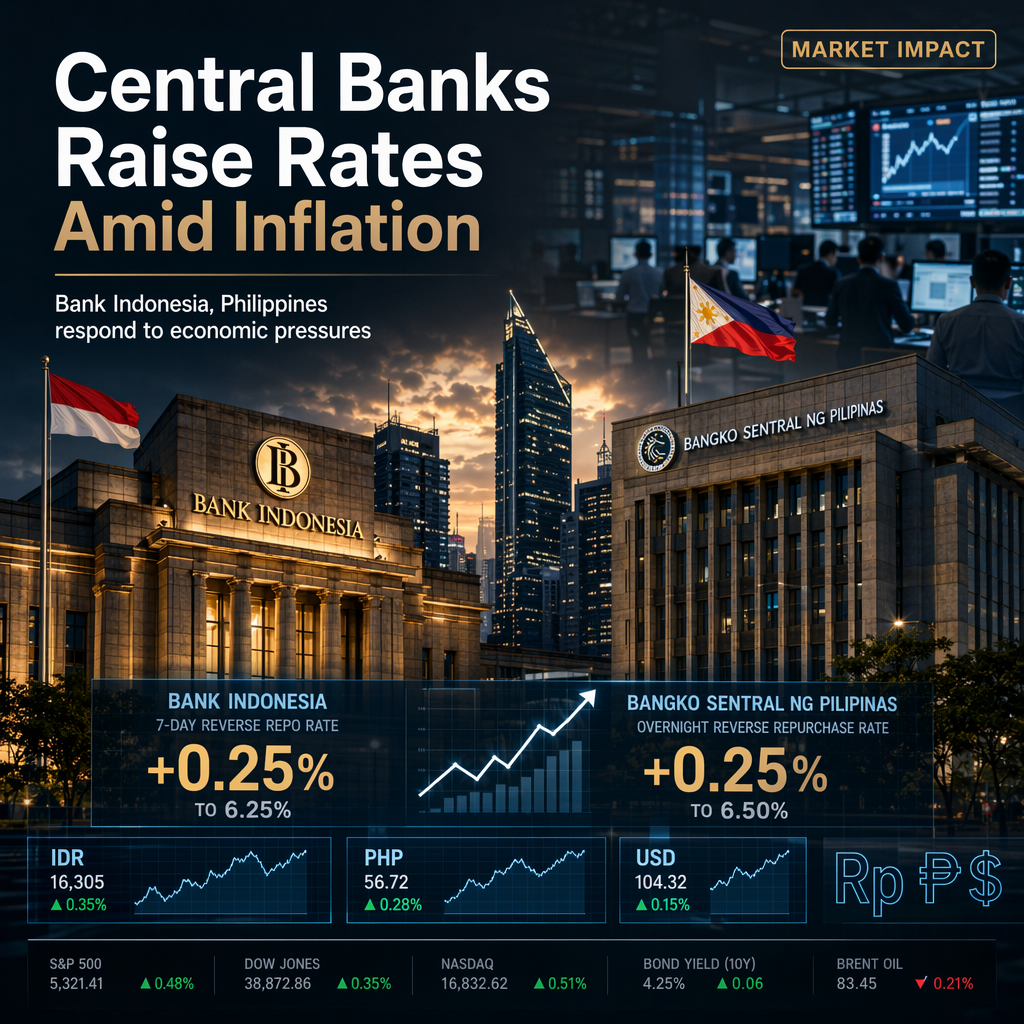
Both the Philippine central bank and Bank Indonesia (BI) raised their main interest rates by 25 basis points in June, reflecting ongoing efforts to address inflationary pressures in their respective economies. The Philippine central bank's decision was driven by persistent inflation above target levels, primarily attributed to high fuel prices resulting from the Iran war. Although the pace of inflation is slowing, the central bank continues to tighten monetary policy to contain price increases [1].
Bank Indonesia increased its benchmark interest rate to 5.75% from 5.5% on June 18, a move that was in line with market expectations [2]. The immediate market reaction saw the Indonesian Rupiah (IDR) receive support against the US Dollar (USD), with the USD/IDR trading around 17,820 at the time of reporting [2]. BI Governor Perry Warjiyo stated that inflation remains under control and the Rupiah is stabilizing, with a tendency to strengthen going forward. The 2026 GDP outlook remains unchanged in the range of +4.9% to +5.7% [2].
Governor Warjiyo also highlighted that Bank Indonesia has intensified currency interventions to defend the Rupiah and has raised SRBI rates to attract foreign capital inflows. As of mid-June, outstanding SRBI rupiah notes stood at 1,021.1 trillion rupiah, with non-resident investors holding 238.1 trillion rupiah [2].
While both central banks are responding to inflationary pressures, the Philippine central bank's actions are specifically linked to external shocks from high fuel prices due to the Iran war, whereas Bank Indonesia's measures are focused on currency stabilization and maintaining controlled inflation [1][2].
CONCLUSION
Both the Philippine central bank and Bank Indonesia have raised interest rates by 25 basis points in response to inflationary pressures and currency concerns. The moves were in line with market expectations and have resulted in immediate support for the Indonesian Rupiah. Forward guidance from Bank Indonesia suggests continued efforts to stabilize the currency and attract foreign capital.