
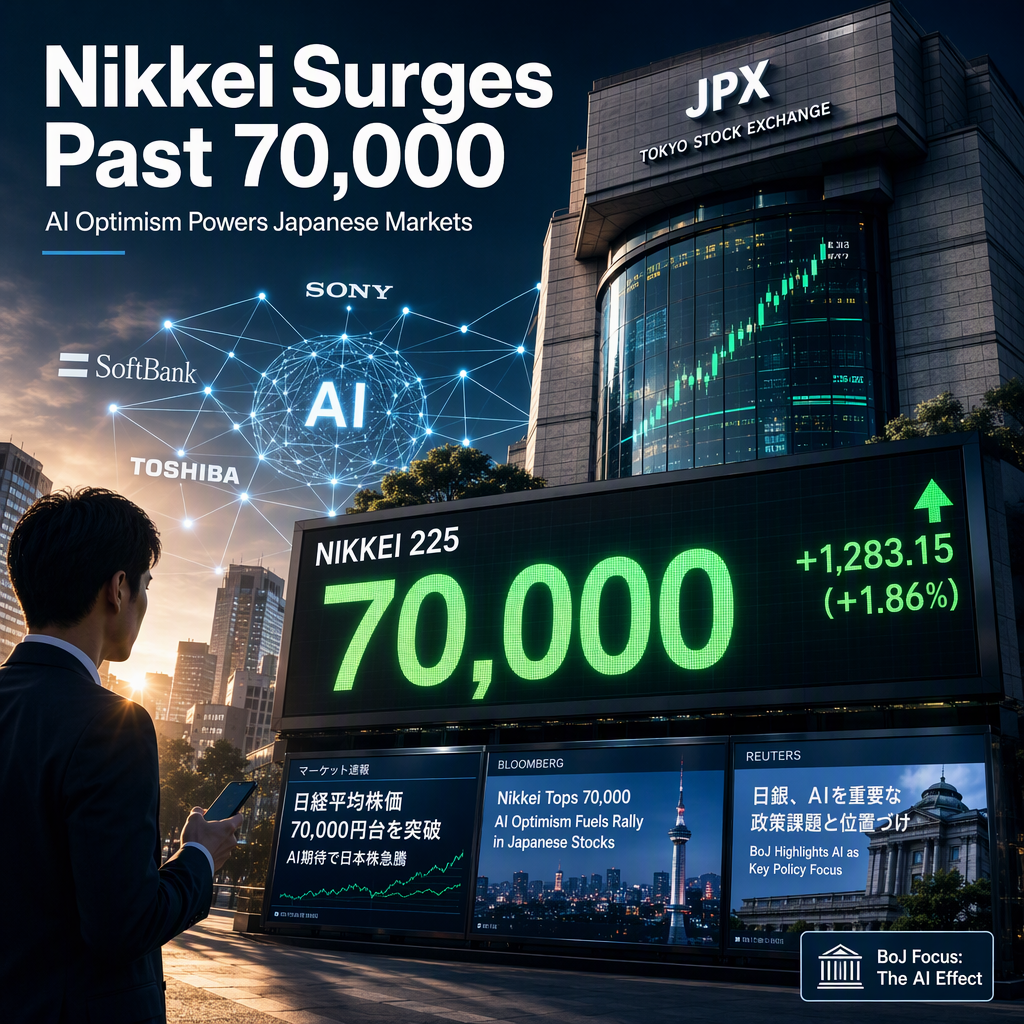
Japanese equities rallied sharply on Monday, with the Nikkei Stock Average surpassing the 70,000 mark during intraday trading for the first time in three months, driven by renewed optimism over artificial intelligence (AI) and a global tech-led recovery in equity markets [1]. The rally was fueled by strong volume in major technology and electronics stocks, as investors bet on sustained demand for AI-related hardware and services [1]. A senior strategist at a major Japanese brokerage noted, 'AI optimism is once again powering the Tokyo market,' highlighting the sector's central role in the current uptrend [1].
The positive sentiment was further supported by the September U.S. jobs report, which showed slower-than-expected growth and led investors to scale back expectations for a Federal Reserve rate hike this month [1]. This easing of U.S. rate hike fears contributed to a rotation back into growth sectors, particularly technology [1]. Market participants are closely monitoring signals from the Fed, as softer employment data has increased expectations that policymakers will pause further rate increases in the near term [1]. Technical analysts are watching support near 69,000 and resistance at recent three-month highs, with the Nikkei's break above 70,000 seen as a bullish signal [1].
On the policy front, Bank of Japan (BoJ) Deputy Governor Shinichi Uchida stated that AI has become a major focus among central banks, including at BoJ monetary policy meetings [2]. Uchida emphasized that AI adoption could have both positive and negative effects on productivity and labor markets, and that it is impacting key monetary policy parameters such as the output gap, financial conditions, and star variables [2]. He described AI as a major positive demand shock, putting upward pressure on the economy and prices, and noted that AI-driven stock price gains have eased financial conditions, while significant bond sales by AI-related firms have pushed long-term rates higher [2].
Uchida also cautioned that while the demand-side impact of AI appears first, making financial conditions more accommodative, there remains a correction risk if profits do not materialize [2]. The BoJ is closely monitoring economic and financial indicators to assess the ongoing effects of AI adoption [2]. In foreign exchange markets, the USD/JPY pair was down 0.21% on the day at 157.50, with Uchida's remarks seen as modestly hawkish, highlighting AI as an upside risk for inflation and the yen [2].
CONCLUSION
The Nikkei's surge above 70,000 underscores the powerful influence of AI optimism on Japanese equities, supported by easing U.S. rate hike concerns and robust tech sector performance. Meanwhile, the BoJ is increasingly focused on AI's macroeconomic impact, viewing it as both a driver of growth and a potential source of inflationary pressure. Market participants are advised to watch for further signals from both domestic earnings and global policy developments.