
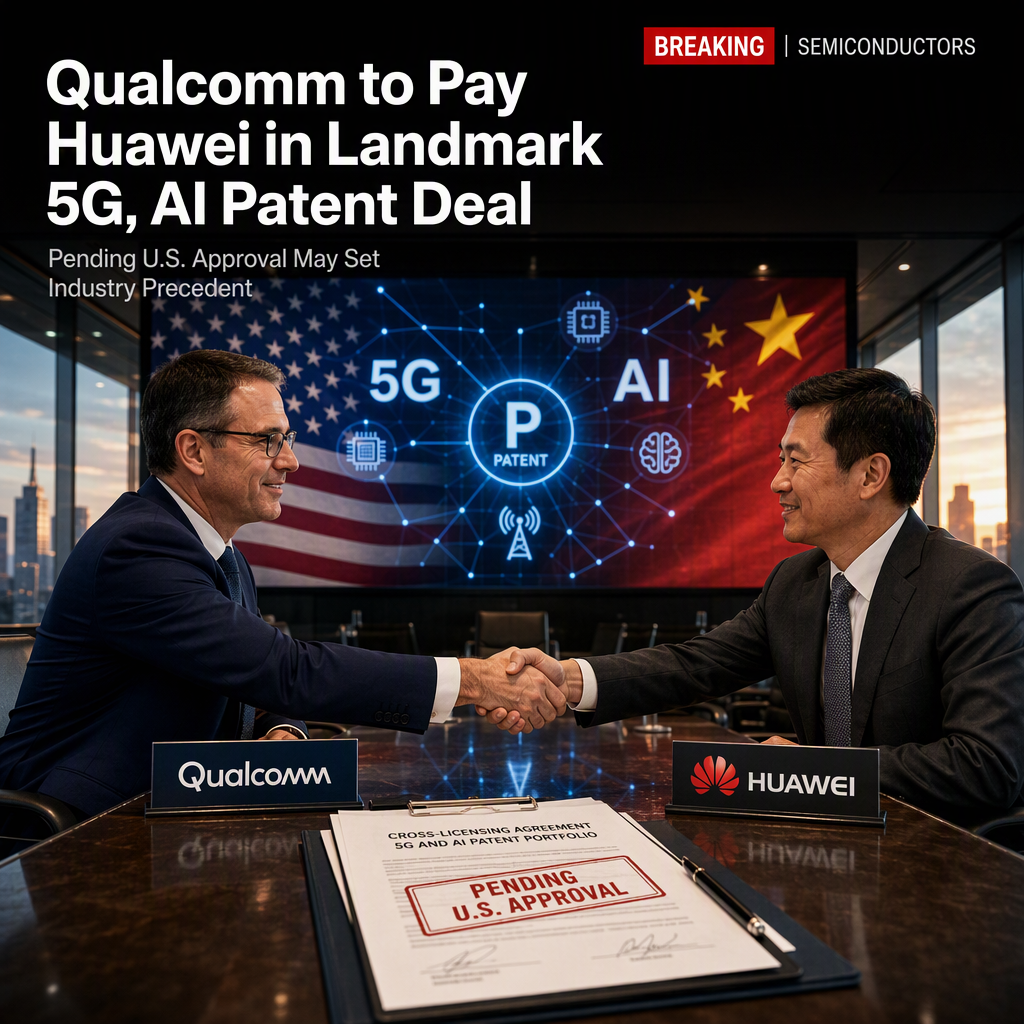
Huawei announced that Qualcomm will pay to use its patents for the first time under a new cross-licensing agreement covering 5G and artificial intelligence (AI) technologies, marking a significant breakthrough for Huawei's intellectual property portfolio and a shift in the companies' licensing relationship [1]. Previously, Huawei had paid to license Qualcomm patents since 2001, but this new arrangement, if approved, will make Qualcomm the net payer for the first time [1].
The agreement encompasses key technologies in both 5G wireless and AI, sectors characterized by rapid innovation and intense competition. While the financial terms were not disclosed, industry analysts cited in the article estimate the deal could be worth hundreds of millions of dollars annually, reflecting the scale of both companies' patent portfolios and their global market reach [1].
The deal is subject to approval by U.S. regulators due to ongoing restrictions and heightened scrutiny of technology transfers involving Chinese companies. Market observers are closely monitoring the regulatory response, as the outcome could set a precedent for future cross-border technology licensing in the semiconductor industry [1]. A Huawei spokesperson described the agreement as a 'significant milestone' for the company's IP business, highlighting Huawei's growing strength in core technologies and commitment to fair competition [1].
Analysts view Qualcomm's decision to pay for Huawei patents as recognition of Huawei's advancements in 5G and AI, areas traditionally dominated by U.S. firms. The cross-licensing deal could also help Qualcomm secure access to essential patents for next-generation mobile chips, as global smartphone makers demand more advanced features [1]. Technical analysis suggests that both companies' stock prices may experience increased volatility in the coming weeks, with Qualcomm's support levels noted around $110 and resistance near $135, depending on regulatory outcomes [1]. Although Huawei is not publicly traded, related semiconductor stocks in Asia could benefit if the deal is approved [1]. Market sentiment is cautiously optimistic, but some traders warn of downside risk if U.S. authorities block the agreement, which could impact broader trading strategies in the semiconductor sector [1].
CONCLUSION
The Qualcomm-Huawei cross-licensing agreement represents a pivotal moment in global technology and intellectual property dynamics, with significant implications for the semiconductor industry. While market sentiment is cautiously optimistic, the deal's ultimate impact hinges on U.S. regulatory approval, which could influence both company valuations and broader cross-border technology licensing trends.