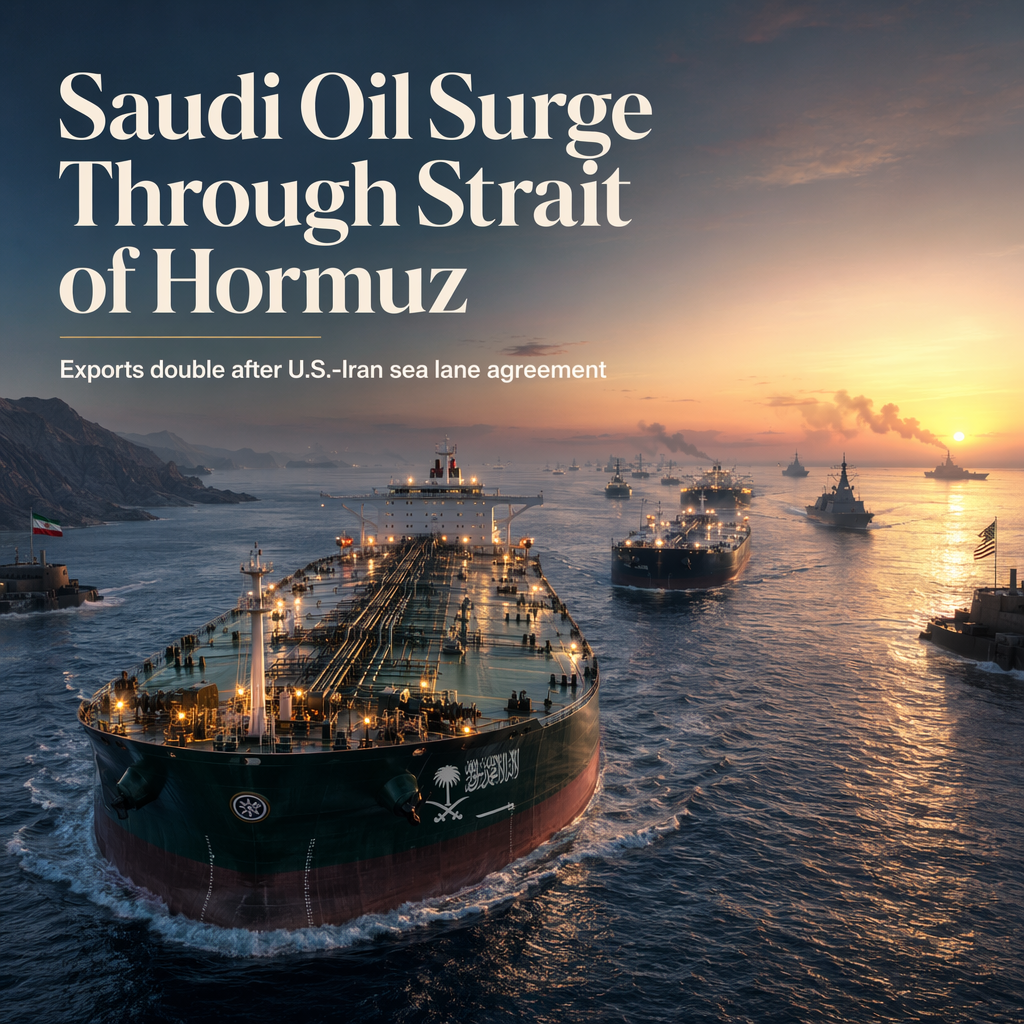
Saudi Arabia has significantly increased its oil shipments through the Strait of Hormuz following the agreement between the U.S. and Iran to reopen the vital sea lane last month [1]. According to trade intelligence firm Kpler, the kingdom shipped about 34 million barrels of oil through Hormuz since June 17, the day the U.S. and Iran signed the agreement to end the war [1]. This figure is more than double the 15 million barrels Saudi Arabia shipped through the strait from March 9 through June 17, highlighting a substantial revival in Saudi crude flows inside the Gulf after months of conflict-driven rerouting [1].
Kpler data further reveals that approximately 24 million barrels of Saudi oil shipped since June 17 was loaded during or before the U.S.-Iran war, indicating that Riyadh is actively clearing a backlog of oil tankers that were unable to exit the Gulf during the conflict [1]. However, about 17 million barrels of Saudi oil loaded before the war remain in the Gulf, suggesting that the process of clearing the backlog is ongoing [1].
During the conflict, Saudi Arabia had largely paused shipments from its Gulf export terminals of Ras Tanura and Juaymah on March 9, redirecting a substantial portion of its oil exports through an East-West pipeline to the Red Sea terminal of Yanbu due to sharply reduced tanker traffic through Hormuz following Iranian attacks [1]. Now, the Saudis are restarting their export logistics in the Gulf, not only clearing the pre-war oil backlog but also resuming regular shipments [1]. Between June 23 and July 1, eleven supertankers bound for Saudi Arabia entered the Gulf, with eight loading oil at Saudi terminals and five already exiting Hormuz [1].
Despite a recent outburst of hostilities between the U.S. and Iran, including Tehran's attacks on two commercial ships and subsequent U.S. strikes on Iran, ships continue to transit Hormuz [1]. Tanker traffic fell to eight ships on Sunday but rose to 16 on Wednesday, according to Kpler data [1]. On Wednesday, about 8.5 million barrels of crude passed through Hormuz, compared to nearly 15 million barrels per day in 2025, as reported by the U.S. Energy Information Administration [1].
CONCLUSION
Saudi Arabia's rapid increase in oil shipments through the Strait of Hormuz marks a significant normalization of Gulf export logistics following the U.S.-Iran sea lane agreement. While the kingdom is actively clearing a backlog of oil, ongoing regional tensions continue to impact tanker traffic. The resumption of shipments is likely to have a notable effect on global oil supply dynamics.