
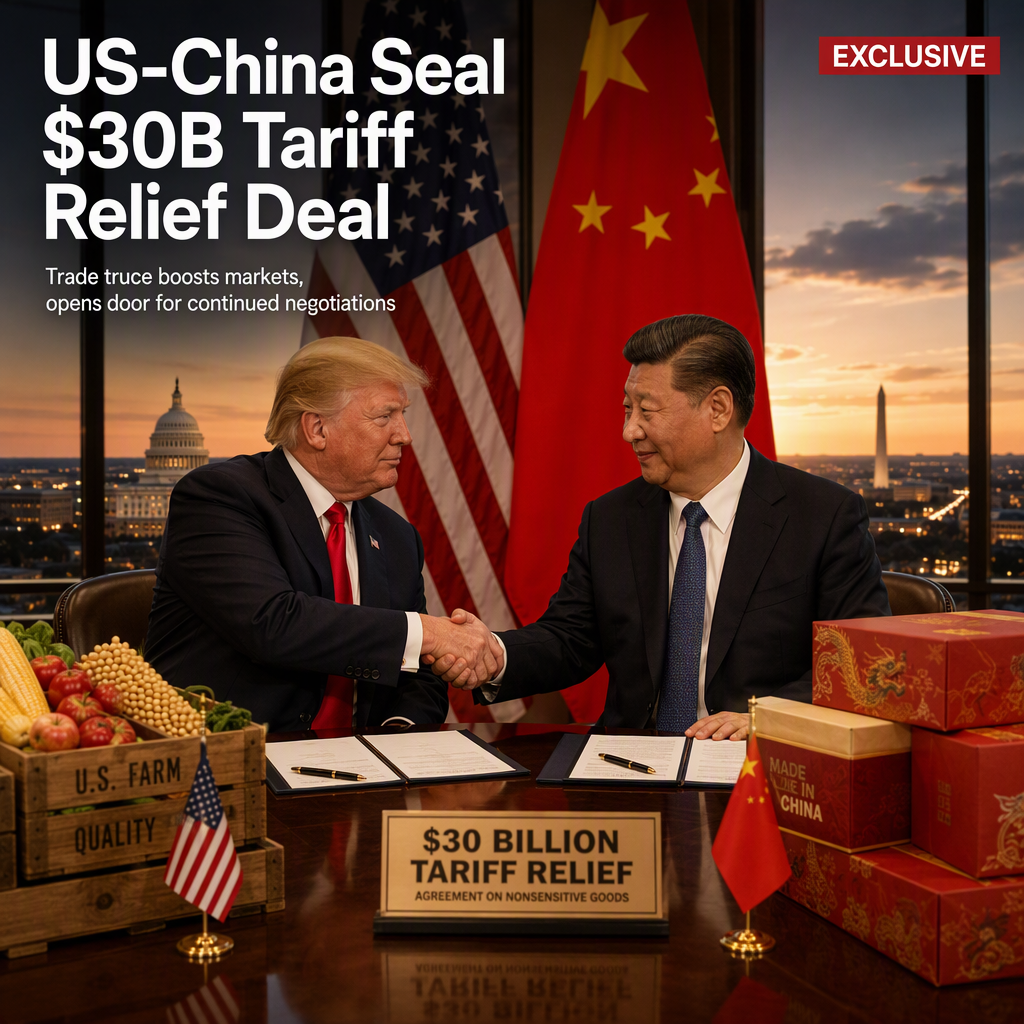
The United States and China have agreed to recommendations for 'more favorable tariff treatment' covering $30 billion worth of nonsensitive products traded in each direction, according to a White House statement released shortly after President Donald Trump and President Xi Jinping concluded a summit in Washington on September 24, 2026 [1]. The relief measures include American farm goods and made-in-China Christmas items, with Beijing also committing to purchase U.S. coal as part of the package [1].
The White House described the meeting as advancing 'a fair and reciprocal' relationship, focusing on trade normalization and improved market access for both countries [1]. While the specific goods classified as 'nonsensitive' and the timeline for implementation have not been fully disclosed, the recommendations are intended to serve as a framework for ongoing negotiations to reduce tariffs, particularly on products unlikely to affect national security or core industries [1].
Market analysts highlighted that the $30 billion figure represents a significant portion of bilateral trade in consumer goods and agricultural products, which could boost trade flows in the coming quarters [1]. Following the announcement, market sentiment turned positive, with shares of major U.S. agricultural exporters rising in after-hours trading. Chinese importers of U.S. coal and agricultural products are also expected to benefit, potentially driving further gains in related sectors [1].
A senior U.S. trade official stated, 'This agreement marks an important step toward stabilizing U.S.-China economic relations,' noting that further negotiations are needed for sensitive sectors [1]. Analysts cautioned that the deal covers only a subset of goods and that additional talks will be required to resolve disputes over technology, intellectual property, and strategic industries [1]. The White House emphasized that the recommendations are subject to review and adjustment based on future economic and security considerations, with both sides pledging to maintain regular consultations for effective implementation [1].
CONCLUSION
The US-China agreement on tariff relief for $30 billion of nonsensitive goods is seen as a significant step toward easing trade tensions and stabilizing economic relations. While immediate market reactions were positive, especially among agricultural exporters, the deal is limited in scope and further negotiations are expected. The framework sets the stage for ongoing dialogue and potential future tariff reductions.