
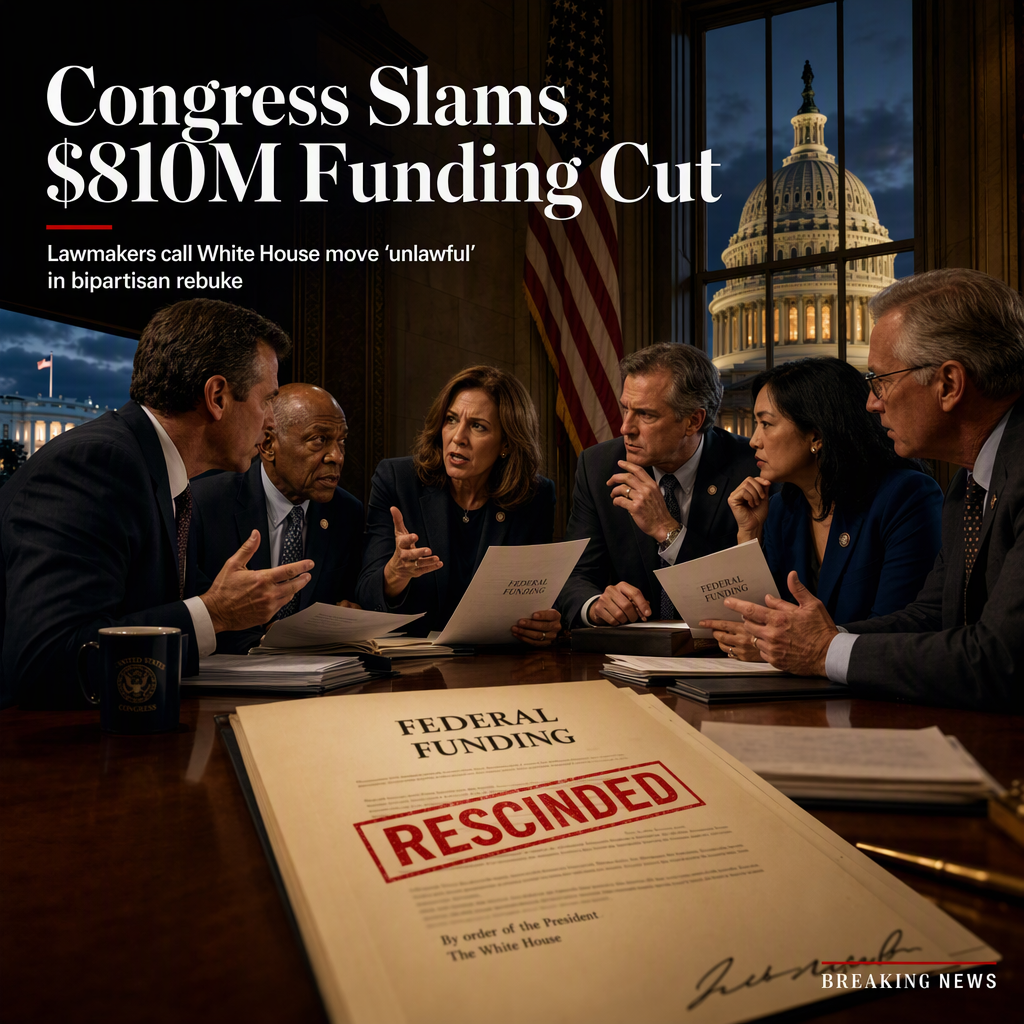
On Friday, the White House announced its intention to cut $810 million in bipartisan, congressionally approved federal funding, a move that has drawn sharp criticism from lawmakers across party lines [1]. The executive branch plans to return the funds to Congress using 'pocket rescissions,' a rare budgetary maneuver previously employed by the Trump administration to negate allocated spending [1]. The affected funds target several programs and agencies serving immigrants, minority groups, and Department of Health and Human Services research initiatives [1].
The administration justified the timing by arguing that the law allows Congress a 45-day window to respond to such actions, but this period cannot be observed if the rescission occurs less than 45 days before the fiscal year ends, which is September 30—just days away [1]. This rationale has been challenged in court and criticized by both Republican and Democratic lawmakers, who argue it undermines congressional authority over appropriations [1].
Senate Appropriations Committee Chair Susan Collins (R-Maine) labeled the move 'unlawful' and pledged to work with colleagues to address what she described as 'illegal actions' by the Office of Management and Budget (OMB) [1]. Collins asserted that the OMB intentionally withheld the funds for months to execute the cancellation and accused the executive branch of usurping Congress's appropriations powers [1]. Senate Appropriations Committee Vice Chair Patty Murray (D-Wash.) called the action a 'theft from the American people' and urged bipartisan opposition to the administration's tactic [1]. Senate Minority Leader Chuck Schumer (D-N.Y.) also condemned the rescissions package, stating it illegally strips nearly $1 billion in critical funding [1].
The White House, in its statement, described the rescinded funding as 'the most harmful government spending' and reiterated President Trump's commitment to cutting what it considers wasteful expenditures [1]. The House is not scheduled to return until after the midterm elections in November, limiting immediate legislative recourse [1].
CONCLUSION
The Trump administration's decision to cut $810 million in federal funds has sparked bipartisan backlash, with lawmakers denouncing the move as unlawful and a violation of congressional authority. The controversy centers on the use of pocket rescissions and the timing of the action, just days before the fiscal year ends. The market impact is medium, as the funding affects multiple programs and has prompted significant political opposition.