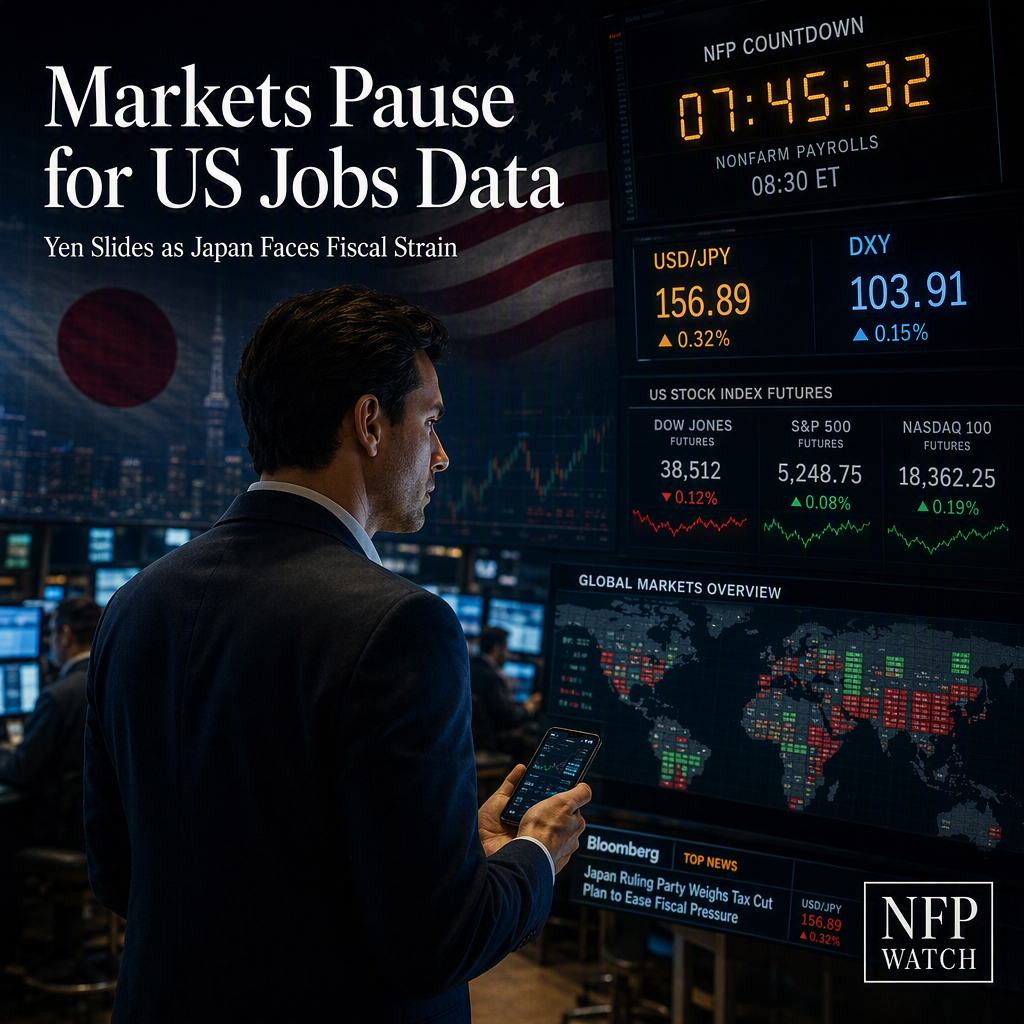
The core event across all sources is the anticipation of the US Nonfarm Payrolls (NFP) report for July, which is expected to significantly influence Federal Reserve monetary policy decisions in the absence of explicit forward guidance from the central bank [1][3][5]. The Japanese Yen (JPY) is trading broadly flat against the US Dollar (USD) at around 158.42 during the European session, with the USD/JPY pair consolidating as investors await the NFP data [1]. The US Dollar Index (DXY) is also trading flat near 100.00, reflecting cautious sentiment ahead of the labor market release [1][3]. Deutsche Bank forecasts a modest payrolls gain (+65k headline vs. +57k previously) and expects the unemployment rate to remain unchanged at 4.2% [1]. Danske Bank projects Nonfarm Payrolls at +70k, with the unemployment rate steady at 4.2% and average hourly earnings rising by 0.3% month-on-month [3]. Commerzbank expects a stronger increase of 100,000 new jobs, above the Bloomberg consensus of +80,000, and notes that positive surprises could shift market expectations toward tighter Fed policy [5].
The Japanese Yen has underperformed this week, particularly against the US Dollar, with a weekly change of -0.81% versus USD and -0.58% versus EUR [1][3]. TD Securities suggests that the recent intervention-driven pullback in USD/JPY does not mark a fundamental shift, and sees scope for USD/JPY to drift to 153.00 in the absence of further US intervention [1]. Fiscal concerns in Japan are also weighing on the Yen, as the government approved a plan to slash the consumption tax on food items to 1% from 8% for two years and backed ¥600 billion a year in cash transfers to low- and middle-income households, adding to already strained finances [2]. Rabobank highlights criticism of the unfunded tax plan and notes that the sustainability of Japan’s policy mix may be judged in the currency market rather than the bond market [2].
Market reactions have been muted ahead of the NFP release, with US stock futures trading mixed: Dow Jones futures are down 0.04%, S&P 500 futures up 0.07%, and Nasdaq 100 futures up 0.29% [4]. Thursday’s US session saw broad declines, led by the Dow Jones (-0.85%), as a rebound in oil prices reignited inflation fears and concerns about a potential Fed rate hike next month. However, CME FedWatch Tool shows that the probability of a 25-basis-point hike in September has softened to 54.5%, down from 67.0% last week [4]. Sector rotation has favored defensives, with energy, consumer staples, and health care outperforming amid risk-off sentiment [4].
On the GBP/JPY front, the cross is consolidating around 213.00, with the British Pound pressured by persistent geopolitical uncertainties and the wide rate gap between Japan and the UK (BoE base rate at 3.75% vs. BoJ at 1.00%) supporting carry trades [2]. Japanese consumer spending fell 3.3% year-on-year in June, marking the seventh straight month of contraction and weakening the case for another Bank of Japan rate hike in September [2].
Analyst opinions diverge on the outlook for the Dollar and Fed policy. Commerzbank has revised its EUR/USD forecast down by two cents, citing increased risk of a Fed rate hike, even though it does not expect the Fed to ultimately take this step [5]. Danske Bank and MUFG/BTMU note that the Fed remains focused on unemployment and wage trends, with policymakers expecting labor demand to cool to a sustainable pace [3].
CONCLUSION
Markets are in a holding pattern ahead of the US Nonfarm Payrolls report, with the US Dollar and Japanese Yen trading flat and US stock futures mixed. Fiscal concerns and weak domestic demand continue to undermine the Yen, while the risk of a Fed rate hike has increased, prompting analysts to revise forecasts for major currency pairs. The outcome of the NFP report will be pivotal for future monetary policy and could trigger significant market moves depending on the data.