
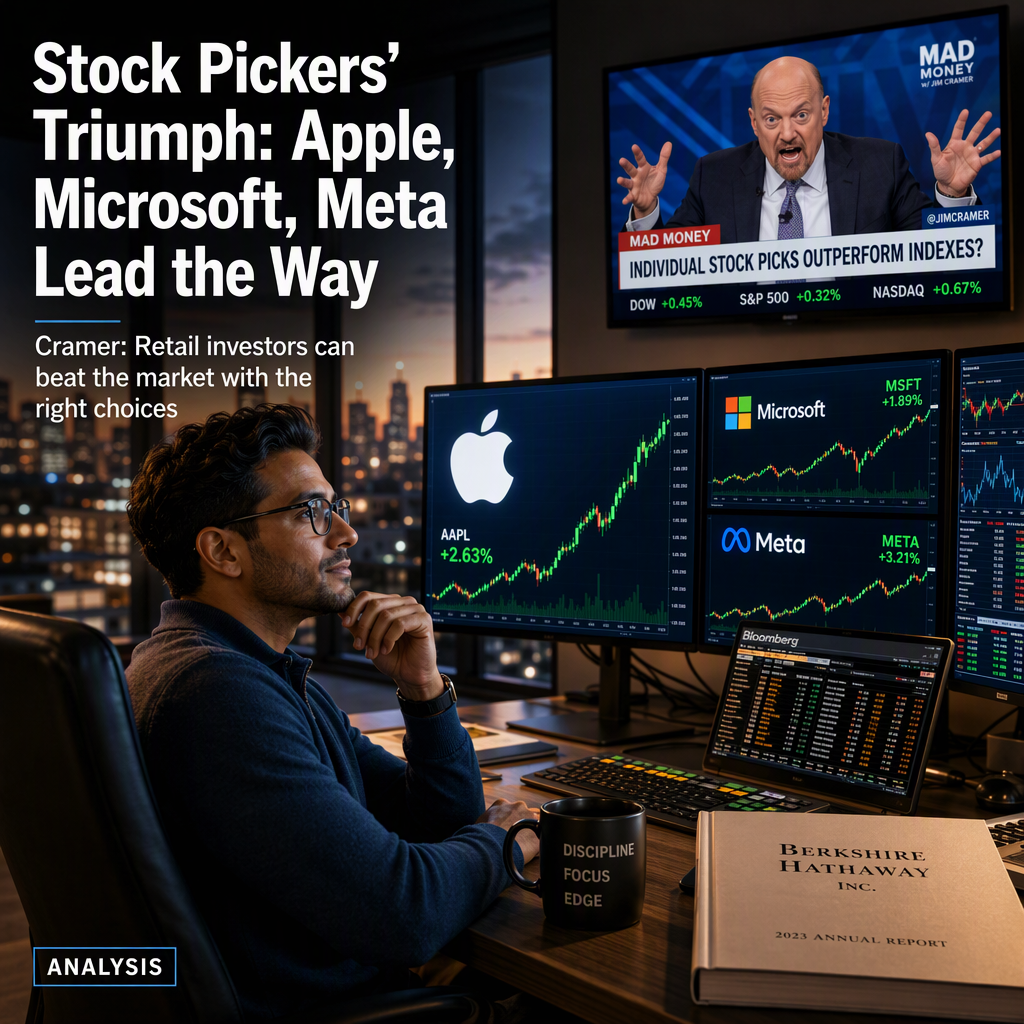
Jim Cramer argues that individual stock picking remains a viable strategy for retail investors, citing the strong performance of Apple, Microsoft, and Meta as evidence that individuals can outperform index investing under the right circumstances [1]. He notes that retail investors now account for up to 20% of all trading volume, a significant increase from 10% in previous decades [1]. Cramer challenges the notion that only professionals or index fund buyers are 'informed investors,' and defends the practice of owning a concentrated portfolio of high-quality stocks [1].
Cramer references Warren Buffett's investment approach at Berkshire Hathaway, highlighting that an individual who invested in Berkshire Hathaway stock would have outperformed an S&P 500 fund, despite some of Buffett's holdings being in a 'tax rut' due to large unrealized capital gains in companies like Coca-Cola and American Express [1]. He points out that Apple has been a key driver of Berkshire's outperformance in the last decade, describing it as a 'concentrated Berkshire position' and reiterating his long-standing advice to 'own it, don't trade it' [1].
The article also touches on recent leadership changes at Berkshire Hathaway, with Howard Buffett becoming chairman earlier in the month and Greg Abel taking over as CEO in January [1]. Cramer contrasts the performance of Coca-Cola and American Express with other consumer stocks like PepsiCo and McDonald's, noting that the latter have faced significant challenges, with PepsiCo potentially experiencing the 'collapse of the year' [1].
While Cramer acknowledges concerns about the impact of health trends and GLP-1 drugs on food and beverage companies, he maintains that individual stock selection—especially in technology leaders like Apple, Microsoft, and Meta—can yield superior results for retail investors [1].
CONCLUSION
Jim Cramer asserts that individual investors can achieve strong returns by carefully selecting leading stocks such as Apple, Microsoft, and Meta. He uses Berkshire Hathaway's concentrated Apple position as a case study for successful stock picking, challenging the idea that only index investing is prudent. The article suggests that, despite market skepticism, retail investors can outperform with the right choices.