
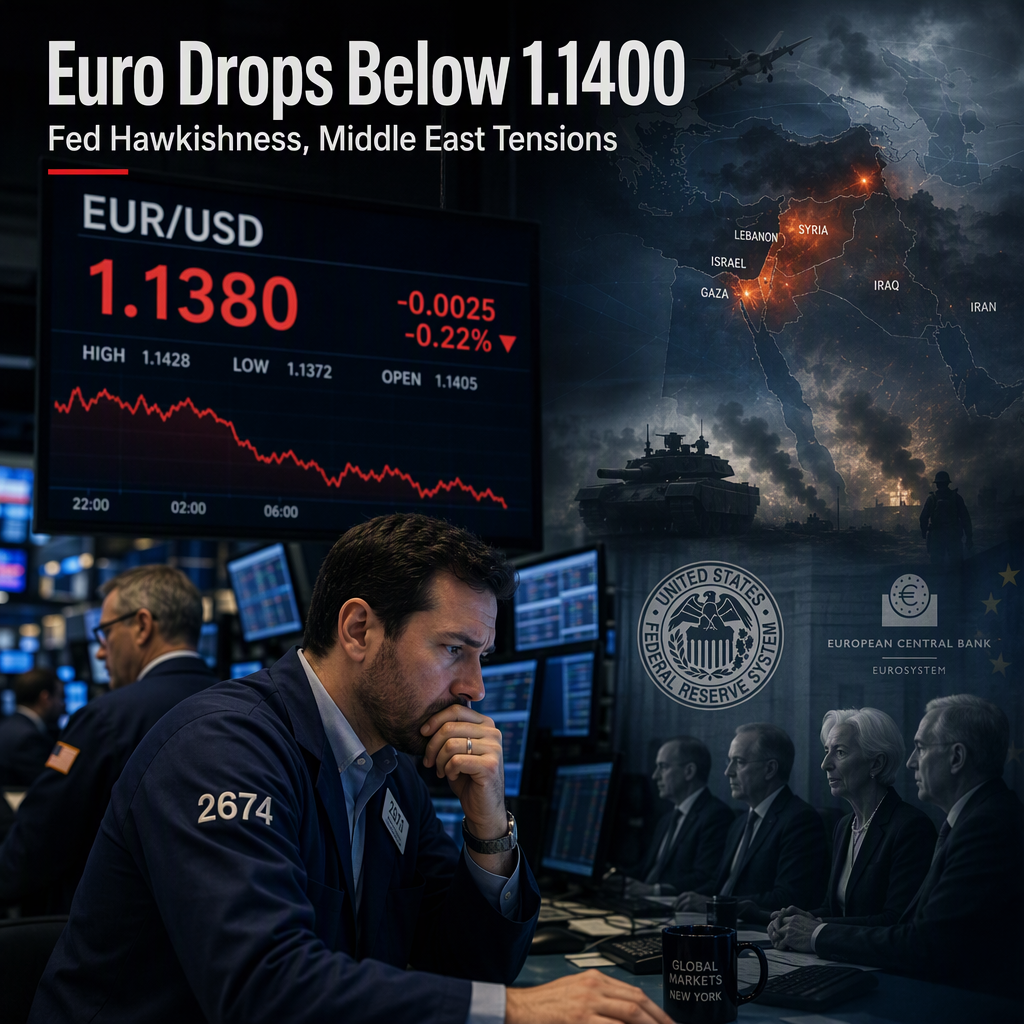
The EUR/USD pair declined to around 1.1380 during the early Asian session on Monday, pressured by hawkish signals from the Federal Reserve and escalating tensions in the Middle East [1]. Multiple Fed officials made hawkish remarks last week, with Cleveland Fed President Beth Hammack expressing concern that persistently high inflation could condition the American public to accept elevated prices, emphasizing that the central bank cannot allow this to happen. Philadelphia Fed President Anna Paulson stated that 'some modest further tightening may be warranted' [1]. As a result, market expectations for a Fed rate hike in October have increased, with the CME FedWatch tool showing a 65.9% probability, up from 57.6% a week earlier and 9.4% a month earlier [1].
Rising tensions in the Middle East are also contributing to safe-haven flows, supporting the US dollar. US President Donald Trump commented on Sunday that he believes the war with Iran will be won 'very soon' and suggested that additional military strikes before the midterm elections are possible. Iran, meanwhile, maintains that it will only reopen a crucial waterway if its conditions are met, with a senior Iranian military leader emphasizing the country's readiness to continue fighting [1].
On the European side, the European Central Bank (ECB) raised its key deposit rate by 25 basis points to 2.50% at its September policy meeting. Markets are currently pricing in roughly a 45% chance of another 25 basis point rate hike in October, with a further hike fully priced only by December at the earliest, according to Reuters [1]. This leaves room for incoming data, such as Germany's upcoming Retail Sales and Consumer Price Index (CPI) inflation reports, to influence expectations [1].
Strategists at UOB Group note that the euro's recent decline has exceeded their earlier expectations. While acknowledging that the euro could weaken further, they argue that deeply oversold conditions suggest the scope for additional downside may be limited. UOB highlights two strong support levels at 1.1355 and 1.1325, and notes that a breach of 1.1430 would indicate that euro weakness is stabilizing [1].
CONCLUSION
The euro's decline below 1.1400 is driven by a combination of hawkish Fed rhetoric and geopolitical tensions, with markets increasingly expecting further US rate hikes. While further downside is possible, analysts see limited scope for additional euro weakness unless key support levels are breached. Upcoming economic data and central bank decisions remain critical for future direction.