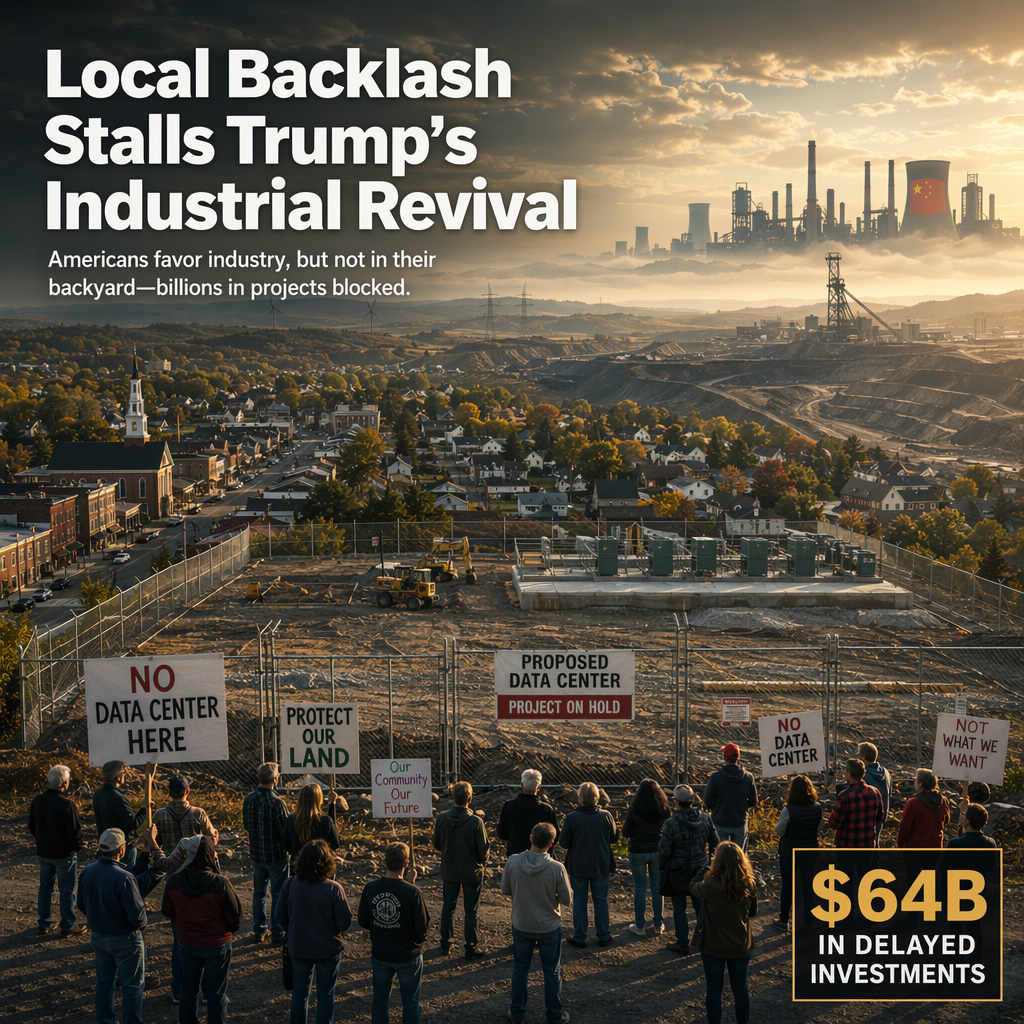
President Donald Trump's reindustrialization agenda, which aims to revive American industry, faces significant resistance from local communities across the United States [1]. While Americans express support for bringing back industry, there is widespread opposition to the physical infrastructure required, such as data centers, mines, and energy projects [1]. A Gallup poll cited in the article found that 71% of Americans oppose data centers being built in their communities, a level of opposition now exceeding that for nuclear power plants [1]. This local activism has already blocked or delayed $64 billion in data center projects between May 2024 and March 2025 [1].
The article highlights that this 'Not In My Backyard' (NIMBY) sentiment extends beyond data centers to critical minerals mining and energy projects. For example, the Resolution Copper Mine in Arizona, which sits on one of the largest copper deposits in the world, spent over two decades in litigation before a land exchange was completed in March 2026, with opponents vowing to continue their fight [1]. Permitting timelines for critical minerals mining in the U.S. are reported to be 7 to 10 years [1]. Additionally, Columbia University researchers found a 111% increase in state bans on renewable energy projects in the last year alone [1].
The article contrasts the U.S. situation with China, noting that China is rapidly building industrial infrastructure without lengthy permitting processes or environmental reviews [1]. China controls 70% of critical minerals refining for 19 of 20 strategic minerals, and the International Energy Agency projects that China's share of global polysilicon, ingot, and wafer production will soon reach almost 95% [1].
The market implications of these trends include potential delays in the development of AI, clean energy, and advanced manufacturing in the U.S., as well as increased reliance on foreign—particularly Chinese—supply chains for critical materials and technology infrastructure [1]. The article suggests that unless political leaders can overcome local opposition, the U.S. risks falling further behind in global industrial competitiveness [1].
CONCLUSION
Local opposition to industrial projects is creating significant hurdles for Trump's reindustrialization agenda, with billions in investments already delayed or blocked. Unless these challenges are addressed, the U.S. may face continued dependence on foreign supply chains and struggle to compete in critical sectors like AI and clean energy.