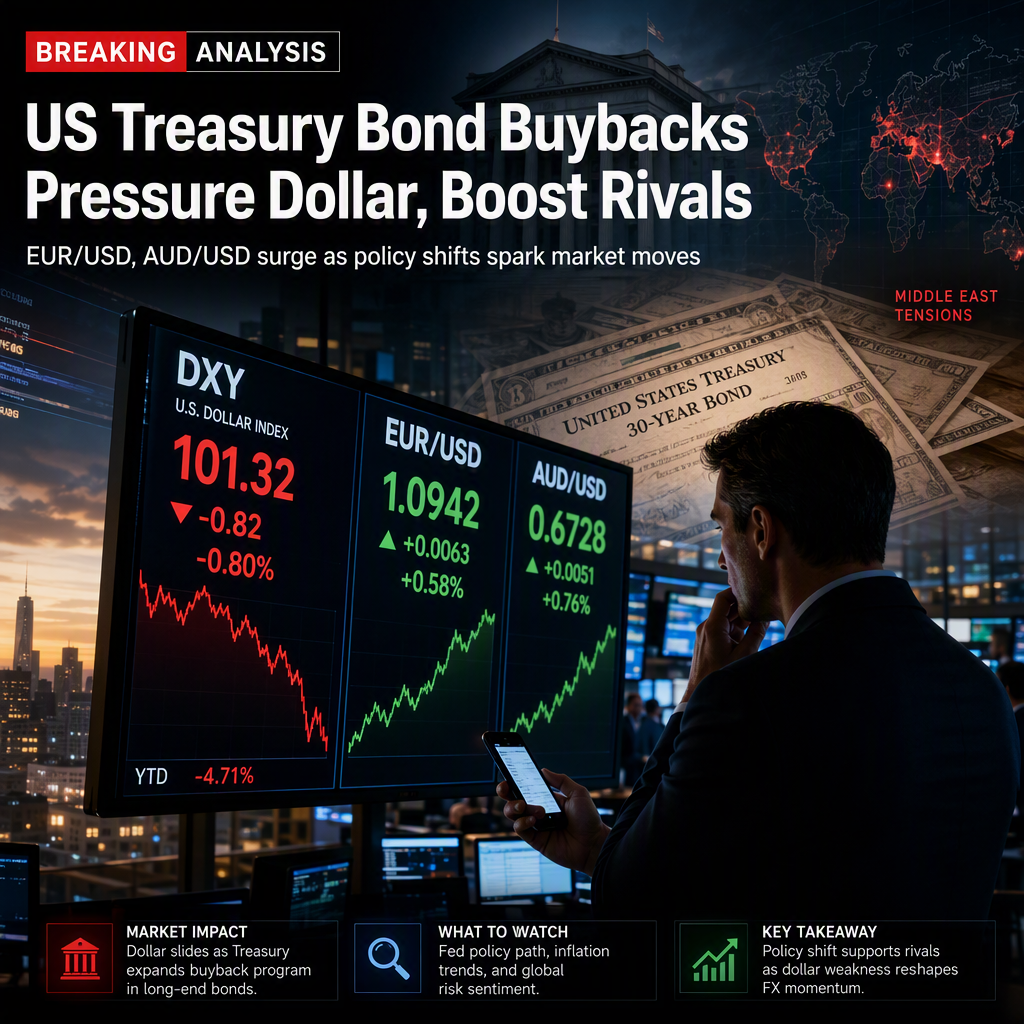
The US Treasury Department surprised financial markets by pledging to at least double its buybacks of longer-dated government debt, with Treasury Secretary Scott Bessent stating that buybacks could expand beyond $4 billion. This move is intended to signal that elevated US bond yields do not accurately reflect underlying economic fundamentals [1][2]. The announcement has put pressure on the US Dollar, which has weakened against both the Euro and the Australian Dollar in recent trading sessions [1][2].
EUR/USD has remained stronger for the fourth consecutive trading day, hovering around 1.1680 during the Asian hours on Monday. The Euro is drawing support from persistent inflation above the European Central Bank's (ECB) 2% target and expectations of further monetary tightening after June’s interest rate hike. Eurozone consumer inflation expectations for the next year ticked down slightly to 2.9% from 3% in June. Analysts at Rabobank expect the ECB to begin discussions on a new structural LTRO framework as excess liquidity wanes, possibly launching operations with a 12-month maturity and a more market-driven approach [1].
Similarly, the AUD/USD pair posted mild gains, trading around 0.7175 during the early Asian session on Monday. Market strategist Marc Chandler noted that while Bessent’s efforts have not significantly affected US yields, they have undermined the dollar, with the market pushing back against the Treasury's actions [2]. However, the Australian Dollar’s advance is tempered by a negative surprise in the latest labour market report, which showed 15.8k job losses in July versus expectations for a 12k job increase. This has shifted market focus to upcoming Australian data, particularly the July CPI release and its implications for Reserve Bank of Australia (RBA) policy [2].
Both articles highlight that escalating geopolitical tensions in the Middle East, particularly threats from Iranian officials in response to potential US actions, are supporting safe-haven demand for the US Dollar and could limit further downside for the currency. Iranian Foreign Minister Abbas Araghchi dismissed new US sanctions as desperate, while Security Chief Mohsen Rezaei warned of 'earthquake-like' retaliation if further action is taken by the US [1][2].
Technical analysis for AUD/USD indicates a bullish near-term bias, with the pair pressing against the upper Bollinger band and the Relative Strength Index suggesting overbought conditions that could slow further upside. Key support and resistance levels are identified at 0.7072 and 0.7175, respectively [2].
CONCLUSION
The US Treasury's expanded bond buyback plan has weakened the US Dollar against both the Euro and Australian Dollar, though safe-haven flows amid Middle East tensions are providing some support for the Greenback. Market participants are closely watching upcoming economic data and central bank policy signals in both Europe and Australia for further direction.