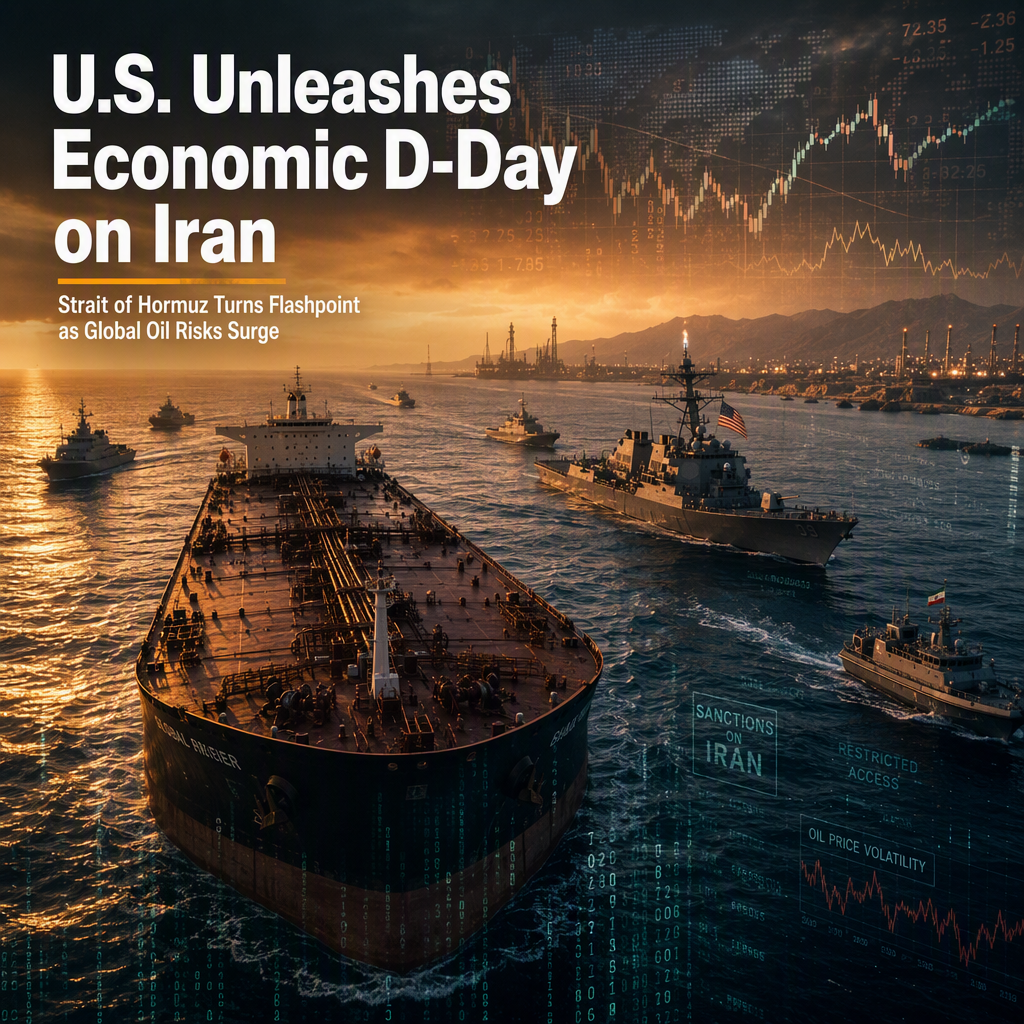
On August 24, 2026, the United States announced it will unveil 'the single greatest financial offensive ever' against Iran, intensifying an already extensive sanctions regime targeting Iran's oil, shipping, banking, energy, aviation, and cryptocurrency sectors [1]. U.S. Treasury Secretary Scott Bessent described the upcoming measures as an 'economic D-Day,' positioning them as the 'endgame' in Washington's campaign against Tehran [1]. The escalation follows the failure of both sides to reach a deal within a 60-day ceasefire window, effectively closing off the formal truce mechanism intended to end the ongoing Middle East war, now in its sixth month [1].
The U.S. has warned that any nation serving as a 'financial artery' for Iran should expect to share in its isolation, signaling potential secondary sanctions on countries and entities conducting business with Tehran [1]. Iran has responded by threatening to seize vessels violating transit rules in the Strait of Hormuz, a critical chokepoint through which roughly a fifth of the world's seaborne oil passed before the war [1]. Mohsen Rezaei, Iran's new secretary of the Supreme National Security Council, stated that any country partnering with the U.S. to impose economic restrictions would be regarded as an enemy and targeted accordingly [1].
Iran's state-controlled Persian Gulf Strait Authority (PGSA) issued warnings on social media that vessels violating transit rules could face penalties such as fines, seizure, or confiscation during future passages [1]. Iranian Foreign Minister Abbas Araghchi dismissed the threat of new U.S. sanctions as a 'desperate' ploy, asserting that such actions were destined to fail [1]. Additionally, Tehran's parliament approved a provision requiring ships passing through the Hormuz chokepoint to pay for services provided by Tehran, though the legislation still awaits full parliamentary approval [1].
Market reactions were noted, with crude prices pulling back in anticipation of the developments, reflecting heightened uncertainty and risk in global energy markets [1].
CONCLUSION
The U.S. is set to impose its most severe financial measures yet against Iran, escalating tensions in the Strait of Hormuz and raising the risk of disruptions to global oil flows. Iran has threatened retaliatory actions against vessels and neighboring countries, while crude prices have already responded to the uncertainty. The situation signals significant market volatility and geopolitical risk for energy and shipping sectors.