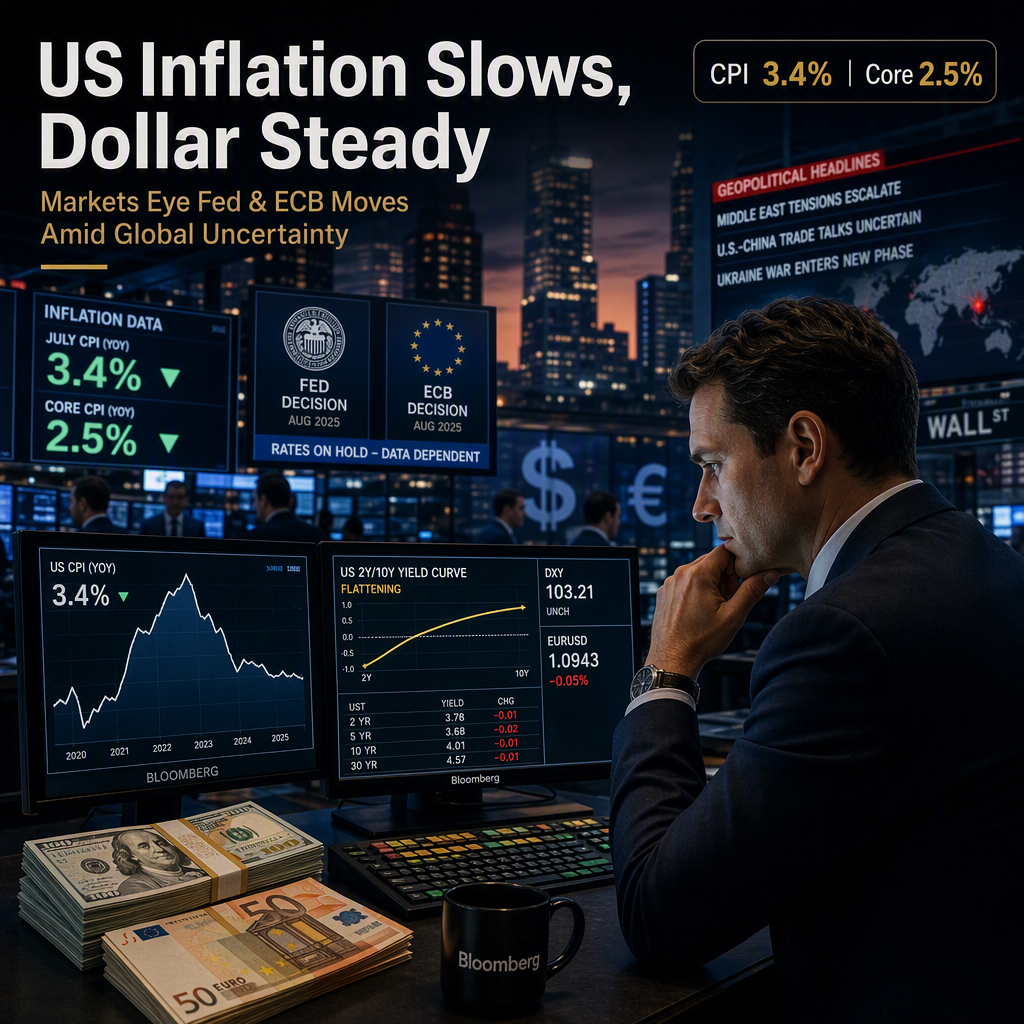
US inflation, as measured by the Consumer Price Index (CPI), slowed to 3.4% year-on-year in July from 3.5% in June, with monthly prices rising by 0.1% after a 0.4% decline in June. The core CPI, which excludes food and energy, increased by 0.2% month-on-month and 2.5% year-on-year, with all figures matching market expectations according to the Bureau of Labor Statistics [1]. ING’s Chris Turner noted that consensus was looking for subdued headline and core readings, with the year-on-year rates dropping to 3.4% and 2.5% respectively, moving closer to the Federal Reserve’s 2% inflation target [2].
The immediate market reaction was muted. EUR/USD traded around 1.1550, up a modest 0.08% on the day, experiencing a brief spike in volatility before returning to pre-release levels [1]. The US Dollar Index (DXY) edged slightly lower following the data, but remained within the 99.40–100.00 range, as markets saw no significant surprise in the inflation figures [1][2]. ING suggested that a soft CPI print could reduce the probability of a September Fed rate hike from 50% to favoring no change, potentially steepening the US yield curve and weakening the dollar, especially against procyclical currencies [2].
On the European side, Germany’s Harmonized Index of Consumer Prices (HICP) confirmed a 2.8% year-on-year increase in July, up from 2.4% in June, mainly driven by a 7.3% rise in energy prices. Excluding food and energy, inflation accelerated to 2.6% from 2.5% [1]. These figures reinforce expectations of potential monetary policy tightening by the European Central Bank (ECB) in September, though the positive impact on the euro was limited due to ongoing geopolitical concerns in the Middle East [1].
Geopolitical tensions also weighed on market sentiment. Reports of attacks on vessels in the Straits of Hormuz and Bab el-Mandeb, and statements from a senior Iranian source indicating no current discussions on extending the ceasefire between the US and Iran, contributed to a risk-averse environment. US President Donald Trump’s call for Tehran to pay reparations to victims of attacks linked to the Islamic Republic further reduced hopes for a swift reopening of the Strait of Hormuz [1].
Additionally, ING highlighted emerging talk that President Trump could be considering a cut in the Capital Gains Tax ahead of the midterms in early November, which could be mildly negative for the dollar from a pro-risk perspective, though the impact would depend on market reactions to potential unfunded tax cuts and the Fed’s response [2].
CONCLUSION
US inflation data for July met expectations, resulting in a subdued market reaction and little change in the dollar or EUR/USD. While softer inflation supports the case for the Fed to hold rates steady in September, ongoing geopolitical risks and potential fiscal policy changes continue to cloud the outlook. Investors remain cautious, with attention turning to upcoming central bank decisions and further developments in global risk factors.