
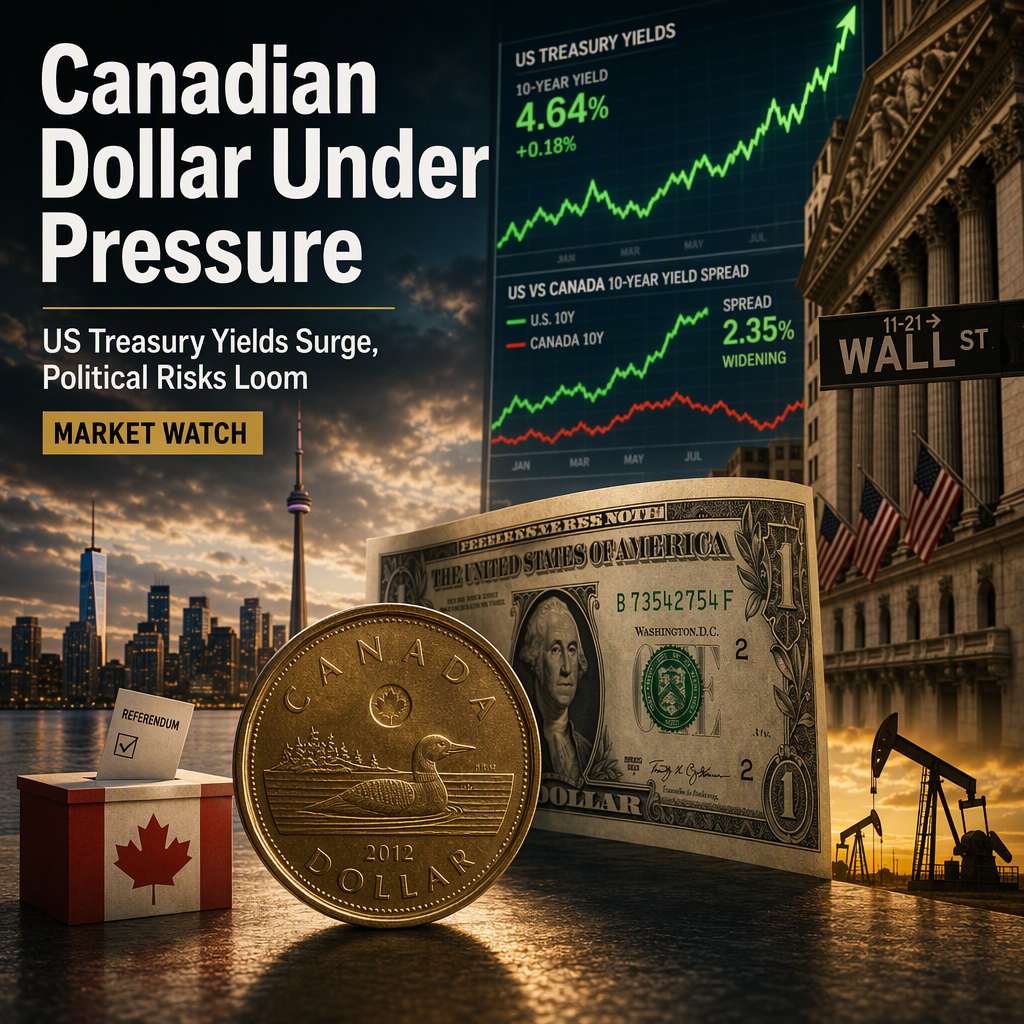
The Canadian Dollar (CAD) has come under pressure against the US Dollar (USD), with USD/CAD trading around 1.4257, near an 18-month high, after rebounding sharply by nearly 0.45% on Wednesday [2]. This move comes as the US Dollar remains firmly bid, supported by surging US Treasury yields, with the benchmark 10-year yield rising to approximately 5.330%, close to Monday’s peak of 5.349%, the highest since 2002 [2]. In contrast, Canada’s 10-year bond yield stands near 3.979%, resulting in a yield gap of roughly 135 basis points, which has increased the relative attractiveness of US Dollar-denominated assets and contributed to the CAD’s decline [2].
Despite the CAD’s recent weakness, it has outperformed most G10 peers and retained much of Tuesday’s 0.4% gain, buoyed by a stronger-than-expected August trade balance [1]. However, domestic political risk remains elevated ahead of Alberta’s October 19 referendum, leaving the CAD vulnerable to sentiment swings [1]. Scotiabank strategists estimate the fair value for USD/CAD at 1.4169, with technical resistance seen in the 1.4250/1.4280 range and support at 1.4100 and 1.40 [1].
Market attention is now focused on the upcoming Federal Reserve (Fed) September meeting minutes, with traders seeking guidance on the likelihood of further tightening after the US central bank’s 25-basis-point rate hike in September [2]. Recent softer US employment and PCE inflation data have reduced expectations of another hike at the October 27-28 meeting [2]. OCBC Bank strategists note that the Fed has signaled a more patient, data-dependent approach, with markets still pricing in slightly more than three rate hikes over the next 12 months—a path OCBC views as aggressive given signs of labor market moderation [2]. OCBC also highlights that higher long-term Treasury yields have already tightened financial conditions, potentially reducing the need for further Fed rate hikes [2].
On the Canadian side, the Bank of Canada (BoC) kept its policy rate unchanged at 2.25% in September, though markets expect at least one more hike by year-end. However, uncertainty around economic growth and US trade policy may keep the BoC cautious [2]. Meanwhile, rising oil prices continue to support the commodity-linked Loonie, but this is being offset by the widening yield differential and ongoing political uncertainties [2][1].
CONCLUSION
The Canadian Dollar is facing significant headwinds from surging US Treasury yields and domestic political risks, despite support from a strong trade balance and rising oil prices. With the yield gap favoring the US Dollar and uncertainty ahead of key central bank meetings, market sentiment remains cautious. The outcome of the Alberta referendum and further Fed guidance will be closely watched for their impact on USD/CAD direction.