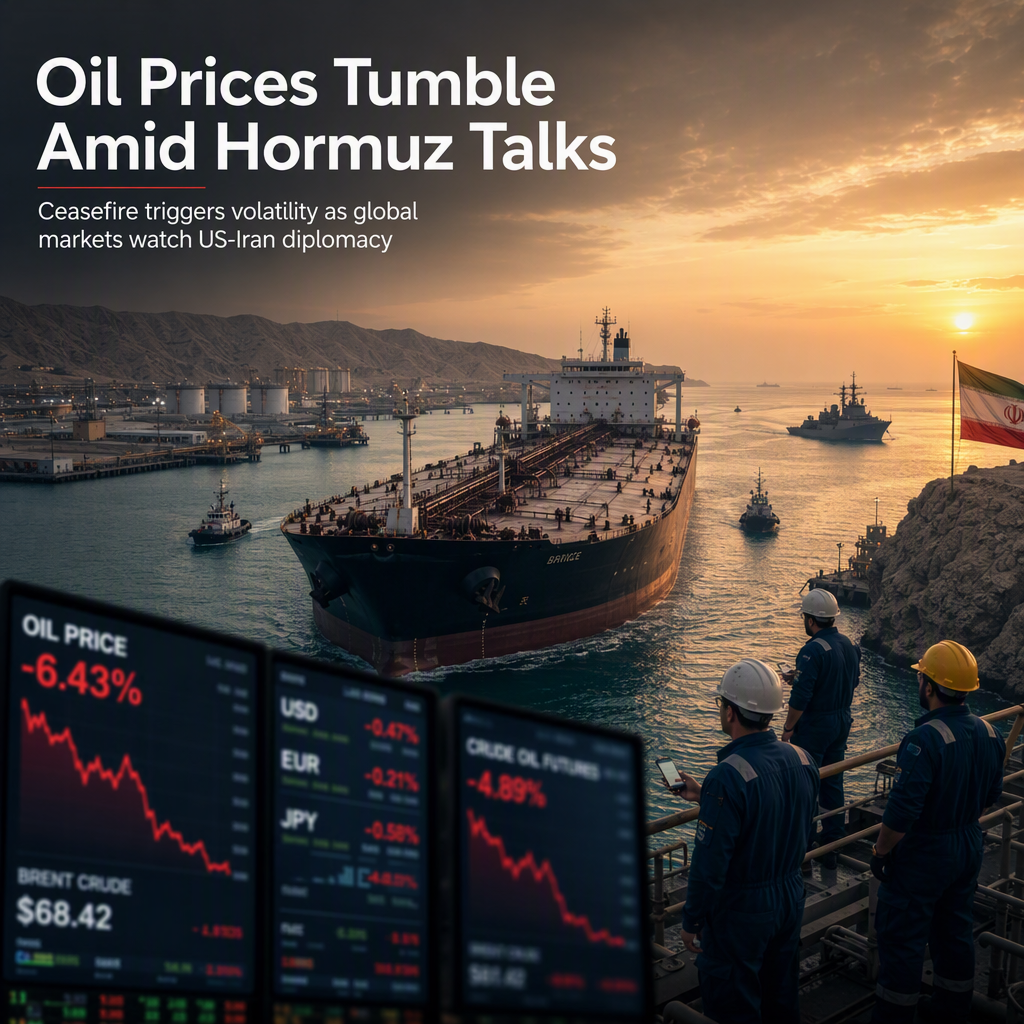
West Texas Intermediate (WTI) futures on NYMEX traded 7.4% lower at around $78.50 during the European trading session on Monday, maintaining opening losses following the announcement of a ceasefire 2.0 between the United States and Iran [1]. Over the weekend, US President Donald Trump stated via Truth Social that planned attacks on Iran have been suspended as Iran agreed to a nuclear deal and the reopening of the Strait of Hormuz, a passage crucial to nearly 20% of global energy supply [1]. However, Iran’s foreign ministry spokesperson Esmail Baghaei contradicted Trump’s remarks, asserting that Tehran is not in discussions with the US regarding the reopening of the Strait of Hormuz, but is instead talking to Oman about the chokepoint [1].
Rabobank's Senior Market Strategist Benjamin Picton highlighted that the halt in strikes on Iran has pushed Brent crude prices lower and supported risk assets, with risk currencies rallying and equity markets poised to extend gains posted late last week [2]. Picton cautioned that, typically, strikes resume later in the week, leading to oil price rallies, equity sell-offs, and rising bond yields, suggesting ongoing volatility driven by Hormuz dynamics [2].
Markets have absorbed large draws in global oil inventories without severe demand destruction, while higher prices have prompted a supply response: US oil rig counts have increased by almost 11% since the war broke out, refinery capacity utilization has risen, and OPEC+ has announced an additional 188,000 lift in production quota from September onwards [2]. Although the physical realities of conflict in Eastern Europe and the Middle East have rendered the OPEC+ increase mostly theoretical for now, it could contribute to a structural reshuffling of the energy market post-crisis [2]. Product markets, particularly Singapore gasoil spot prices, remain elevated, sitting more than two standard deviations above the long-run spread to Brent, indicating the seriousness of the current supply squeeze [2].
Financial markets are awaiting the outcome of peace talks between the US and Iran, expected to take place Monday afternoon, though details regarding the location and participants remain unspecified [1]. Trump described the deal as imminent, involving the Hormuz Strait and the denuclearization of Iran, but conflicting statements from Iran cast uncertainty on the negotiations [1].
CONCLUSION
Oil prices have declined amid the US-Iran ceasefire and diplomatic developments around the Strait of Hormuz, with markets responding positively in the short term. However, ongoing tensions and conflicting statements suggest continued volatility, and analysts warn that strikes and price rallies may resume later in the week. The structural supply squeeze remains a key concern, with elevated product prices and increased production quotas signaling persistent market risks.