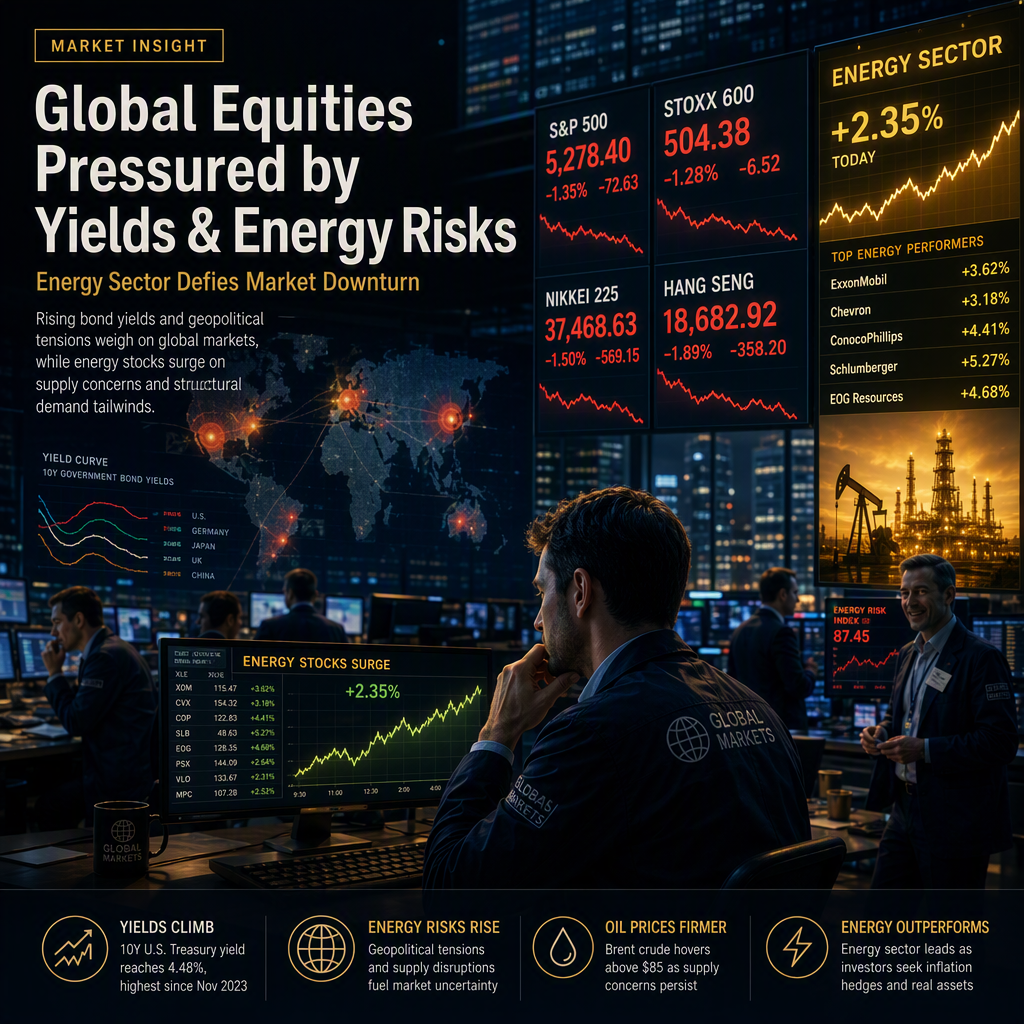
Global equity markets experienced pressure as higher yields and energy risks weighed on investor sentiment, according to Deutsche Bank strategists [1]. The S&P 500 declined by 0.18%, influenced by geopolitical developments and the release of details regarding the Oman-Iran deal [1]. Within the S&P 500, the energy sector was the only clear outperformer, rising 1.59%, while industrials and materials lagged, falling 0.83% and 0.79% respectively [1]. Tech indices showed mixed results: the Nasdaq Composite slipped 0.06%, but the Mag-7 and the Philly semiconductor index advanced by 0.24% and 0.33% respectively [1].
European markets fared better than their US counterparts, with the Stoxx 600 gaining 0.16%, the CAC 40 rising 0.35%, and the DAX edging up 0.05%. The FTSE 100 was the only major European index to decline, falling 0.19% [1]. In fixed income, nominal yields moved higher, led by UK gilts, with the 10-year gilt yield up 4.8 basis points, followed by French OATs (+3.3bps) and German bunds (+2.9bps) [1].
Asian equity markets were generally weaker, with the KOSPI dropping 1.10% and extending its weekly losses to over 6%, marking a seventh consecutive weekly decline [1]. The Nikkei also fell 0.55% but remained on track for a weekly gain of over 1.0% [1]. In contrast, mainland Chinese equities outperformed, with the CSI 300 and Shanghai Composite rising 0.83% and 0.50% respectively, and Hong Kong's Hang Seng trading modestly higher at 0.15% [1]. The S&P/ASX 200 struggled for direction, down 0.03% [1]. US equity futures and Treasuries were reported to be broadly flat ahead of the July jobs report [1].
CONCLUSION
Global equities faced downward pressure due to higher yields and energy risks, with energy stocks outperforming while industrials and materials lagged. European markets showed relative resilience, and Chinese equities outperformed their regional peers. Market sentiment remains cautious ahead of the upcoming US jobs report.