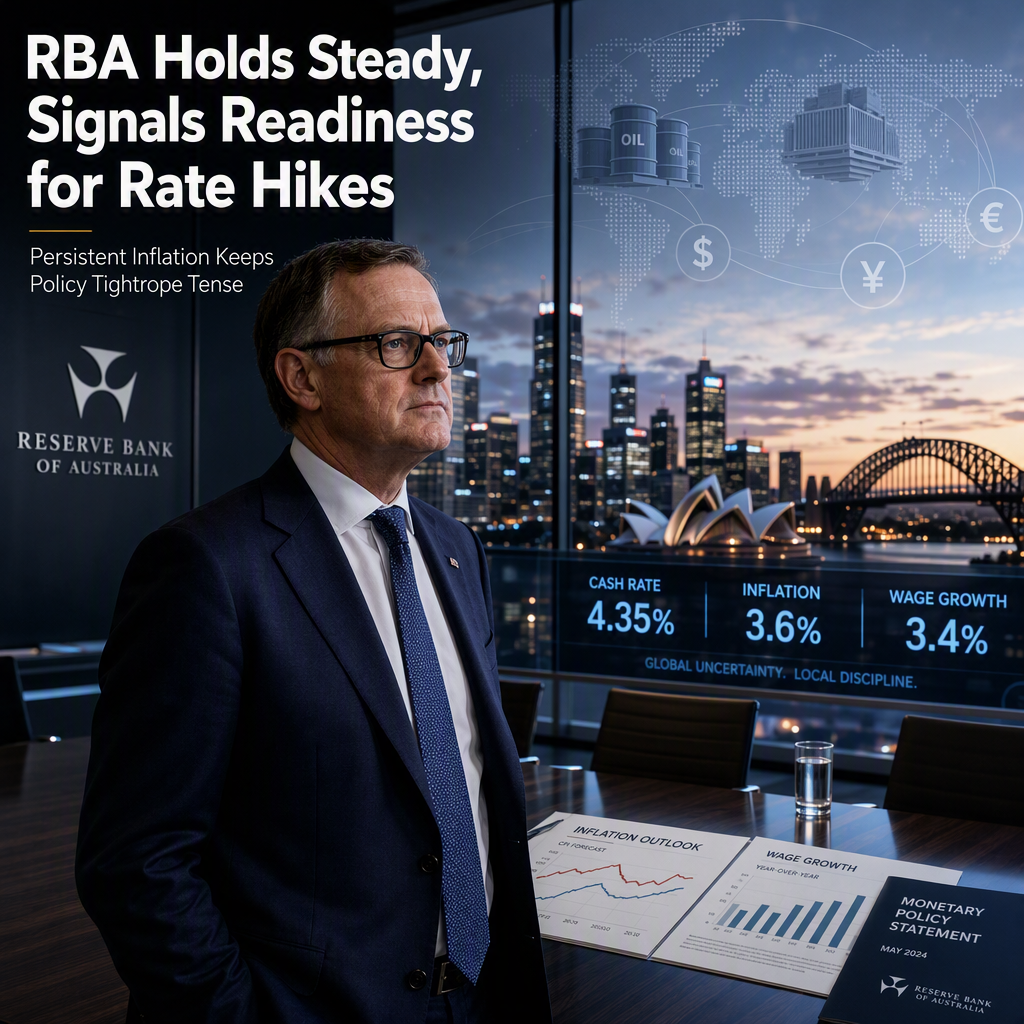
The Reserve Bank of Australia (RBA) continues to express concern about inflation, with Deputy Governor Andrew Hauser stating that further rate hikes cannot be ruled out. Hauser highlighted both external risks, such as potential fuel cost spikes driven by developments in the Middle East, and domestic factors including excessive pressure on capacity, weak productivity, and limited capacity growth as contributing to ongoing inflationary pressures. He emphasized that if upside risks materialize and inflation does not continue to decline, the RBA will raise rates again, reinforcing the central bank's hawkish bias despite its recent decision to leave the cash rate unchanged at last week's meeting [1].
Australia's Wage Price Index for the June quarter 2026 increased by 0.8% quarter-on-quarter for the fifth consecutive quarter, resulting in annual wage growth of 3.2% year-on-year. This figure is unchanged from Q1 but slightly lower than the 3.4% year-on-year growth recorded in Q2 2025. Private-sector wages rose 0.7% quarter-on-quarter and 3.1% year-on-year (compared to 3.2% in March quarter 2026), while public-sector wages increased 0.9% quarter-on-quarter and 3.4% year-on-year [1].
The RBA's continued vigilance on inflation, coupled with stable wage growth, suggests that policymakers remain alert to both global and domestic risks. The central bank's willingness to consider further rate hikes if inflation persists signals a cautious approach to monetary policy, which may impact market expectations regarding future interest rate movements [1].
CONCLUSION
The RBA's hawkish stance and readiness to raise rates if inflation risks materialize underscore ongoing concerns about price stability. Stable wage growth provides some reassurance, but persistent inflation pressures keep the outlook uncertain. Market participants should remain attentive to future RBA communications and data releases for signals on potential policy shifts.