
Rabobank analysts Mauricio Une and Renan Alves report that the Federal Reserve (Fed) raised interest rates by 25 basis points and signaled a more restrictive monetary policy stance to address second-round inflationary effects. Despite this, Rabobank suggests that only a single rate hike is likely, with further increases dependent on developments in the Middle East and the resilience of the U.S. economy [1].
Meanwhile, Brazil's Copom cut the Selic rate to 13.75%. In the wake of these moves, the Brazilian Real (BRL) weakened slightly, closing the previous week at BRL 5.1462 per USD, marking a 0.49% depreciation against the U.S. dollar. Nevertheless, the BRL outperformed most emerging-market peers, ranking as the ninth-best performer among 24 currencies tracked [1].
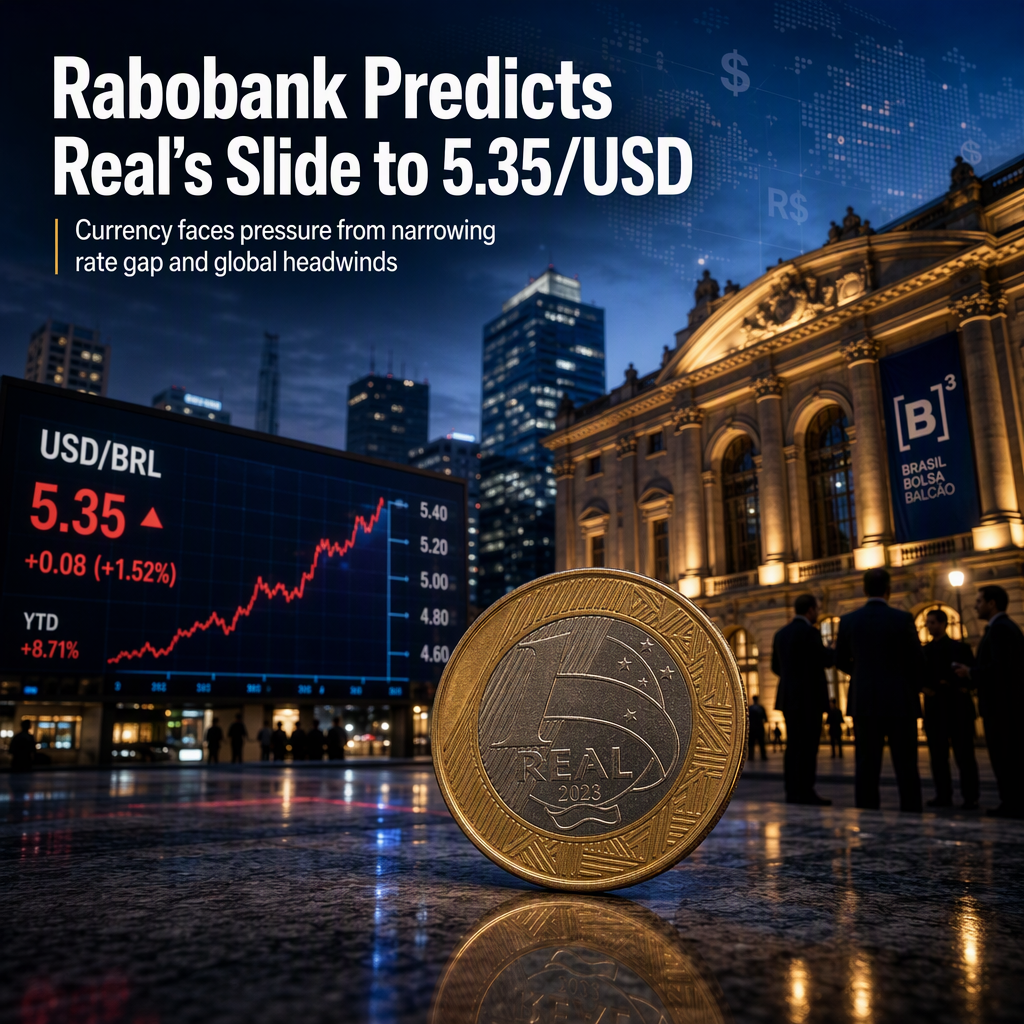
Rabobank forecasts that a narrowing interest rate differential between Brazil and advanced economies, combined with a potentially stronger U.S. dollar and Brazil's fragile domestic fiscal situation in an election year, will push the USD/BRL exchange rate to 5.35 by the end of the year [1].
No specific market reactions or analyst opinions beyond Rabobank's outlook are mentioned in the article [1].
CONCLUSION
Rabobank anticipates further weakening of the Brazilian Real to 5.35 per USD by year-end, driven by a narrowing rate differential and a stronger U.S. dollar. The outlook is shaped by both domestic fiscal challenges and global monetary policy trends, with no immediate market reactions detailed.