
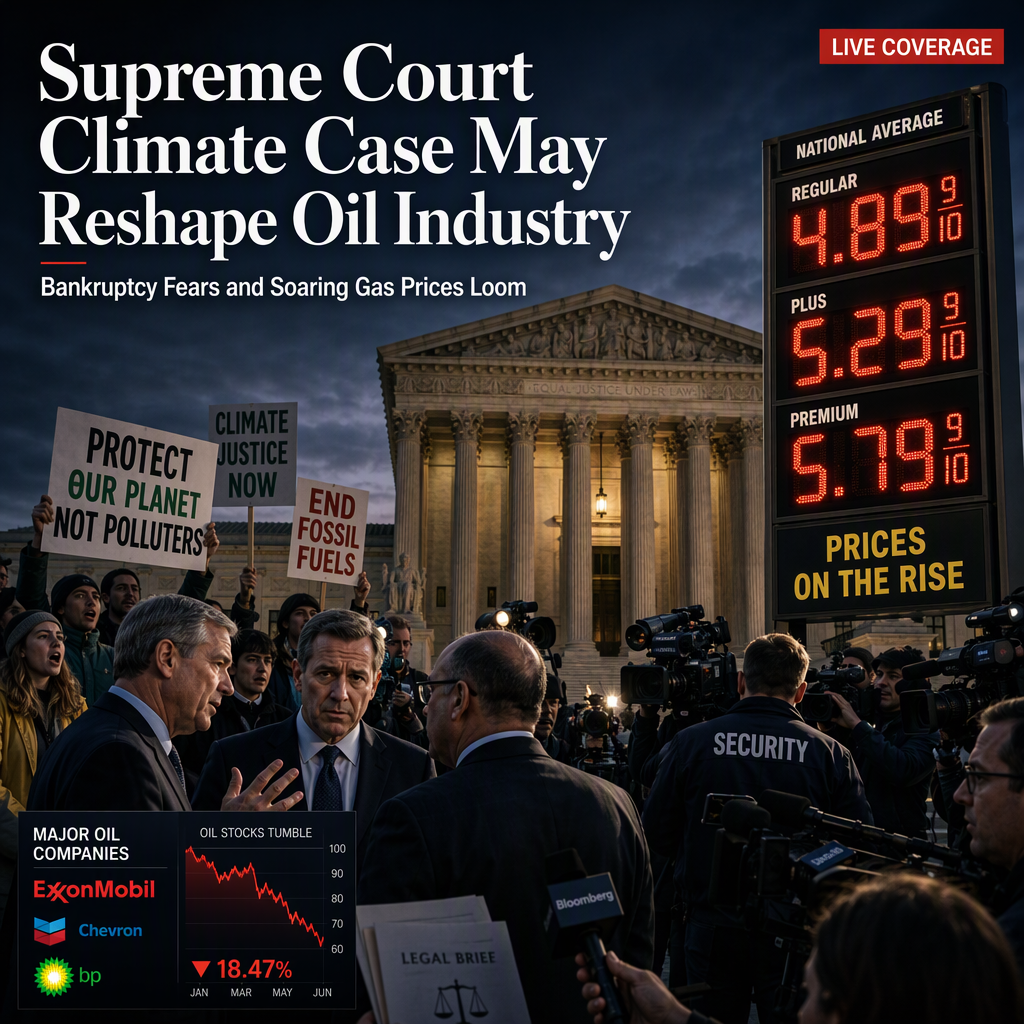
The Supreme Court heard arguments in Suncor v. Boulder, a pivotal climate change lawsuit that could have sweeping financial consequences for the oil industry and consumers if cities and states are allowed to pursue billions in damages against fossil fuel companies under state law for alleged climate damage linked to emissions crossing state borders [1]. Energy policy experts, including Jason Isaac, CEO of the American Energy Institute, warned that such litigation could bankrupt oil companies, devastate gas stations, and drive up gas prices nationwide, citing the potential for a mass exodus from the industry and increased scarcity of fuel [1].
During oral arguments, Justice Clarence Thomas questioned Boulder's attorney, Kevin Russell, about whether the legal theory underpinning the case could expose businesses beyond oil producers, such as large retailers, to similar lawsuits. Russell acknowledged that nothing in their theory prevents this, though state tort law could impose additional limitations [1]. Justice Brett Kavanaugh also raised concerns about the financial consequences of widespread litigation, warning that enough lawsuits could bankrupt defendants and potentially affect virtually any manufacturer or business [1].
The city and county of Boulder, Colorado, sued ExxonMobil and Suncor Energy in 2018, alleging the companies knowingly contributed to climate change while misleading the public about the dangers of fossil fuels. Boulder seeks damages to cover mounting costs of climate-related harms, referencing a 1977 internal memo from ExxonMobil that stated "current scientific opinion overwhelmingly favors" the view that fossil fuels contribute to rising CO2 emissions [1]. There are approximately 30 similar lawsuits pending across the country, including cases in Portland and Baltimore [1].
Climate activists gathered outside the Supreme Court during oral arguments, highlighting the broader public and political interest in the outcome of Suncor v. Boulder [1].
CONCLUSION
The Supreme Court's decision in Suncor v. Boulder could have far-reaching implications for the oil industry, potentially exposing companies to massive financial liabilities and driving up consumer costs. With dozens of similar lawsuits pending nationwide, the outcome may set a precedent affecting not only oil producers but other businesses as well. Market participants should closely monitor the case, as its resolution could significantly impact energy prices and industry stability.