
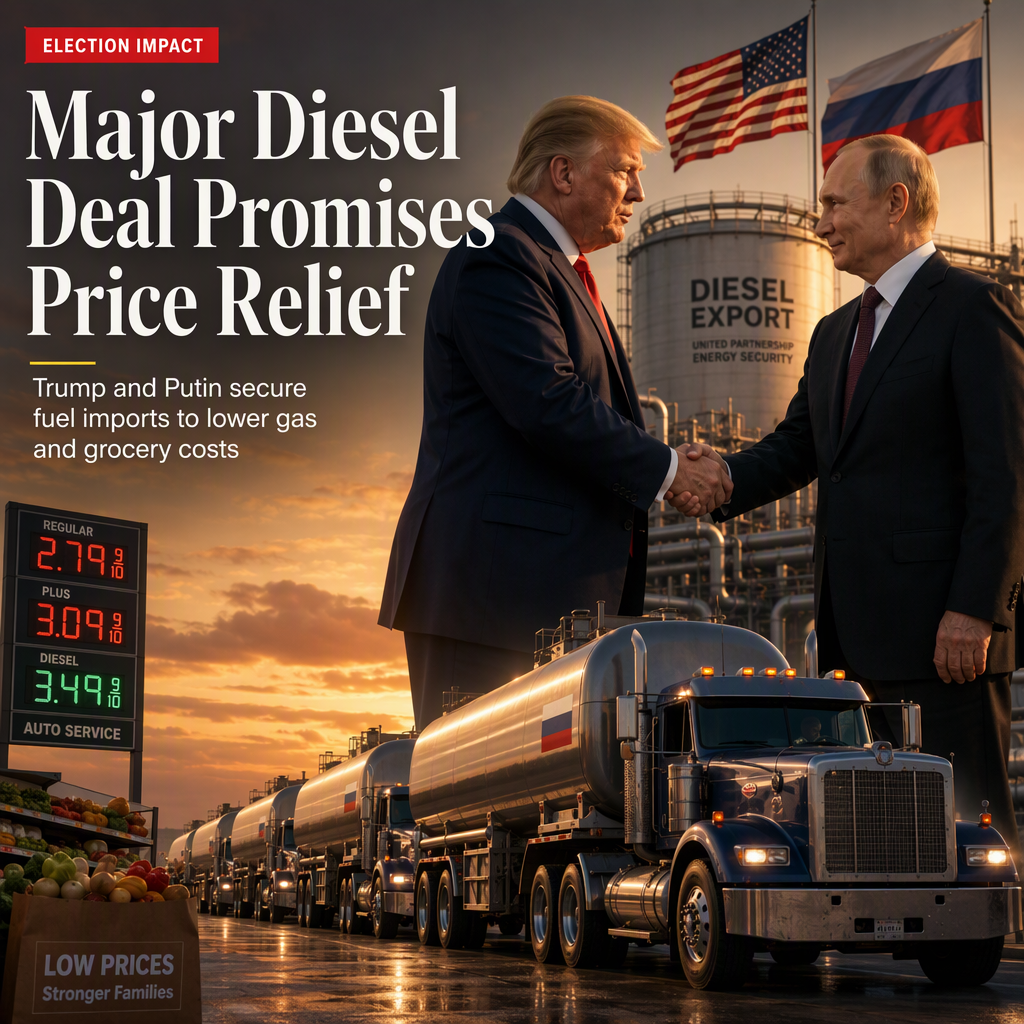
Incoming White House press secretary Katie Zacharia announced that President Donald Trump has secured a diesel deal with Russian President Vladimir Putin, which is expected to lower gas and grocery prices for Americans. Zacharia stated that the agreement involves Russia supplying 'over 300,000 Tons of Diesel Fuel to the American and Global Marketplace immediately, another 500,000 Tons during the month of November, and 1,000,000 Tons immediately thereafter' [1]. She emphasized that this move is part of Trump's 'multifaceted' approach to tackling inflation while prioritizing American interests [1].
Zacharia highlighted that high diesel prices, driven by ongoing conflicts involving Iran and Ukraine, have contributed to rising fuel costs and inflation, particularly as the midterm elections approach [1]. She suggested that the diesel deal could also support peace efforts between Ukraine and Russia [1]. Zacharia referenced previous deals with Venezuela, Canada, and Greenland as examples of Trump's efforts to secure energy resources for the U.S. [1].
In her remarks, Zacharia also discussed the political implications of the deal, noting that President Trump has 'delivered historic results' but expressed disappointment that congressional Republicans had not passed key legislation such as the SAVE America Act [1]. She further criticized Democratic campaign strategies, alleging that certain candidates are being kept out of the public eye [1].
No specific market reactions or analyst opinions were provided in the article. However, the scale of the diesel deal and its potential impact on fuel and grocery prices were emphasized as significant ahead of the upcoming elections [1].
CONCLUSION
President Trump's diesel deal with Russia is positioned as a major step toward reducing gas and grocery prices in the U.S., with immediate and large-scale fuel imports promised. While the article underscores the potential economic and political benefits, it does not provide specific market reactions or analyst commentary. The development is likely to have a high market impact given the quantities involved and the timing before the midterm elections.