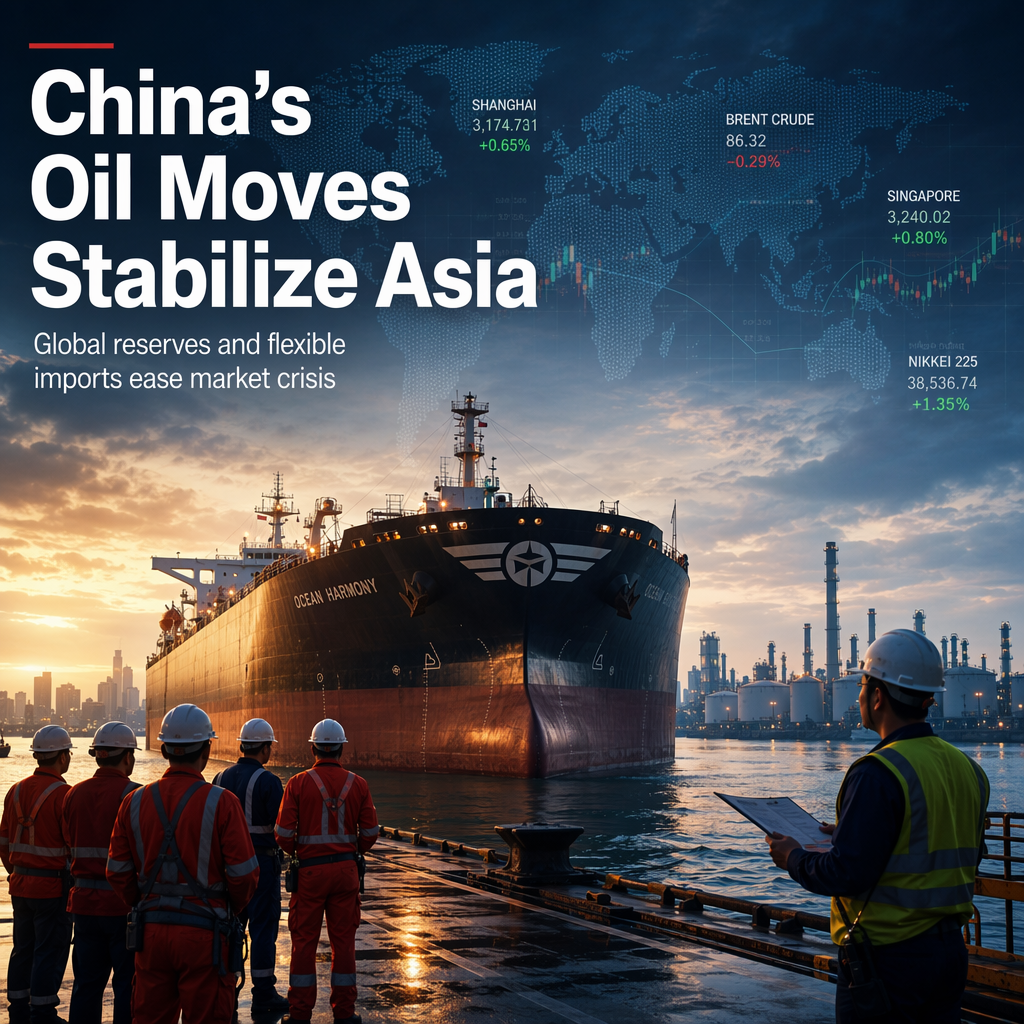
The closure of the Strait of Hormuz during the U.S.-Iran military conflict was widely expected to trigger a dramatic surge in global crude oil prices due to disrupted tanker traffic and reduced Middle Eastern supply. However, two key factors helped cushion the anticipated market shock: China's strategic reduction in oil imports and a coordinated global release of oil reserves [1][2].
China played a pivotal role as a 'swing importer,' adjusting its crude purchases and tapping into its strategic petroleum reserves. This flexibility helped mitigate the loss of supply, with market analysts attributing the less severe-than-expected price spike to China's actions. Brent crude futures initially spiked toward $110 per barrel but retreated to the $100-$105 range as Chinese demand eased, with technical support seen around $98 and resistance at $110. China's teapot refiners were among the first to curtail purchases, which moderated Asian crude benchmarks and narrowed the price gap with European and U.S. markets [1].
Simultaneously, the International Energy Agency's 32 member countries agreed to release 400 million barrels of oil reserves into the market, a move credited by the Japanese government with stabilizing Asia's economic outlook. This unprecedented intervention helped Asian economies avoid a sharp slowdown, as they were able to import crude from alternative sources outside the Middle East. Oil prices, which had surged above $110 per barrel at the onset of the conflict, stabilized in the $85-90 range following the reserve release. Technical indicators showed support at $80 and resistance near $95 per barrel. The Bank of Japan reported a sharp improvement in business sentiment during the April-June quarter, and import costs remained manageable, preventing inflationary spillover [2].
According to a Japanese government report, the flexibility of Asian importers in sourcing oil from the Americas and Africa, combined with the timely release of reserves, were key in averting a regional recession. The report concluded that international cooperation and strategic reserve management were decisive in stabilizing Asia's economic trajectory during the crisis [2].
There is a discrepancy in reported oil price ranges: Source 1 notes Brent crude retreating to $100-$105 per barrel with support at $98 and resistance at $110, while Source 2 reports stabilization in the $85-90 range with support at $80 and resistance near $95 following the reserve release [1][2].
CONCLUSION
China's strategic reduction in oil imports and the coordinated global release of oil reserves played critical roles in stabilizing oil prices and averting an economic slowdown in Asia during the Iran conflict. Despite initial fears of a severe price spike, these measures helped maintain market stability and business confidence. The event underscores the importance of flexible import strategies and international cooperation in managing energy market shocks.