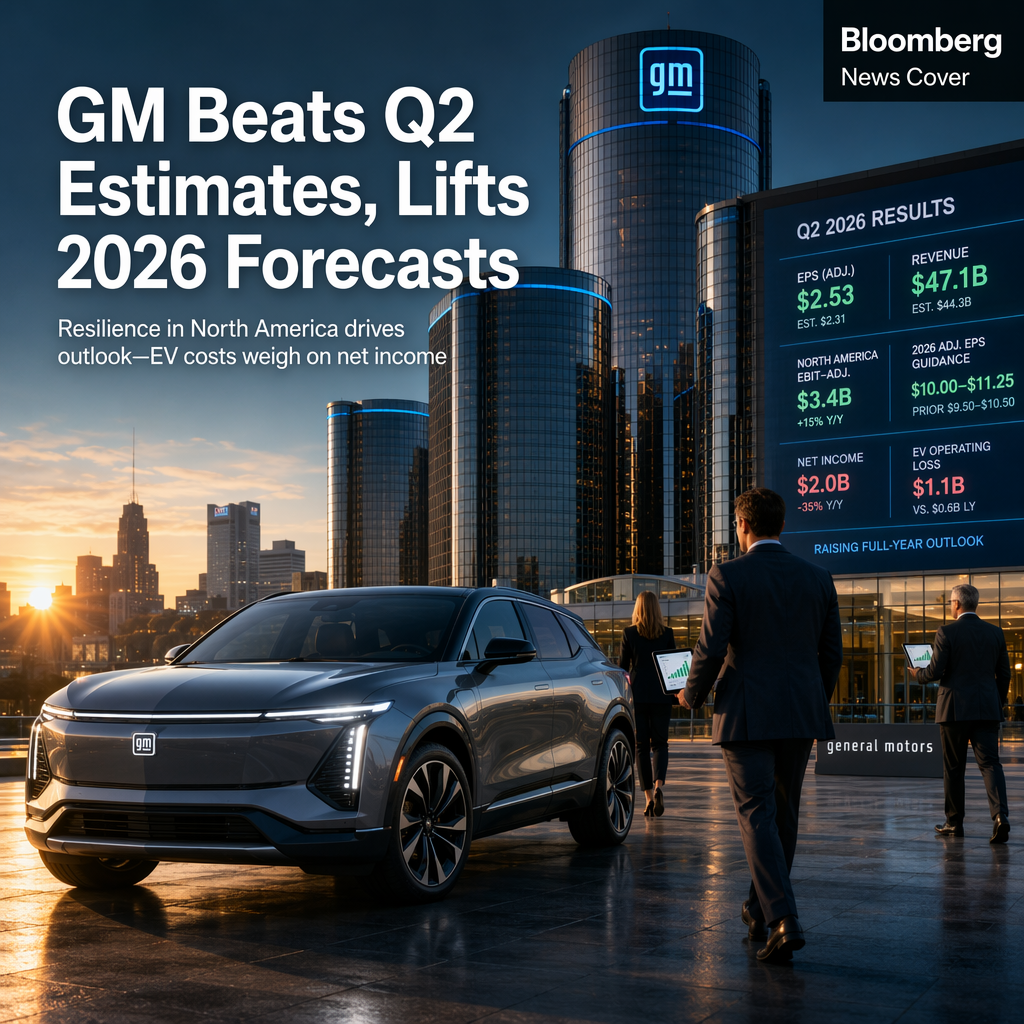
General Motors (GM) reported second-quarter results that exceeded Wall Street expectations, prompting the automaker to raise several key 2026 earnings forecasts. For the second quarter, GM posted adjusted earnings per share of $3.57, surpassing the expected $3.20, and revenue of $48.03 billion, above the anticipated $47.01 billion [1]. The company increased its full-year adjusted earnings before interest and taxes (EBIT) guidance to a range of $14 billion to $16 billion, or $12 to $14 adjusted EPS, up from the previous range of $13.5 billion to $15.5 billion, or $11.50 to $13.50 adjusted EPS. Adjusted automotive free cash flow guidance was also raised to $9.5 billion to $11.5 billion, compared to the prior $9 billion to $11 billion [1].
Despite these positive adjustments, GM lowered its expectations for net income attributable to stockholders to between $8.4 billion and $9.8 billion, down from the previously lowered guidance of $9.9 billion to $11.4 billion. This marks the second consecutive quarter in which GM has reduced its net income guidance while raising other forecasts. In April, the company adjusted its guidance to reflect a $500 million tariff rebate [1].
GM's North American operations were a significant driver of its results, with an 8.6% EBIT-adjusted margin in North America, up 2.5 percentage points from a year ago. CEO and Chair Mary Barra highlighted the company's efforts to lower warranty costs, reduce electric vehicle (EV) losses, and increase operating efficiency. GM also reported profitability in its international operations, including its China joint ventures. The average vehicle transaction price during the quarter was $52,000, with the company maintaining discipline regarding incentives [1].
The automaker stated it has "substantially" completed material charges related to its pullback in all-electric vehicles, which have totaled $10.9 billion in EV-related charges since the second half of last year. As of the second quarter, GM has paid $4.5 billion of an expected $7.2 billion in cash charges related to the EV pullback. For the quarter, net income attributable to stockholders was $1.3 billion, a 31.1% decrease from a year earlier, while adjusted earnings increased about 30% to more than $3.9 billion, representing an 8.2% adjusted profit margin. Revenue was up 1.9% year-over-year [1].
CONCLUSION
GM's strong second-quarter performance and raised 2026 guidance signal resilience in its core operations, particularly in North America, despite ongoing challenges in net income and EV-related charges. The company's disciplined pricing and operational efficiencies have contributed to its positive outlook, though investors should note the continued reduction in net income forecasts.